Second Takaichi Cabinet launched…fiscal expansion and hawkish security push set in motion
Summary
- The second Takaichi Cabinet said it will move in earnest, under a strong governing mandate, to pursue fiscal expansion, “Sanaenomics,” and hawkish foreign and security policies.
- Takaichi emphasized “responsible proactive fiscal policy,” saying she will lay out contributions to GDP growth and higher tax revenue through growth and crisis-management investment, a public-private investment roadmap, and a “Japan Growth Strategy.”
- She said she will cut the current 8% consumption tax rate on food to 0% for two years, while also strengthening security through exports of weapons to third countries and the introduction of attack drones, and pushing for a spy prevention law and the establishment of a “National Intelligence Agency.”
Forecast Trend Report by Period


Re-elected as the 105th prime minister after a landslide election victory
‘Sanaenomics’ on the back of a strong governing mandate
Push to set the consumption tax on food to 0% for two years
Exports of weapons to third countries; introduction of attack drones
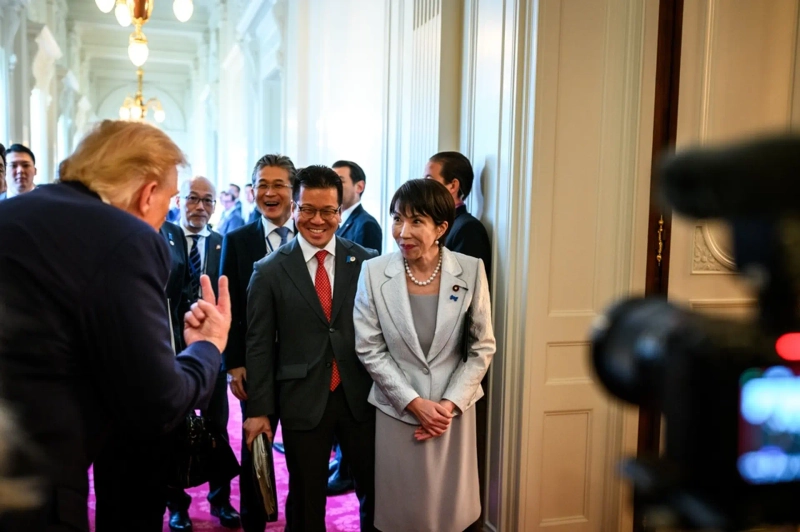
Prime Minister Sanae Takaichi, who led Japan’s ruling Liberal Democratic Party (LDP) to a sweeping victory in the general election, was re-elected as prime minister on the 18th. The second Takaichi Cabinet is expected to press ahead with “Sanaenomics,” including fiscal expansion, and with hawkish foreign and security policies, backed by a strong governing mandate.
Takaichi won 354 of 464 votes cast in the prime ministerial nomination election held the same day in a special session of the House of Representatives (lower house; 465 members), securing re-election as Japan’s 105th prime minister. In the Oct. 8 lower-house election, the LDP alone won 316 seats, surpassing the 310-seat threshold needed to submit a constitutional amendment. Together with coalition partner Nippon Ishin no Kai, the bloc secured 352 seats, delivering a historic landslide.
Takaichi launched her second cabinet on the day. All ministers from the first cabinet, formed in October last year, were retained. Keiji Furuya, one of Takaichi’s closest allies who had served as chair of the LDP’s election strategy committee—one of the party’s four key posts—will move to become chair of the House of Representatives’ Constitutional Review Committee. The move is seen as laying groundwork for constitutional revision.
Takaichi plans to outline her economic and security agenda in a parliamentary address on the 20th. According to a draft obtained by Japanese media, she will again stress her signature policy of “responsible proactive fiscal policy,” and say that budgets related to “growth and crisis-management investment” will be placed under a separate multi-year management framework. She also plans to express her intention to present next month a public-private investment roadmap for advanced technologies.
Takaichi will also propose to quantify, in a “Japan Growth Strategy” to be compiled in the summer, the effects of government support in spurring private investment. The aim is to make it possible to project contributions to gross domestic product (GDP) growth and increases in tax revenue. Japan’s real GDP growth rate last year was 1.1%, topping South Korea’s 1.0% for the first time in 27 years. However, the Organisation for Economic Co-operation and Development (OECD) and others have forecast that South Korea’s growth rate will again exceed Japan’s this year.
Takaichi is also seen as signaling that she will move quickly to prepare measures to cut the current 8% consumption tax rate on food to 0% for two years and to expedite submission of the relevant bill. If the food consumption tax rate falls to “zero,” there are concerns it would create an annual hole of about 5 trillion yen in tax revenue. While Takaichi has said she will not rely on “deficit-financing bonds,” the key question is how she would fill the gap from a consumption tax cut that is a core funding source for the social security system.
On foreign policy, she plans to strategically evolve former Prime Minister Shinzo Abe’s “Free and Open Indo-Pacific” initiative, noting that 10 years have passed since the policy was first set out. She is expected to say she will work to strengthen the economic foundation—including supply chains for critical materials—and expand security cooperation.
In security policy, Japan is already accelerating a distinctly conservative agenda. It is considering allowing weapons jointly developed with other countries to be exported not only to co-developers but also to third countries.
This would expand the scope by revising the “Three Principles on Transfer of Defense Equipment” implementation guidelines, which regulate arms exports. Japan’s Acquisition, Technology & Logistics Agency held a tender for attack drones the previous day and awarded the contract to an Australian model. It is said to be Japan’s first introduction of attack drones. Some have pointed out that this could run counter to the Constitution’s “renunciation of war” clause.
The Takaichi Cabinet is also reviving efforts to enact legislation to prevent espionage—an initiative the LDP sought but failed to introduce in the 1980s. It is reviewing a plan to pass a bill establishing a “National Intelligence Agency,” an organization to oversee intelligence collection and analysis functions, and to set up as early as summer an expert panel on a “spy prevention law.”
Tokyo=Correspondent Il-gyu Kim black0419@hankyung.com

Korea Economic Daily
hankyung@bloomingbit.ioThe Korea Economic Daily Global is a digital media where latest news on Korean companies, industries, and financial markets.