"The U.S. worries South Korea may not keep its investment pledge..Japan is now America’s pacemaker" [Lee Sang-eun’s Washington Now]
Summary
- It reported that President Trump, after the ruling that reciprocal tariffs were unlawful, warned of higher tariffs, heightening uncertainty over existing trade agreements.
- It said that in Washington, concerns are being raised over whether South Korea will follow through on its U.S. investment pledge, while the government has emphasized its commitment—such as by launching a Strategic Investment Implementation Committee.
- It reported that depending on the U.S. Section 301 investigation and assessments of non-tariff barriers, tariff rates on South Korea and the burden from product-specific tariffs could increase, making it difficult to adjust the pace of investment in the U.S.
Forecast Trend Report by Period


President Donald Trump threatened in a post on social media yesterday, saying that “countries that want to play games will face tariffs far higher—and far worse—than what they recently agreed to.”
It was a warning to brace themselves if they try to overturn or seek adjustments to a deal on the grounds that the reciprocal tariffs underpinning the trade agreement have been nullified. It also underscores how deeply the administration is concerned that the court ruling finding the reciprocal tariffs unlawful could affect existing trade deals.
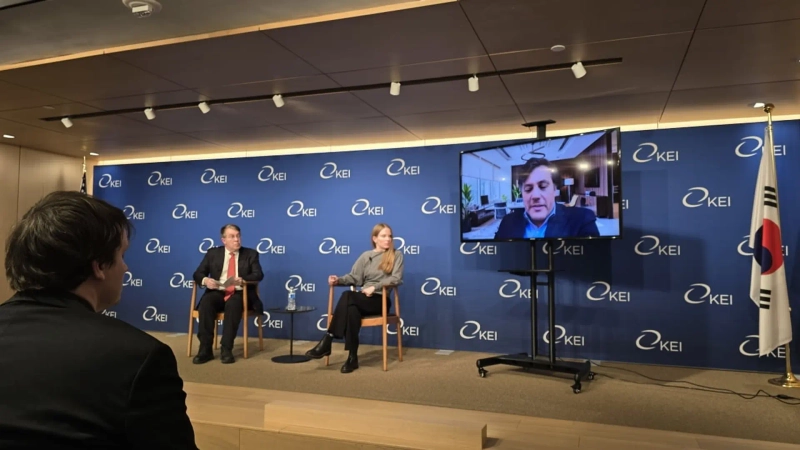
Around Washington, there is a view that, unlike Japan, South Korea and Europe may not keep their promises. A briefing at the Korea Economic Institute of America (KEI) was held yesterday (23rd), and KEI President Scott Snyder told reporters that while South Korea has talked about being a “pacemaker,” Japan is America’s pacemaker when it comes to economic matters. In that context, Trump’s threat could be interpreted as being aimed at South Korea or Europe. Asked whether he believes the U.S. would also keep its commitments—both country-specific tariff rates and product-specific duties—if South Korea keeps its pledge to invest in the U.S., he replied, “I think it will.”
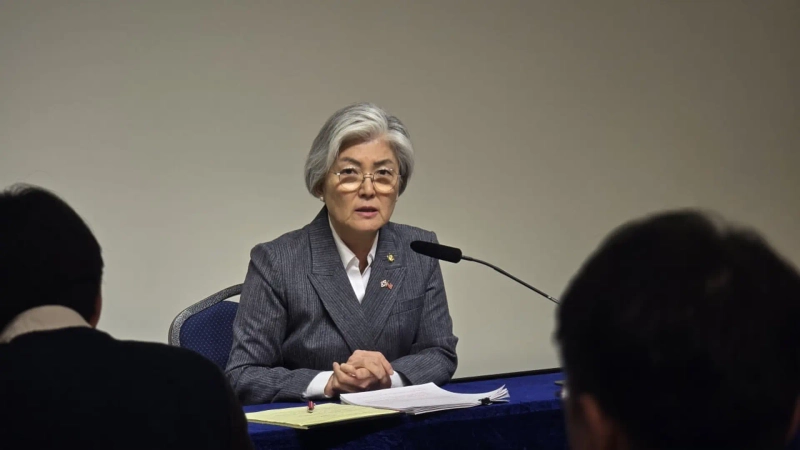
South Korea, for its part, has maintained that it will honor its U.S. investment commitment. Back-channel talks are continuing, including a visit by a government working-level delegation to the U.S. last week for consultations. On the 24th, Ambassador to the U.S. Kang Kyung-wha also told a correspondents’ briefing that she had actively explained Seoul’s determination to carry out the investments, stressing the government’s intent to manage related matters closely—such as launching a Strategic Investment Implementation Committee even before the special act takes effect.
The key question now is whether the two sides can identify projects that align with the U.S. side, which is increasingly pressed for time ahead of the midterm elections. Some observers say Washington wants announcements of large-scale projects even if, as in Japan’s case, their feasibility is not particularly high.
South Korea’s biggest concern at the moment is the outcome of the USTR’s Section 301 investigation, because it is expected to replace the reciprocal-tariff component that had been based on the IEEPA (International Emergency Economic Powers Act).
However, unlike the IEEPA—which was justified on national-security grounds—using Section 301 requires a basis to justify tariff rates. The U.S. needs a process: calculating how much damage specific U.S. industries have suffered due to a country’s unfair trade practices, holding public hearings, and so on.
As a country with a free trade agreement (FTA) with the U.S., South Korea is unlikely to be accused of unfair trade on the basis of tariffs. The problem, however, is non-tariff barriers—such as Google Maps, network usage fees, and the proposed amendment to the Information and Communications Network Act—and how much harm the U.S. will assess them as having caused.
Peter Harrell, a senior fellow at the Carnegie Endowment for International Peace who attended the KEI discussion yesterday, said in response to a question about whether the scale of damage from South Korea’s non-tariff barriers could justify a high tariff rate on South Korea that “it should be possible to assess South Korea’s non-tariff barriers at a level that justifies the current 15% tariff rate.” While not calculated rigorously, he expects the U.S. will find a way to produce a figure that keeps rates around current levels. But he added that it would be difficult to justify “a high tariff rate like 60%, for example.”
Product-specific tariffs are also expected to be revised in a way that expands the scope and increases the intensity. If that happens, the burden on Korean companies could be greater than before, making it difficult to slow the pace of investment in the U.S.
Washington = Correspondent Lee Sang-eun selee@hankyung.com

Korea Economic Daily
hankyung@bloomingbit.ioThe Korea Economic Daily Global is a digital media where latest news on Korean companies, industries, and financial markets.