PiCK
Trump: "Tariffs will get tougher" in hard-line remarks…Too early to call a bitcoin bottom [Kang Min-seung’s Trade Now]
Summary
- It assessed that U.S. bitcoin spot ETFs have seen net outflows for five consecutive weeks and that investor participation remains low, indicating a defensive phase.
- It said the area around $60,000 and $65,000 in bitcoin is a key support zone, and that a break could open a path for further declines to $52,500.
- It assessed that on-chain indicators show that true capitulation and panic selling have not yet emerged, making it difficult to definitively call the current zone a bottom formation.
Forecast Trend Report by Period


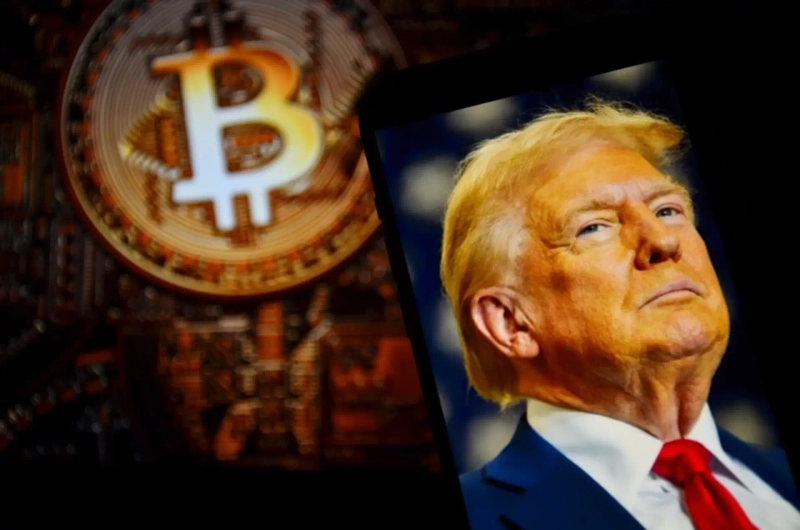
As U.S. President Donald Trump reaffirmed his resolve to tighten tariffs, expectations for additional rate cuts have weakened, deepening a wait-and-see mood in bitcoin (BTC) as well. With spot ETF outflows continuing, experts say the path toward further declines or a rebound could hinge on whether the $60,000 level holds.
As of 5:20 p.m. on the 25th, bitcoin was trading at $65,184 on Binance’s USDT market, up 3% from the previous day. At the same time, it was trading at 94.77 million won on Upbit’s KRW market. The so-called kimchi premium— the price gap between overseas and domestic exchanges—stood at about 1.39%.
Trump reiterates tougher tariffs and a hard-line external stance
Recently, global equity and digital-asset (cryptocurrency) markets have remained in a holding pattern as investors look to confirm the direction of U.S. policy and the path of monetary policy, even as some concerns surrounding the artificial intelligence (AI) industry have eased. In his State of the Union address, Trump reaffirmed his “America First” approach and a hard-line tariff stance.
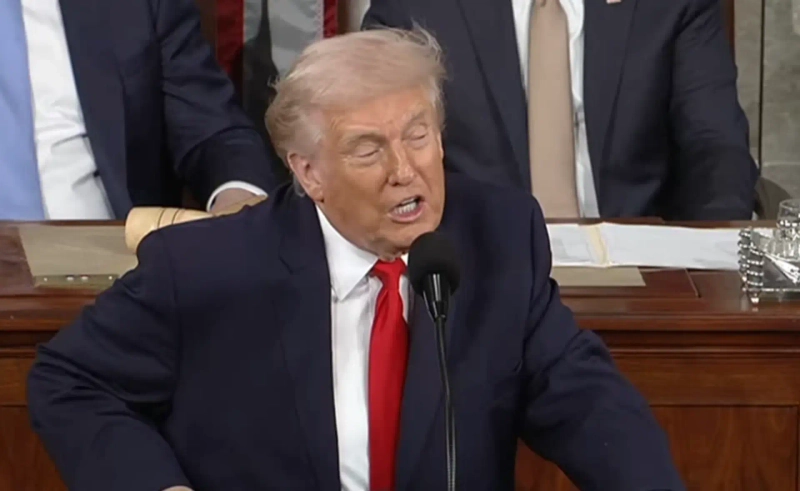
On the 24th (local time; the 25th in Korea), in his first State of the Union address of his second term, Trump called the Supreme Court’s ruling that reciprocal tariffs were illegal “a very regrettable decision,” but said that “almost all countries and companies want to keep the existing agreements.” Stressing that he would maintain the policy through alternative means, he added that “tariffs going forward will be stronger than before.” The U.S. administration is considering using provisions such as Sections 122 and 301 of the Trade Act and Section 232 of the Trade Expansion Act, instead of the International Emergency Economic Powers Act (IEEPA).
On the U.S. economy, he claimed that “America has come back stronger than ever.” He underscored progress on inflation, saying, “Over the past 12 months we brought core inflation down to its lowest level in about five years, and in the last three months of last year it fell to as low as 1.7%.” At the same time, on Iran, he warned, “If necessary, we will not hesitate to confront threats aimed at the United States,” also hinting at the possibility of a military response.
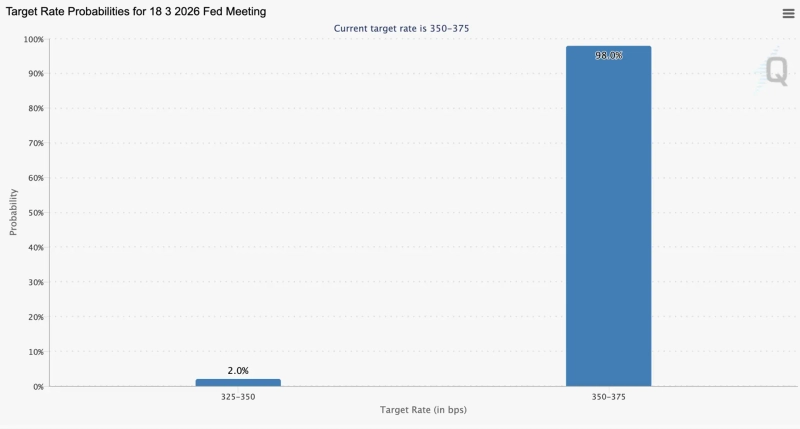
In markets, caution still dominates when it comes to monetary policy. As of 5 p.m. that day, CME FedWatch showed the futures market pricing in a 98% probability that the policy rate will be held in March. Previously released minutes from the January FOMC noted a two-way rate path—leaving room for additional tightening depending on the pace of disinflation, while not ruling out a shift toward easing depending on economic conditions. As a result, risk aversion is not easing easily.
ETF outflows; on-chain in defensive mode…mixed supply-demand signals
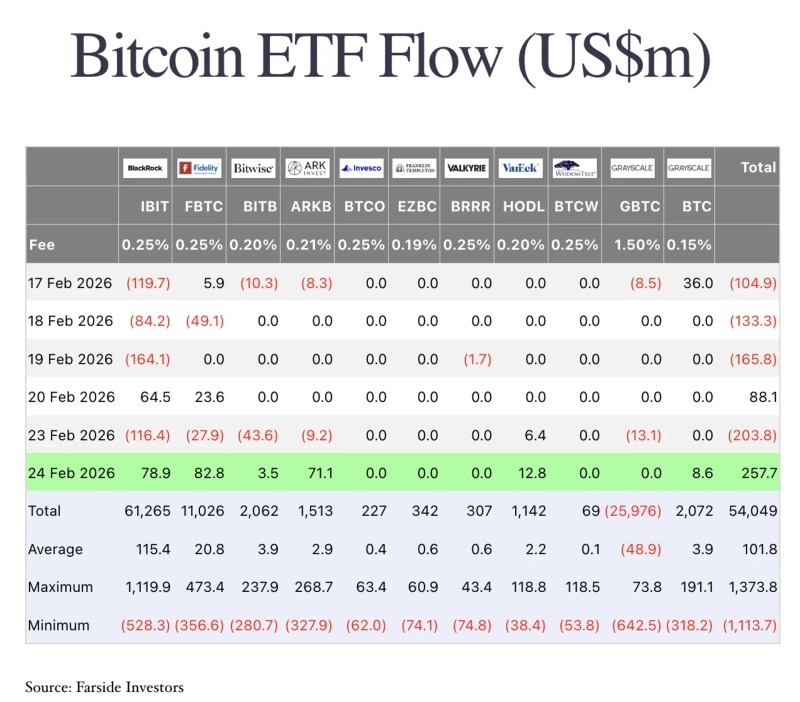
Last week (17–20), U.S. bitcoin spot ETFs saw net outflows totaling $315.9 million (about 451.4 billion won), extending the capital-exit trend. With net outflows continuing for five consecutive weeks, it marks the longest outflow stretch since February last year. As of today, total net assets in bitcoin spot ETFs are about $84.3 billion, down to roughly half of the peak seen in October last year.
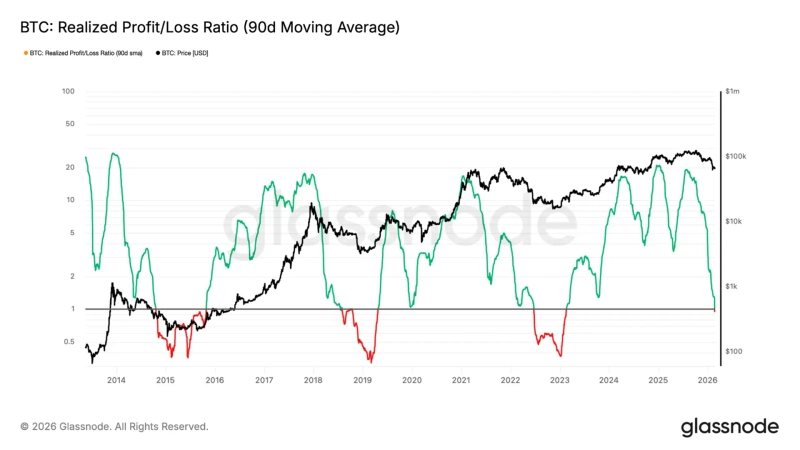
Major on-chain indicators remain in a defensive phase. On the 25th, on-chain analytics firm Glassnode assessed that “spot, derivatives, ETFs, and on-chain indicators broadly remain in a defensive state, and investor participation is low.” It added, “The realized profit/loss ratio has recently fallen below 1, entering a phase of excessive loss realization.” The realized profit/loss ratio indicates whether market participants are taking profits or selling at a loss; a reading below 1 implies a phase in which loss-selling dominates. Glassnode added, however, that “when this phase has persisted for more than six months in the past, rebounds tended to emerge alongside a recovery in liquidity.”
Meanwhile, accumulation buying is also being spotted at lower price levels. Crypto-focused media outlet CoinDesk reported on the 24th that “around the $60,000–$70,000 range, about 429,000 BTC was newly purchased, lifting holdings formed at that price band by 43% from the start of the year.” This suggests that hands are changing in the correction phase, raising the possibility that a mid- to long-term support line could form.
Some analysts also argue that the recent downtrend is gradually moving into a stabilization phase. Global crypto exchange Bitfinex said, “As volatility compresses, the market is shifting from a liquidation-driven plunge phase to a balance phase,” adding that “a substantial portion of selling supply is being absorbed in the $60,000–$69,000 demand zone.” It cautioned, however, that “institutional flows remain cautious,” and that “bitcoin is likely to stay range-bound unless sustained accumulation flows come in.”
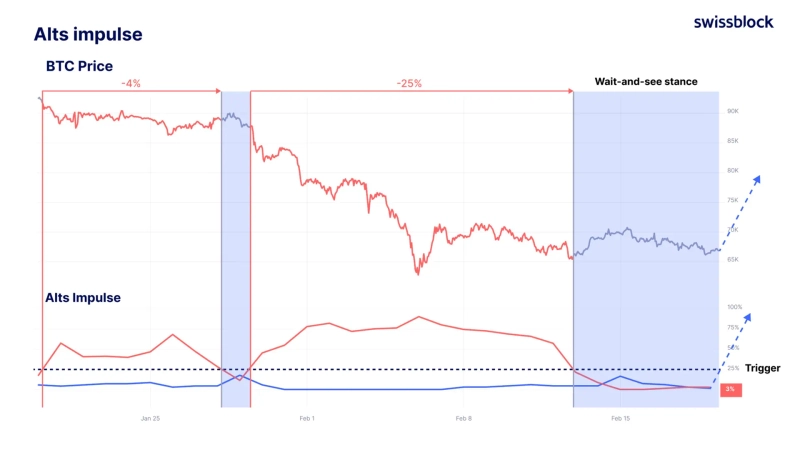
In particular, regulatory uncertainty is also cited as a factor constraining investor sentiment. The CLARITY Act, a bill related to the structure of the digital-asset market, has faced difficulties in the U.S. Congress, reducing policy visibility. Some observers say that if the bill is not passed within the second quarter—before the U.S. midterm election cycle fully ramps up—weakness in digital assets could become prolonged.
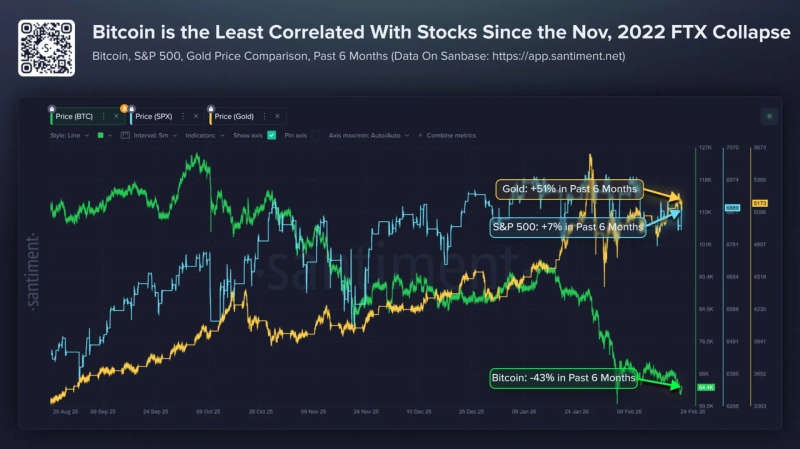
With internal flows weakening, correlations with traditional financial assets have also visibly declined. On-chain analytics firm Santiment said that “since late August last year, gold has risen 51% and the S&P 500 has gained 7%, but bitcoin has fallen 43%,” adding that “this is the lowest correlation level since late 2022.” It added that “in the past, after correlations fell sharply, there were cases where bitcoin re-tracked equity moves and shifted into a rebound phase.” This is interpreted as suggesting the possibility of a rebalancing of flows after a short-term divergence.
Bitcoin at the $60,000 inflection point…experts: “Too early to call a bottom”
Experts say bitcoin is at a crossroads between further declines and a technical rebound at a key price zone. In the near term, whether the $60,000 level holds is being cited as a key variable.
Ayush Jindal, a NewsBTC researcher, said, “If bitcoin fails to break above the $66,600 zone in the short term, downside pressure could persist.” He added that “a short-term support line has formed around $65,000,” and that “$64,200 and $62,500 are additional support zones; if those are breached, a pullback to $61,200 is possible.” He noted, however, that “if $66,600 is broken to the upside, a rebound could extend to $68,000 and the $70,000 level.”
Rakesh Upadhyay, a Cointelegraph researcher, said, “If bitcoin fails to reclaim $70,185—often cited as a short-term support level—downward pressure could strengthen again,” adding that “if the daily close forms below $60,000, a path opens for further declines to $52,500.” He projected that “conversely, if $70,185 is broken to the upside, a rebound could extend to $74,508 in the medium term.”
Caution is also being voiced that it is too early to say the market has entered a full-fledged bottoming zone. Alex Kuptsikevich, chief analyst at FxPro, said, “The move back to $63,000 does not feel like the bottom of this decline,” adding, “If it fails to stage a meaningful rebound from current levels, there remains a potential risk of an additional decline of about 25%, down to the 2023 accumulation zone.” He added that “true capitulation (capitulation·mass selling) has not yet appeared,” and that “unless a sharp collapse in sentiment accompanied by panic selling is confirmed, it is still difficult to conclude that a bottom has formed.”
Kang Min-seung, BloombergBit reporter minriver@bloomingbit.io

Minseung Kang
minriver@bloomingbit.ioBlockchain journalist | Writer of Trade Now & Altcoin Now, must-read content for investors.