ETFs near the “KRW 400trn era”…Korea-focused products overtake overseas equity funds
Summary
- Net assets of Korea equity ETFs rose to KRW 158.0998trn, overtaking overseas equity funds, as retail investors’ “return to domestic equities” accelerates.
- Total ETF net assets surged to KRW 374.3trn, and the number of KRW 1trn-plus mega ETFs increased 2.3x from a year earlier to 77.
- With more buying of Korea-market ETFs via retirement-pension accounts, downside support in the domestic market is strengthening, while high-dividend and monthly-distribution ETFs are gaining popularity.
Forecast Trend Report by Period


Retail investors’ “return to domestic equities” ignites the ETF market
Betting on ETFs over individual stocks
As top names such as Samsung Electronics and SK hynix surge
Investors turn to ETFs rather than chasing individual shares
7 of the top 10 by net buying are “Korea-market products”
KRW 1trn-AUM ETFs up 2.3x in a year
14 ETFs joined the KRW 1trn club this year
Only 3 of them are overseas-investment products
Growing retirement-pension investing also reinforces downside support
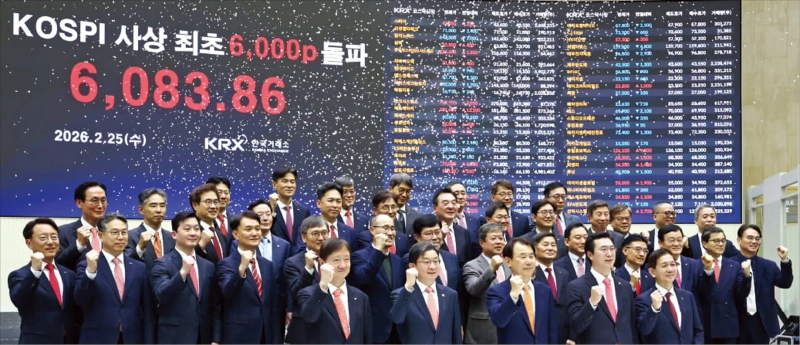
With the KOSPI index breaking above 6,000 just a month after hitting the “5,000 level,” retail investors’ “return to domestic equities” has gained traction. As “Seohak ants” money that had been heading to the US market flowed back en masse into Korean stocks, net assets of Korea equity exchange-traded funds (ETFs) overtook those of overseas equity ETFs. Beyond simple index trackers, “mega ETFs” with KRW 1trn in scale investing in leading industries such as semiconductors and defense are appearing in rapid succession.
Large-scale inflows, with an “ETF boom” behind them
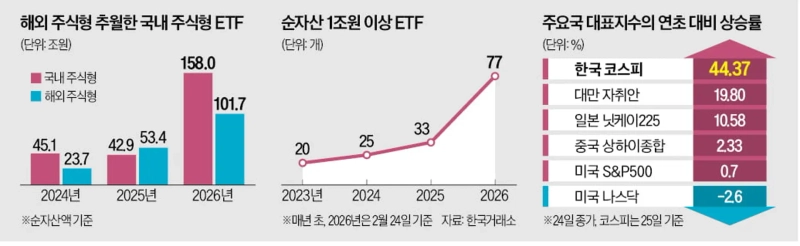
According to Korea Exchange on the 25th, as of the previous day net assets of Korea equity ETFs totaled KRW 158.0998trn. This exceeds overseas equity ETFs’ net assets (KRW 101.7229trn) by more than KRW 56trn. The picture is the exact opposite of a year ago. Until early last year, amid a boom in US stock investing centered on the Magnificent Seven (M7), overseas equity ETFs (KRW 53.4005trn) far outpaced Korea equity ETFs (KRW 42.9436trn). After that, as the domestic market extended an explosive rally, retail money seeking higher returns poured into Korean stocks.
That these large inflows are taking the form of ETFs rather than “alju stocks” (individual names) is a clear shift in recent investing trends. Over the past year, retail investors were net sellers of KRW 27.9921trn worth of stocks on the KOSPI market. But including ETFs, this flips to net buying of KRW 25.1512trn. In other words, individuals sold individual shares and bought ETFs in large amounts.
Analysts say that as shares of top market-cap names such as Samsung Electronics and SK hynix surged, investors chose to pivot to ETFs rather than chase individual stocks. Lower volatility than single names and low-cost diversification appealed to retail investors. Considering buying within retirement-pension accounts—which is tallied as institutional buying—the actual scale of inflows is estimated to be much larger.
Of the 10 ETFs with the largest retail net buying this year, seven were domestic-investment products. “KODEX KOSDAQ150” ranked first with net buying of more than KRW 3trn. “KODEX 200” and “TIGER Semiconductor TOP10” were also in the top 10.
Rapidly increasing “mega ETFs”
As retail money has poured in at a rapid pace, Korea’s ETF market is also expanding sharply. Total ETF net assets, which stood at KRW 171.8trn in early last year, swelled to KRW 374.3trn as of the previous day—up by more than KRW 200trn. After surpassing KRW 300trn at the start of this year, it added nearly KRW 75trn in just over two months, putting the KRW 400trn milestone within sight. The number of listed products exceeded 1,000, totaling 1,069.
As the market has grown, the number of mega ETFs with more than KRW 1trn in net assets has also increased. The count rose to 77 from 33 in early last year—up 2.3x in a little over a year. A large share of newly added members of the “KRW 1trn club” were products investing in the domestic market. Of the 32 ETFs that reached KRW 1trn in net assets last year, more than 70% were domestically focused. This year as well, 14 mega ETFs have emerged, and only three of them were overseas-investment products.
In the past, large ETFs were mostly index trackers such as the KOSPI 200, but recently products investing in industries driving the Korean economy—semiconductors, defense, shipbuilding and others—have become the dominant trend. Since the start of this year, theme ETFs such as “KODEX AI Semiconductor,” “HANARO Fn K-Semiconductor,” “KODEX Robot Active,” and “TIGER Shipbuilding TOP10” have joined the KRW 1trn club. High-dividend equity ETFs and monthly-distribution products such as KOSPI 200-based covered-call strategies are also gaining popularity.
The brokerage industry expects downside support in the domestic market to strengthen further as investing in Korea-market ETFs through retirement pensions increases, because money that enters retirement-pension accounts does not easily flow out. Indeed, major brokerages are seeing a rising share of domestic-investment products within retirement-pension accounts. An asset-management industry official explained, “As conviction has solidified that the domestic market will continue to trend upward steadily, the pace of inflows into pension accounts has accelerated.”
Reporter Yang Ji-yoon yang@hankyung.com

Korea Economic Daily
hankyung@bloomingbit.ioThe Korea Economic Daily Global is a digital media where latest news on Korean companies, industries, and financial markets.