PiCK
"Bitcoin has proven its safe-haven status"…Iran crisis brings 'digital gold' back into focus
Summary
- Bitcoin has held the $70,000 level despite the Iran crisis, and the likelihood of breaking above $75,000 has increased.
- Despite geopolitical risk, the crypto market has seen the digital gold and alternative safe-haven asset narrative return to the spotlight, with limited selling pressure.
- With net inflows into U.S. spot Bitcoin ETFs signaling recovering institutional demand, analysts say the next direction hinges on international oil prices and the Fed’s monetary policy.
Forecast Trend Report by Period


Rebound despite Middle East jitters…successfully reestablishes itself in the $70,000 range
"Holding up better than equities…no reason to sell"
Signs of recovering institutional demand…oil prices are the key variable
Bitcoin (BTC) has managed to hold the $70,000 level despite heightened geopolitical tensions stemming from the recent Iran crisis. Some observers say it is increasingly likely to break above the key resistance level of $75,000 within this month. Analysts note that the Middle East conflict has revived Bitcoin’s “digital gold” narrative.
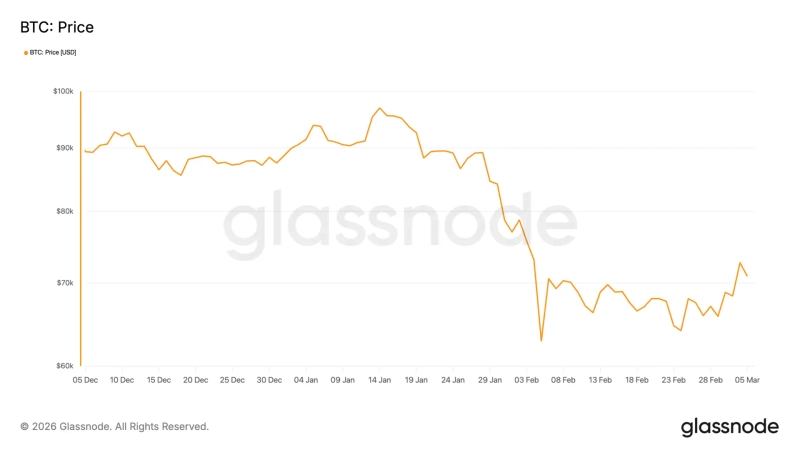
According to CoinMarketCap, a cryptocurrency market-tracking website, Bitcoin was trading around $71,000 as of the day, down about 1.7% from the previous day. Compared with a week earlier, it is up more than 5%.
After slipping into the $60,000 range in mid-June and remaining sluggish, Bitcoin regained the $70,000 range early this month. On the previous day (the 5th), it surged nearly 8% in a single session, briefly climbing above $74,000. Bitcoin topping $74,000 marks its first such move in about a month since early last month.
Markets focused on this rebound because Bitcoin’s upswing coincided with U.S. strikes on Iran. Geopolitical risk typically fuels “risk-off” sentiment across risk assets, which has tended to weigh on Bitcoin, but the Iran crisis instead became a catalyst for a rebound.
K33 Research, a crypto analytics firm, said that while oil and natural gas prices jumped and equities fell on Iran’s attacks on regional refining facilities and the closure of the Strait of Hormuz, the crypto market posted relatively resilient gains. “At current price levels, there is still no compelling reason to sell Bitcoin,” it said.
"The 'digital gold' narrative regains momentum"
Some say the episode has added fresh momentum to Bitcoin’s narrative as “digital gold.” Immediately after the U.S. strikes, Bitcoin withdrawals surged at Iran’s largest cryptocurrency exchange, Nobitex, demonstrating its usefulness as an “alternative safe-haven asset.”
Livio Weng, CEO of Bitfire, said, “Unlike gold, which has physical constraints, Bitcoin trades 24/7 and can be moved instantly across borders,” adding, “It serves as an escape valve for capital during periods of geopolitical tension.”
Bok Jin-sol, research lead at Populus Research, said, “With Bitcoin’s price having remained in a downturn recently, the digital-gold narrative had weakened considerably,” adding, “I believe the Iran crisis has partly demonstrated its safe-haven function, helping the narrative recover to some extent.”
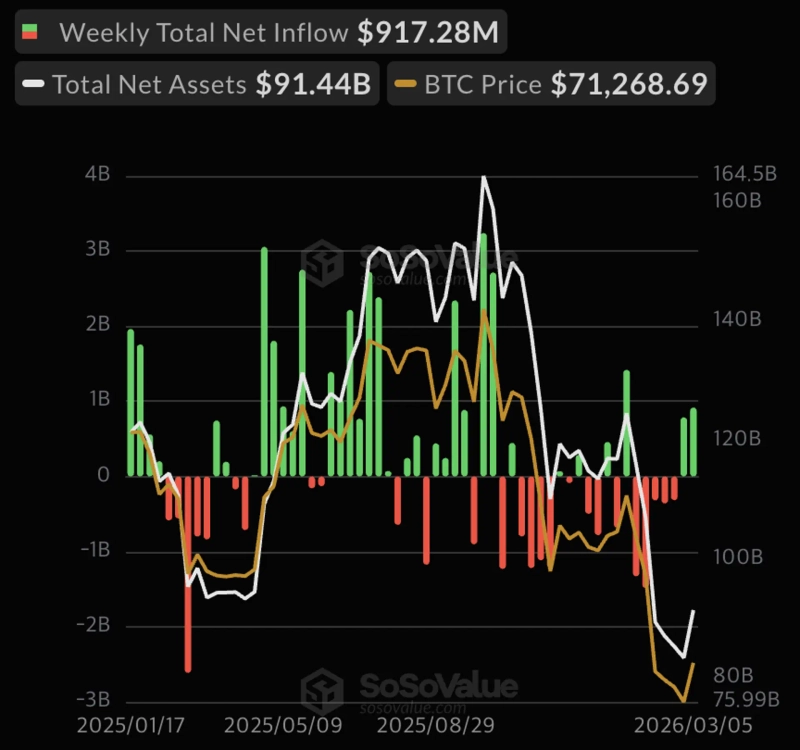
Analysts also point to signs that demand from institutional investors is returning. According to SoSoValue, U.S. spot Bitcoin exchange-traded funds (ETFs) recorded net inflows of $917 million this week (about 1.4 trillion won).
If this trend holds, the market is likely to log net inflows for a second consecutive week on a weekly basis, following last week. On-chain analytics firm Glassnode said, “Over the past few days, flows (into Bitcoin ETFs) have stabilized,” adding, “Selling pressure (in Bitcoin) from institutional investors is easing.”
Risk of inflation flare-up if the crisis drags on
Going forward, the key variable for direction appears to be international oil prices. If the war drags on and oil prices spike, it could stoke inflation and directly affect the U.S. Federal Reserve’s (Fed) policy-rate decisions. If the Fed slows the pace of rate cuts out of concern about renewed price pressures, risk appetite for risk assets could inevitably cool.
Binance Research, the research arm of global crypto exchange Binance, said in its weekly report that while the market’s initial reaction was limited, prolonged disruptions to energy supply could have far broader spillovers beyond commodity markets. “A sustained energy shock could materially affect the Fed’s monetary policy,” it said. It added that if the prolonged Middle East crisis increases U.S. Treasury supply and inflation proves more persistent, it could tighten financial conditions—producing outcomes that run counter to what risk assets need.
The key question is whether Bitcoin can break above $75,000, seen as a critical resistance level. On Polymarket, the world’s largest betting site, the probability that Bitcoin will surpass $75,000 within this month stood at 68% as of the day—nearly double the 36% seen in early this month right after the Iran crisis.
Glassnode said, “For the time being, $75,000 is likely to be a key price zone where liquidity and positioning concentrate,” adding, “Whether the recent move extends into a sustained recovery depends on whether sufficiently strong spot demand returns to the market to absorb overhead supply.”

JOON HYOUNG LEE
gilson@bloomingbit.ioCrypto Journalist based in Seoul