Palm oil also surges as crude jumps…hits a six-month high
Summary
- Palm oil futures rose to 4,408 ringgit per tonne, hitting a six-month high, amid an international oil shock stemming from the Middle East.
- With Brent, WTI, a narrower POGO spread, and rising biodiesel demand, palm oil is gaining prominence as an energy-linked commodity.
- Supply uncertainty—including Indonesia’s B50 policy and higher palm oil export taxes—is increasing the likelihood of further palm oil gains and potential product price hikes for processed foods.
Forecast Trend Report by Period


PRICE
Will snack foods and instant noodles get pricier amid the oil shock?
Traded at 4,408 ringgit per tonne in Malaysia
Up 10% from just before the Middle East war
Driven by a sharp rise in demand for biodiesel feedstock
Top producer Indonesia’s policy also a wildcard
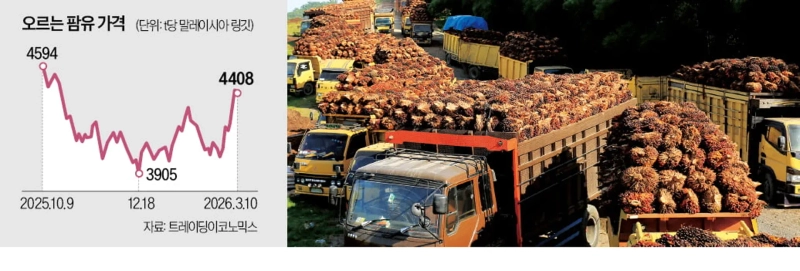
Palm oil prices—widely used as frying oil in processed foods such as snacks, instant noodles and bread—have jumped more than 10% in two weeks on the back of an oil shock triggered by the Middle East. With signs that elevated crude prices may persist, palm oil, which is also a biodiesel feedstock, is emerging as an alternative energy source. The spike is fueling concerns that processed food prices could rise further.
Cooking oil turned fuel
On the 10th (local time), palm oil futures on Bursa Malaysia in Kuala Lumpur traded at 4,408 ringgit per tonne (about 1.64 million won). That is up 10.03% from 4,006 ringgit on the 25th of last month, before the U.S.-Iran war began. On the 9th, prices climbed as high as 4,568 ringgit, the highest level in six months. During the session, prices at one point surged about 9% from the previous day to 4,774 ringgit, marking the biggest one-day gain since mid-2022.
Palm oil is an edible oil made from the fruit of oil palms grown in Indonesia, Malaysia and elsewhere. It is mainly used as frying oil for processed foods such as snacks, instant noodles and bread. Indonesia and Malaysia supply 85% of the world’s palm oil.
Through last year, palm oil prices faced downward pressure as inventories built up on rising output in Indonesia and Malaysia. The shift in price momentum is tied to a crude rally driven by the Middle East war. With both Brent and West Texas Intermediate (WTI) oscillating above $100 a barrel, demand has surged for palm oil as a biodiesel feedstock, analysts say.
The 'POGO spread'—the price gap between palm oil and gasoil—has narrowed sharply. As of the 6th, the POGO spread stood at $177.96 per tonne, down 44% from a year earlier. That means soaring gasoil prices have made palm oil-based biodiesel relatively more economical. Rising exchange rates and concerns over shipping delays are also boosting demand among Asian importers such as India for Southeast Asian palm oil that can be procured for immediate delivery, adding to upward pressure.
Anilkumar Bagani, head of research at Sunvin Group, said, "Palm oil is currently trading at a discount to gasoil, making it an attractive window," adding, "As biodiesel demand reacts sensitively to international crude prices, palm oil is being highlighted as an energy-linked commodity."
Indonesia weighs the 'B50' card
Supply-side uncertainty is also fanning the rally. Indonesia, the world’s largest palm oil producer, has signaled it may push again around mid-year for its 'B50' policy, which would allow the blending ratio of palm oil in biodiesel to rise to as high as 50% as an energy-security response to a crude price surge.
If Indonesia raises the permitted blending ratio from the current 40% to 50%, export volumes of palm oil to the global market would inevitably take an immediate hit. If Iran blocks the Strait of Hormuz and freight rates rise, import costs for palm oil could climb further. Another headwind is the Indonesian government’s recent sharp increase in palm oil export taxes and levies to $241 per tonne from $165, effectively tightening control over volumes.
If palm oil’s sharp rally persists, the processed food industry will have little choice but to move toward product price hikes. A food-industry official said, "We will keep a close watch on palm oil price trends and work out countermeasures."
Reporter Hyun-jin Ra raraland@hankyung.com

Korea Economic Daily
hankyung@bloomingbit.ioThe Korea Economic Daily Global is a digital media where latest news on Korean companies, industries, and financial markets.