PiCK
Trump: 'A bleak future if you don’t help the U.S.'…Pressures allies again
Summary
- U.S. President Donald Trump said he is demanding that allies dispatch warships to form a Strait of Hormuz coalition fleet, warning that if they do not comply, the future of NATO would be very bleak.
- He repeatedly urged China to join, saying it obtains 90% of its oil through the Strait of Hormuz, and reported that he pressed Beijing to state its position quickly by raising the possibility of postponing a U.S.-China summit.
- Iran is granting permission to transit the Strait of Hormuz through separate talks with countries such as India, while Japan, France, the United Kingdom and China are taking a cautious stance on dispatching warships, complicating efforts to form a coalition fleet.
Forecast Trend Report by Period


Calls for participation in 'Hormuz escort'…Hints at postponing a summit with China
Japan, the U.K. and others in 'cautious mode' despite U.S. request
China criticizes: 'Set the fire, then pass on the bill'
Iran seeks to drive a wedge between the U.S. and other countries
'Passage permits through Hormuz for India and others'
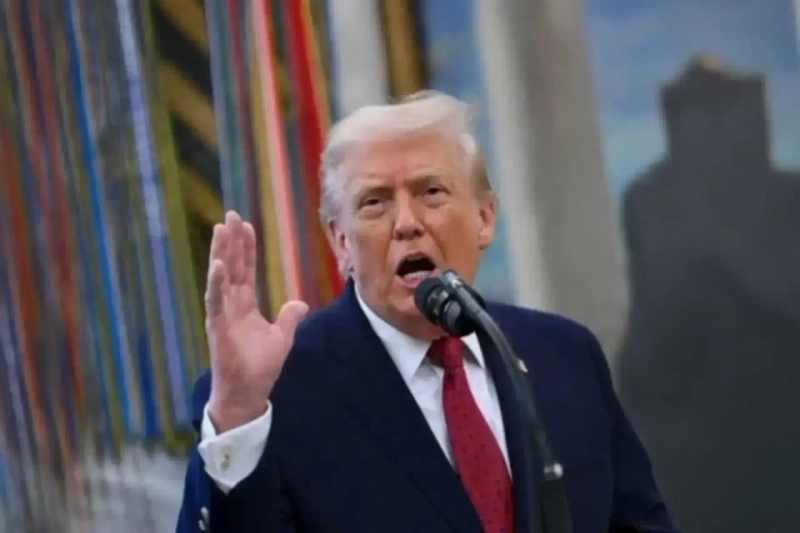
U.S. President Donald Trump has ramped up pressure on other countries to dispatch warships to the Strait of Hormuz. He warned that if allies do not send warships, they will "face a very bad future." He also suggested the possibility of delaying a summit with China, which is scheduled for later this month. However, as some countries—such as India—have succeeded in transiting the strait through separate negotiations with the Iranian government, the coalition fleet Trump wants is becoming harder to assemble.
◇'The U.S. will form a coalition fleet,' but…
In an interview with the Financial Times (FT) on the 15th (local time), Trump said Europe and China are heavily dependent on Gulf oil, adding that "it is only natural that the beneficiaries of the Strait of Hormuz help ensure nothing bad happens there." He continued, "If there is no response or they refuse, I think the future of the North Atlantic Treaty Organization (NATO) will be very bad." A day earlier, Trump used social media to ask five countries—China, France, Japan, South Korea and the United Kingdom—to dispatch warships. He added that the U.S. helped Europe in the war in Ukraine and said, "Now we’ll see whether they help us."
He again urged China to send warships as well. "China gets 90% of its oil through this strait, so it should help," he stressed. He then said, "Waiting until the U.S.-China summit may be too late," adding, "I want to know (whether China will join) before then. (Two weeks) is too long." Trump also said, "We may postpone (the China visit schedule)," pressing Beijing to state its position quickly.
The Wall Street Journal (WSJ) reported that "the Trump administration plans to announce as early as this week that multiple countries have agreed to form a coalition to escort ships transiting the Strait of Hormuz."
◇National positions grow increasingly negative
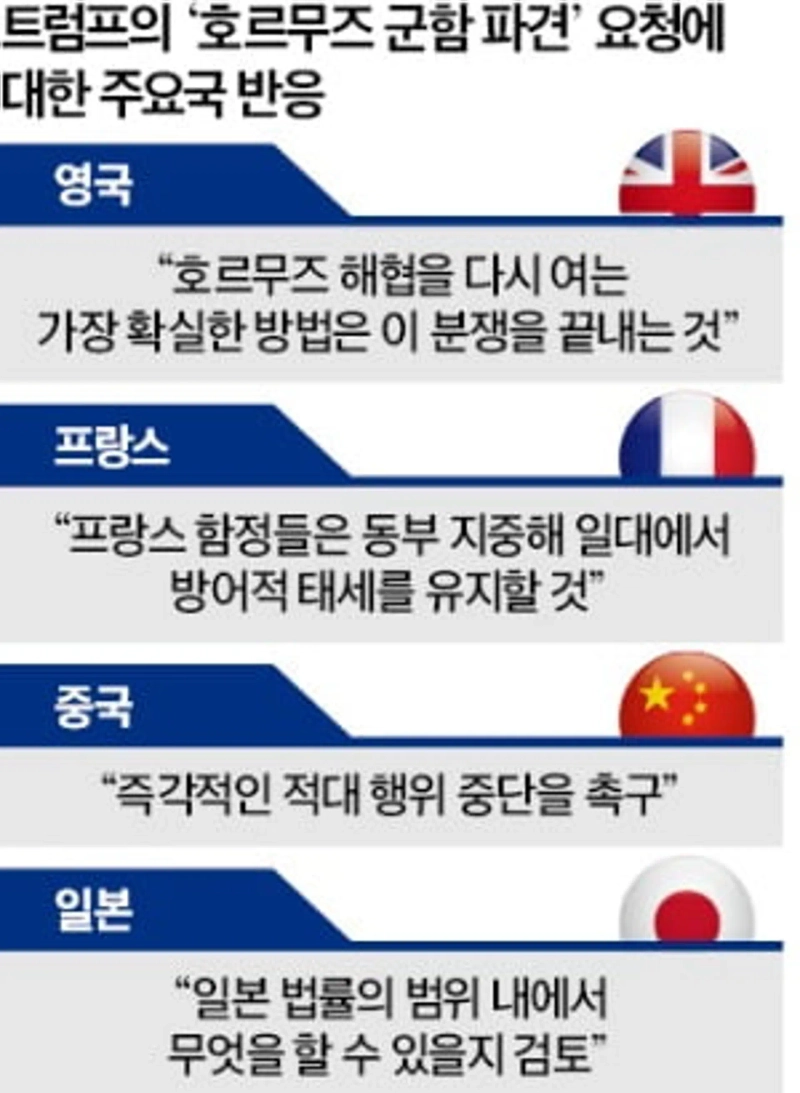
In response, Iran’s strategy is to maximize divisions between the U.S. and Israel and other countries. Iranian Foreign Minister Abbas Araghchi said that day, "We have received requests from several countries for the safe passage of ships through the Strait of Hormuz, and a number of them have been granted permission." India is a prime example. Indian External Affairs Minister Subrahmanyam Jaishankar said, "Two Indian-flagged gas carriers have passed through the Strait of Hormuz," adding that "direct dialogue with Iran is the most effective way to resume maritime transport through the Strait of Hormuz."
Countries that received Trump’s request to dispatch warships are also delaying their responses. Japanese Prime Minister Sanae Takaichi said on the 16th at the House of Councillors Budget Committee, "Within the scope of Japanese law, we are examining how to protect the lives of Japan-related vessels and their crews, and what we can do."
France’s Foreign Ministry said on X (formerly Twitter) on the 14th only that "French vessels will maintain a defensive posture in the eastern Mediterranean." U.K. Energy Security Secretary Ed Miliband said, "The surest way to reopen the Strait of Hormuz is to end this conflict." He added, however, that Britain is discussing with allies including the U.S. what support it can provide.
On the 16th, China’s state-run Global Times said, "The cause of tensions in the Strait of Hormuz is not a shortage of naval vessels, but the war," and criticized that "someone has set this region on fire and is asking the world to share the cost of putting it out."
Reporter Kim Dong-hyun 3code@hankyung.com

Korea Economic Daily
hankyung@bloomingbit.ioThe Korea Economic Daily Global is a digital media where latest news on Korean companies, industries, and financial markets.