Won-dollar exchange rate blows through the ceiling… “Could reach 1,550 won if the Iran war drags on”
Summary
- The won-dollar exchange rate breached 1,500 won intraday, marking its highest level since 2009.
- With the U.S.-Iran war and a sharp jump in global oil prices, fears of stagflation have lifted the dollar as a safe haven.
- Despite Korea’s bonds entering the World Government Bond Index (WGBI) next month, actual inflows may be limited, and the rate could rise to 1,550 won if the war is prolonged.
Forecast Trend Report by Period


First intraday breach of 1,500 won since the 2009 financial crisis
Fears of “S-panic” as global oil prices jump
Dollar gains on safe-haven demand
Authorities watch without separate market intervention
“Further gains would only drain FX reserves”
Inclusion in global bond index next month seen as a plus
“Inflow may be smaller than expected”
The won-dollar exchange rate broke above 1,500 won intraday in onshore trading on the 16th. It is the first time since 2009, during the global financial crisis, that the rate has exceeded 1,500 won in the regular onshore market rather than offshore trading. The move reflects a stronger dollar as fears of stagflation—an economic slump amid high inflation—spread on the back of a surge in oil prices triggered by a prolonged U.S.-Iran war. While FX authorities say they can take market-stabilization steps at an appropriate time, they have been hesitant to intervene. With the possibility that the exchange rate could spike into the 1,550-won range if oil rises further, the view is that it is not yet time to deploy verbal intervention or draw down FX reserves.
◇ Dollar strengthens on “S-panic”… FX authorities stand pat
Won-dollar exchange rate blows through the ceiling… “Could reach 1,550 won if the Iran war drags on”
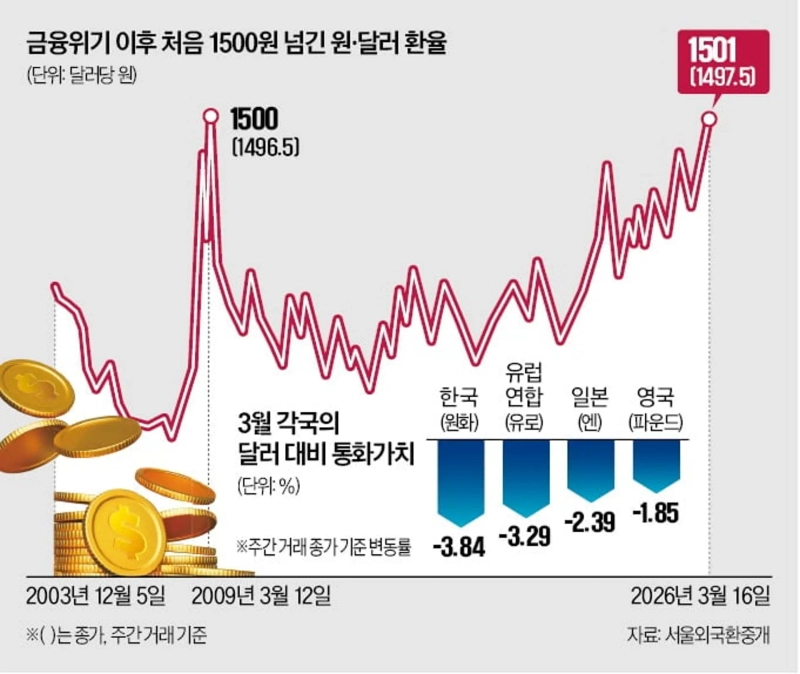
In the Seoul FX market on the 16th, the won-dollar rate (as of 3:30 p.m.) ended daytime trading at 1,497.5 won, up 3.8 won from the previous day (a decline in the won’s value). On a daytime closing basis, it was the highest since March 10, 2009 (1,511.5 won). The rate opened at 1,501 won, up 7.3 won, marking the first time it has topped 1,500 won in daytime trading since March 12, 2009 (intraday 1,500 won). It later pared some gains and closed below 1,500 won.
Since the outbreak of the U.S.-Iran war, the exchange rate has moved in tandem with global oil prices. On the 9th, when crude rose above $100 per barrel, the rate ended daytime trading at 1,495.5 won. As oil slid back into the $80s per barrel, the rate also eased over two days on the 10th and 11th, seemingly stabilizing in the 1,460-won range.
But the situation shifted again after the U.S. attacked military facilities on Kharg Island, a key hub for Iran’s crude exports, over the weekend. As geopolitical tensions rose, global oil prices jumped back to around $100.
As concerns grew that stagflation driven by an oil supply shock—like that of the 1970s—could reemerge, the safe-haven dollar also climbed. The dollar index, which measures the dollar against a basket of six major currencies, had hovered in the 90s this year but broke above 100 on the 13th of this month (100.1) and held around that level on the day.
FX authorities were said not to have undertaken separate market intervention that day. An FX market dealer said, “With Middle East risk pushing the dollar higher, not only the won but major currencies broadly weakened,” adding, “In such circumstances, direct intervention or verbal intervention would have limited effect, and the judgment may have been to stand pat given the risk of merely draining FX reserves.”
The authorities are reviewing various market-stabilization tools. An official said, “Along with verbal intervention, we are looking at several FX market stabilization measures, including building the ‘National Pension Service New Framework.’”
◇ “The exchange rate could jump to 1,550 won”
Some also forecast that the won could be supported if Korean government bonds are included in the World Government Bond Index (WGBI) next month. According to the Bank of Korea, inclusion in the WGBI is expected to bring foreign investment of roughly $50 billion to $60 billion into Korea to buy Korean government bonds. The process could boost demand to sell dollars and buy won, lifting the won.
Others argue it will be hard to get overly optimistic. An FX market expert said, “Most foreign investors hedge currency risk, so the funds that actually sell dollars and buy won may not be as large as expected,” adding, “Over about eight months after WGBI inclusion, the scale of tangible inflows into Korea will likely be around $2 billion to $3 billion per month.”
Markets see developments in the Middle East and the path of global oil prices as key to the exchange rate’s direction going forward. Park Sang-hyun, a research fellow at iM Securities, said, “An exchange rate around 1,500 won is excessively high relative to Korea’s economic fundamentals,” but added, “If the war drags on and global oil prices rise further beyond $100, the exchange rate could also climb to 1,550 won.”
Reporters Kim Ik-hwan / Shim Seong-mi / Nam Jeong-min lovepen@hankyung.com

Korea Economic Daily
hankyung@bloomingbit.ioThe Korea Economic Daily Global is a digital media where latest news on Korean companies, industries, and financial markets.