PiCK
Bitcoin ‘shaken’ by Middle East-driven energy shock…compounded by delayed rate cuts [Lee Soo-hyun’s Coin Radar]
Summary
- It said Bitcoin is facing downside pressure around the $70,000 level due to an energy war, a surge in international oil prices, and delayed rate cuts stemming from Middle East risks.
- It said Ethereum is showing relatively resilient price action around the $2,100 support level, supported by institutional inflows, expanding net inflows into spot ETFs, and sustained high open interest (OI).
- It said the expansion of CeDeFi, rising TVL, and the on-chain migration of exchange liquidity are fueling talk of Mantle (MNT) ecosystem expansion and potential additional upside momentum.
Forecast Trend Report by Period



<Lee Soo-hyun’s Coin Radar> is a weekly column that reviews trends in the virtual asset (cryptocurrency) market and explains the backdrop. Going beyond a simple listing of price moves, it offers a multi-angle analysis of global macro issues and investor positioning, providing insights to gauge the market’s direction..
Major coins
1. Bitcoin (BTC)

Bitcoin held around $74,000 this week, but selling pressure from the energy shock has pushed it down, barely keeping the $70,000 level intact. As of the 20th, Bitcoin is trading around $70,000 on CoinMarketCap.
The biggest driver is Middle East risk. The key point is that the latest clash has spread beyond a mere military confrontation into an “energy war” that directly hits supply chains. After Israel carried out airstrikes on Iran’s largest gas field, South Pars, and the Asaluyeh processing facilities, concerns over disruptions to gas output intensified. In response, Iran has continued missile attacks targeting Qatar’s Ras Laffan industrial complex. The area is a critical hub responsible for about 20% of global LNG supply.
Oil prices reacted immediately. On the 19th (local time), Brent crude climbed above $119 intraday, nearing $120. The spike in oil prices quickly translated into inflation concerns, which in turn reinforced interest-rate pressure and weighed on Bitcoin.
Inflation data and monetary-policy variables also added to the headwinds. The U.S. February Producer Price Index (PPI) rose 0.7% month on month, well above market expectations (0.3%), while the year-on-year increase hit 3.4%—the highest in a year. With oil prices rising, concerns about a renewed uptick in inflation have grown.
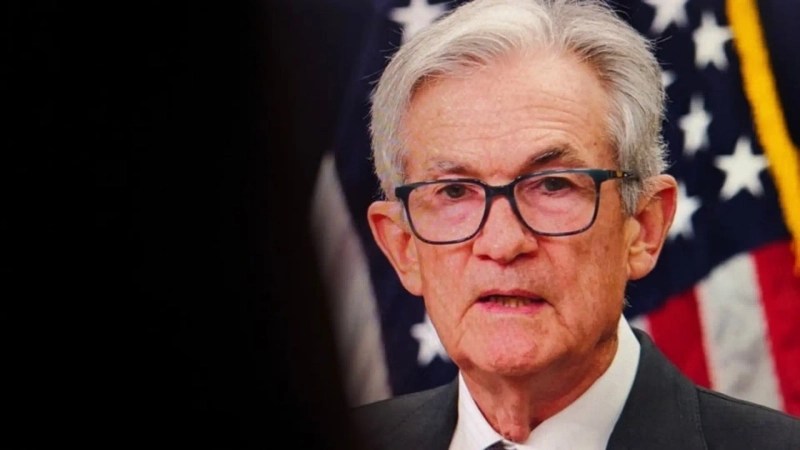
This week’s Federal Open Market Committee (FOMC) meeting was another burden. The Fed held its policy rate at 3.50–3.75%, but Chair Jerome Powell reaffirmed a hawkish stance, saying there would be “no rate cuts without progress on inflation.” Markets were also unsettled by mentions among some officials of the possibility of further rate hikes.
In the near term, volatility is likely to persist. Robin Singh, CEO of Coinli, said, “Bitcoin has fallen nearly 5% over the past 24 hours, seemingly losing short-term upside momentum, and it could drop to $65,000 in the coming days,” adding that “prices are likely to move within a range of $65,000–$75,000 over the next few weeks.”
Rakesh Upadhyay, a Cointelegraph researcher, said, “If Bitcoin falls below $71,158 on the daily chart, the uptrend could weaken, and downside pressure could expand toward the $65,000 support level.” He added, “Conversely, if it breaks firmly above the $74,508 resistance level, room could open for a further rally toward $84,000.”
2. Ethereum (ETH)
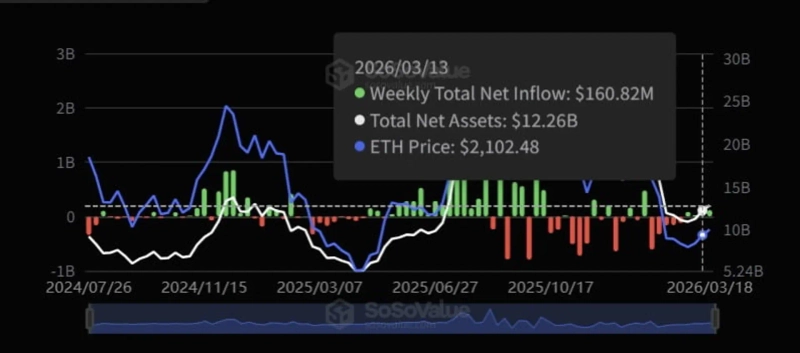
Ethereum has shown relatively steady price action, holding the $2,100 level fairly firmly despite macro headwinds. As of the 20th, it is hovering around $2,150 on CoinMarketCap.
The biggest support factor is institutional inflows. According to SosoValue data, spot Ethereum ETFs saw net inflows of about $160 million last week, the largest since mid-January. Institutions are also buying Ethereum aggressively. BitMine has purchased more than 100,000 ETH this month alone, bringing its total holdings to 4.6 million ETH.
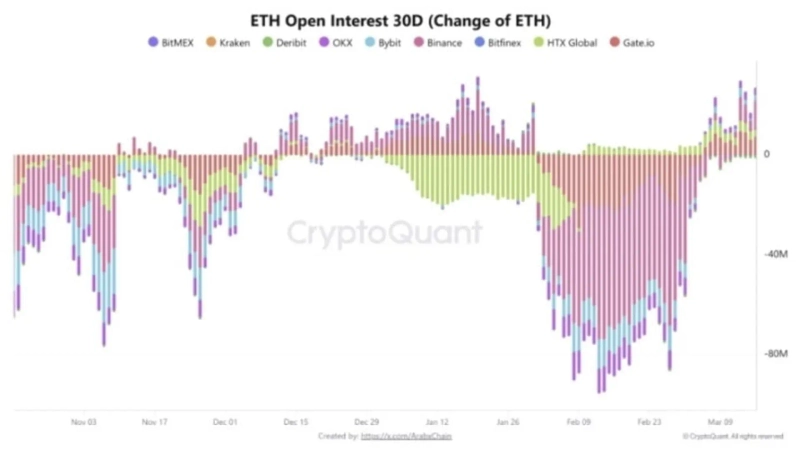
Meaningful changes have also emerged in the derivatives market. Based on CryptoQuant data from the 18th, open interest (OI) rose on Binance and Bybit, signaling continued inflows, while OI declined on Kraken and Bitfinex, pointing to more cautious positioning.
CryptoQuant contributor Arab Chain said, “Diverging fund flows across exchanges generally indicate liquidity reallocation,” adding, “Especially given that overall open interest remains elevated, it can be interpreted as a sign that investors are holding positions while anticipating further upside.”
In terms of price levels, around $2,110 is seen as the key support. Investment outlet FXStreet said that holding this zone could keep the uptrend intact, and that a break above $2,390 could open the way for further gains into the $2,700 range. Conversely, if $2,100 gives way, the door opens to a pullback toward the $1,700 range, making the current area a key inflection point.
Cointelegraph also said “$2,100 is a very important level,” adding that “if it fails to hold the $2,100 line, it could retreat to the major support at $1,800.”
3. XRP (XRP)
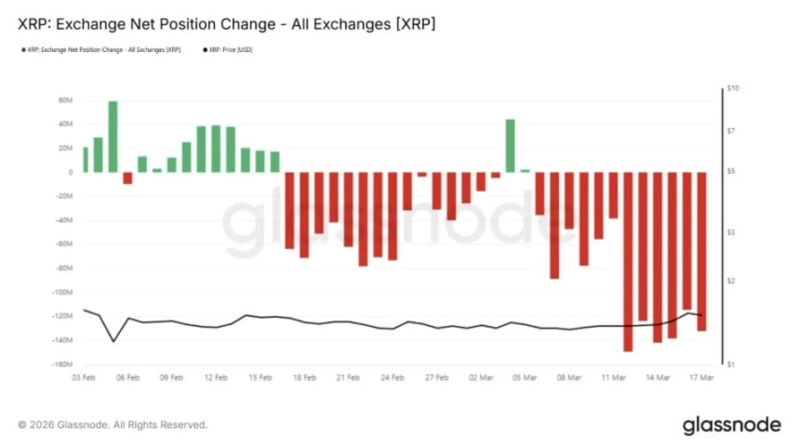
XRP saw its upside capped even though there was positive regulatory news. As of the 20th, it is trading at $1.45 on CoinMarketCap.
XRP has posted a gradual recovery over the past several days. In particular, on the 17th (local time), reports that the U.S. Securities and Exchange Commission (SEC) and the Commodity Futures Trading Commission (CFTC) jointly classified virtual assets (cryptocurrencies) as “digital commodities” briefly sent it up to $1.60 intraday. However, profit-taking emerged quickly, and the rally did not last.
This pattern is also visible in on-chain data. According to Glassnode, exchange net position change data show that XRP holders have maintained a net-selling bias over the past 30 days. This is interpreted as repeated distribution as holders take profits on each rebound.
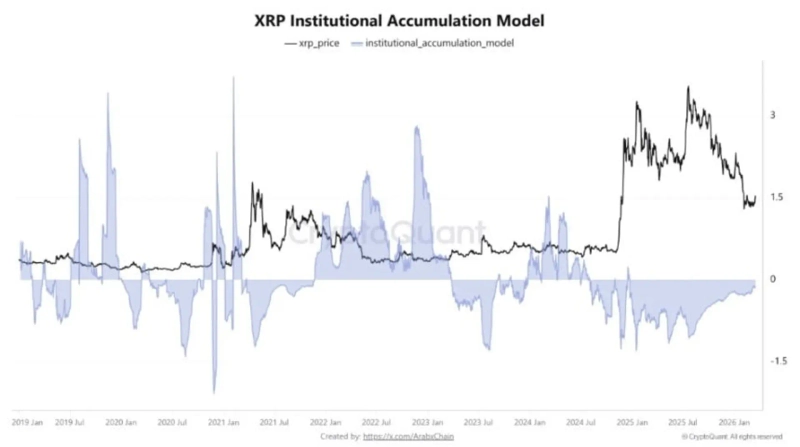
Institutional inflows are also not evident. On CryptoQuant, the institutional buying indicator remains in negative territory at -0.14. Given that strong rallies have historically appeared when the indicator turns positive, the current move is interpreted as a limited, retail-led rebound.
The market is watching the approval of an XRP spot exchange-traded fund (ETF) and broader institutional access as key variables that could support prices going forward. With some XRP-based ETF products already launched, investors are focused on whether the SEC will grant official approval for a “single spot ETF” scheduled for the 27th. If approved, the potential for up to $8 billion in new inflows—centered on pension and individual retirement account (IRA) money—has been raised.
From a technical standpoint, $1.50 is the key pivot. Crypto-focused outlet BeInCrypto said, “If XRP breaks above $1.58, room could open for further gains up to $1.70.” CoinGape likewise said, “If it decisively breaks above $1.50, a path opens toward $1.55,” adding that “if upside momentum strengthens thereafter, the $1.65 and $1.70 zones are the next targets.” Still, analysts say that if it breaks below the short-term support at $1.45, further downside cannot be ruled out.
Issue coins
1. Mantle (MNT)
Mantle posted a relatively resilient performance, rising about 4% over the past week on CoinMarketCap despite a broad decline across the altcoin market. As of the 20th, it is trading around $0.75 on CoinMarketCap.
The key backdrop is the expansion of “CeDeFi.” Mantle has partnered with global exchange Bybit, DeFi lending protocol Aave, and yield automation protocol CIAN to build a structure linking centralized finance (CeFi) and decentralized finance (DeFi). The core is enabling exchange users to access DeFi yield products within the existing exchange environment without having to create a separate on-chain wallet or move funds. Lowering entry barriers while simplifying the user experience is a key feature.
Market reaction has been swift. Within a month of Aave being deployed on the Mantle chain, total value locked (TVL) surpassed $1.25 billion, and assets under management in Mantle Vault also crossed $150 million, with liquidity flowing in rapidly.
This issue is meaningful in that it goes beyond a one-off event and reflects a structural shift in which liquidity that had stayed on exchanges moves on-chain. How consistently real user funds continue to flow in will be the key variable. If the CeDeFi model becomes firmly established, it could lead to Mantle ecosystem expansion and additional upside momentum.

Suehyeon Lee
shlee@bloomingbit.ioI'm reporter Suehyeon Lee, your Web3 Moderator.