Shin Hyun-song’s Focus on Financial Stability Signals Caution on Preemptive Rate Hikes
Summary
- Shin places the greatest weight on financial stability, debt levels and global liquidity, fueling expectations that he will be cautious about preemptively raising the benchmark rate.
- He could still raise interest rates preemptively if external conditions worsen, including the US benchmark rate, domestic household debt, and a stronger dollar coupled with a weaker won.
- Shin is expected to pursue preemptive action through macroprudential tools such as housing loans, foreign-currency liquidity regulation and non-core debt management.
Forecast Trend Report by Period


Review of 15 papers by BOK governor nominee
Focus on housing loans and foreign-currency liquidity rules
Preemptive response seen coming through financial-stability tools
Wary of excessive central-bank transparency
Attention on whether BOK retains its “K dot plot”

Shin Hyun-song, the nominee to lead the Bank of Korea, would take charge of monetary policy as fears of stagflation build, with slowing growth and rising prices weighing on the economy. A review of 15 of his major papers shows Shin has argued that central banks should consider not only inflation, but also debt in the financial system, capital flows and global liquidity when setting policy.
That helps explain why Shin, who places financial stability above all else, may not move to preemptively raise the benchmark interest rate as quickly as some investors fear. If the Federal Reserve resumes raising rates, however, the BOK may have little choice but to follow. He could also turn more hawkish if concern over rising household debt intensifies.
◇ How the BOK communicates with markets
Shin first drew attention with his 1998 paper, “Unique Equilibrium in a Model of Self-Fulfilling Currency Attacks,” which showed that currency crises can be amplified not only by economic fundamentals but also by the interaction of market expectations and financial variables. That view later extended to monetary policy: inflation and growth alone are not enough, and policymakers must also account for expectations and financial conditions.
In his 2002 paper “The Social Value of Public Information,” Shin argued that excessive central-bank disclosure can lead market participants to rely too heavily on public signals, reinforcing herd behavior. That is one reason observers expect the BOK to be cautious about forward guidance, or signaling the future path of interest rates in advance.
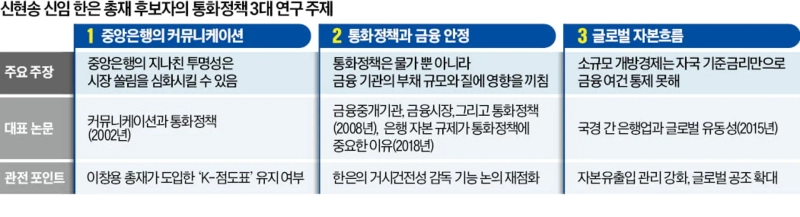
Choi Jae-won, an economics professor at Seoul National University, said forward guidance is a measure of necessity used by central banks that must contain inflation when rates are already low. Shin is likely to view forward guidance as having an overly powerful effect on financial markets, Choi added. At the same time, Shin appears to believe central-bank communication should evolve in a more sophisticated way. That has fueled speculation he could expand and further develop the “K dot plot” introduced by BOK Governor Rhee Chang-yong in February.
◇ Financial stability through a macro lens
Shin’s work shifted more clearly toward financial-stability tools with his 2008 paper, “Financial Intermediaries, Financial Stability, and Monetary Policy.” In that paper, he argued that rate cuts do more than support growth. They can also encourage financial institutions to expand borrowing, increasing systemic risk.
His 2011 paper, “Macroprudential Policies Beyond Basel III,” is regarded as a practical policy manifesto. It argued that capital regulations alone are not enough to safeguard financial stability and that broader macroprudential tools are needed to cover the financial system as a whole, including bank lending and foreign-currency funding.
In his 2018 paper, “Why Bank Capital Matters for Monetary Policy,” Shin stressed the importance of non-core liabilities as an early warning signal of financial crises. A sharp increase in non-core liabilities indicates weakening risk premiums, he wrote, arguing that the more banks rely on market-based funding rather than deposits, the more vulnerable the system becomes.
That helps explain why Shin is expected to take a close interest in South Korea’s property lending, foreign-currency liquidity regulation and management of non-core debt. Choi Sang-yup, a professor at Yonsei University, said Shin’s background at the Bank for International Settlements suggests he has long been wary of banks and households taking on excessive debt and risk. The preemptive response Shin emphasizes goes beyond rate increases and instead points to early action on broader macroeconomic risks such as debt, Choi said.
◇ Global liquidity: Domestic variables are not enough
Shin’s argument that central banks should actively reflect global financial conditions is widely viewed as his most distinctive academic contribution. In his view, looking only at domestic inflation and growth is not enough when setting benchmark rates. Open economies such as South Korea also need to monitor global dollar flows and cross-border bank credit.
His 2015 paper, “Capital Flows and the Risk-Taking Channel of Monetary Policy,” explained how low rates in advanced economies such as the US can fuel credit expansion and capital inflows in emerging markets. The paper underscored the limits of central banks that set rates based only on domestic economic conditions.
Shin wrote that the dollar is a key indicator of risk-taking capacity in global capital markets. Global factors play a bigger role than domestic ones in determining banking-sector capital flows, he argued.
Based on that record, experts said that if Shin moves ahead with a preemptive rate increase, the main trigger would more likely be external variables than inflation, including US policy rates, the exchange rate and international oil prices. Choi said the BOK could raise rates preemptively to prevent capital outflows from worsening amid a stronger dollar and weaker won, and to keep elevated household debt from putting further strain on the economy.
Jung Young-hyo / Shim Sung-mi, Korea Economic Daily reporters hugh@hankyung.com

Korea Economic Daily
hankyung@bloomingbit.ioThe Korea Economic Daily Global is a digital media where latest news on Korean companies, industries, and financial markets.