"The Shadow of ActiveX" Looms Over Korea Won Stablecoin Debate [Hankyung Koala]
Summary
- He said Korea’s discussion of a won-denominated stablecoin is focused only on controlling issuers, leaving out discussion of connect wallet, which is central to Web3.
- He said that in the current global market, stablecoins and DeFi are growing explosively around a wallet-based ecosystem.
- He noted that if a Korean-style won stablecoin is designed around identity checks and KYC-heavy regulation, it could repeat the failure of public certificates and lose competitiveness as programmable money.
Forecast Trend Report by Period


Kim Min-seung’s ₿-ficial
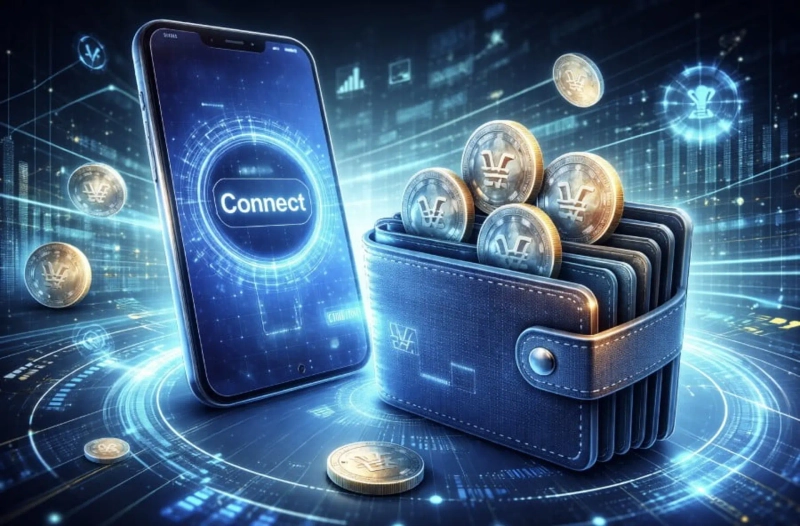
Can a won-denominated stablecoin “CONNECT WALLET”?
In the early 2000s, South Korea’s internet was the fastest in the world—but also the most inconvenient. The culprit was the public certificate. You needed it for everything from banking and government services to shopping payments. You had to install ActiveX, which only worked on Windows, and painstakingly type passwords packed with special characters. For foreigners, using Korean internet banking was virtually impossible. It was like building the world’s worst user experience on top of world-class IT infrastructure.
The justification was security. The core regulatory logic was that online transactions must verify the identity of the counterparty, and that the method had to be a government-certified public certificate. Yet even after 20 years, online financial fraud did not decline; instead, phishing that stole public certificates emerged as a new type of crime. A system created for security ended up creating a new security threat. After the 2020 revision of the Electronic Signature Act abolished the public certificate’s monopoly, easy payments grew explosively. Biometric authentication became widespread, and Toss and Kakao Pay became everyday infrastructure. Security improved rather than weakened. It became clear that the 20-year premise—“it’s safe only if identity is controlled”—was wrong.
Today’s debate over won-denominated stablecoins seems to be repeating that history. What stablecoins are and where they can be used has already been discussed sufficiently. Countries around the world are preparing adoption in their own ways. The United States enacted the Genius Act last July, establishing a legal foundation for issuance and distribution. Last year, stablecoin transaction volume reached $33 trillion—nearly twice Visa’s annual payment processing volume. Against this backdrop, Korea is also, reluctantly, reviewing the introduction of a won stablecoin. Experts across sectors are continuing discussions on how to create and distribute one. But there is one thing conspicuously missing from all these conversations: “connect wallet” (wallet connection) for blockchain wallets.
Stablecoins exist on blockchains. Just as a bank account holds won, a blockchain wallet holds stablecoins. They are transferred from wallet to wallet, and by connecting a wallet you can use smart-contract-based services such as decentralized finance (DeFi). This is precisely why stablecoins become “programmable money.” “Using” a stablecoin is, in effect, “connecting” a wallet.
In Web2, the way to access a service is to “log in.” You create an ID and password, verify your email, and sometimes even register your phone number and ID card. Or you outsource authentication by borrowing a platform account such as Google or Naver. It’s a structure where the service provider verifies and authorizes the user’s identity—essentially no different from the logic of public certificates. You must prove who you are to get in.
Web3 is different. You “connect” a wallet. There is no sign-up and no registration of personal data. With a single blockchain wallet, you can access a service, transact, and leave. The wallet itself is identity, account, and authentication method. In Q3 last year, DeFi’s TVL (total value locked) hit a record high of $237 billion, and most of that capital moves with a single “wallet connection.” Trillions of dollars move without IDs or passwords. It may be hard to accept with a Web2 mindset, but it works in practice—and it is growing explosively.
With Gary Gensler, the former chair of the U.S. Securities and Exchange Commission (SEC), who effectively blocked the development of the Web3 industry, stepping down and the Trump administration taking office, this wallet-based ecosystem is also coming back to life. On top of that, a new variable is being added: the agentic economy. An era is coming in which AI agents collect data on their own, commission tasks from other agents, and pay service fees. You can’t register an email address and go through identity verification every time you connect to thousands of data feeds. That is why there is active discussion about equipping agents with stablecoin wallets. Coinbase’s revival of the x402 protocol and the development of AgentKit are representative. Access is via “connect wallet,” and payment is via stablecoins. Wallet connection is not a choice; it is infrastructure.
Yet Korea’s won stablecoin discussion is still circling, month after month, around issuer qualification requirements. It is likely to drift toward allowing only banks to issue—or granting issuance rights only to conglomerates that can be controlled as tightly as banks. Meanwhile, discussion of where and how a won stablecoin would actually be used, and how to make the most of its advantages as a “coin,” is missing. The center of the debate is not use, but control.
Will a won stablecoin built this way really be able to move freely through “connect wallet”? Within a discussion structure led by banks and financial authorities, can we even imagine transactions without ID submission and KYC (know-your-customer)? If the starting point of the debate is the idea that fund transfers are impossible without verifying the owner’s identity, the outcome is likely to be a carbon copy of the public certificate from 20 years ago.
Those who designed the public certificate system were experts in their own right. They likely made what they considered the best judgment within their domain. But by hard-coding that judgment into law and institutions, Korea’s internet was trapped for 20 years in ActiveX and public certificates. It was the result of experts pursuing control and safety drawing the boundaries of freedom and innovation as well.
For a won stablecoin to be truly “programmable,” and for AI agents to be able to use it freely, “connect wallet” must be permitted from the outset. That is how dollar stablecoins move. It is difficult to succeed with an approach of blocking first and looking for reasons to loosen later—much like how Korea still has not fully escaped the government’s 2017 stance of “blanket prohibition.”
Kim Min-seung, head of the Korbit Research Center, ...
He is a founding member and head of the Korbit Research Center. He works to explain, in an accessible way, complex events and concepts unfolding in the blockchain and virtual asset ecosystem, and to help people with different perspectives understand one another. He has experience in blockchain project strategy planning and software development, among other areas.
※This article is an external contributor’s column introduced to provide diverse perspectives to cryptocurrency investment newsletter subscribers, and does not represent the views of The Korea Economic Daily.

Korea Economic Daily
hankyung@bloomingbit.ioThe Korea Economic Daily Global is a digital media where latest news on Korean companies, industries, and financial markets.