People Power Party sets party line to abolish taxation of virtual assets… “NTS not adequately prepared”
Summary
- The People Power Party said it has decided to adopt as its party line the abolition of the virtual-asset income tax slated to take effect next year.
- Lawmaker Park Soo-young said he has introduced a revision to the Income Tax Act to delete virtual-asset taxation provisions, citing insufficient NTS infrastructure and concerns over capital outflows.
- Lawmakers Kim Eun-hye and Choi Bo-yoon emphasized the need to address double-taxation concerns, the issue of classifying gains as other income, and legislation to foster the digital-asset industry and improve the investment environment.
Forecast Trend Report by Period


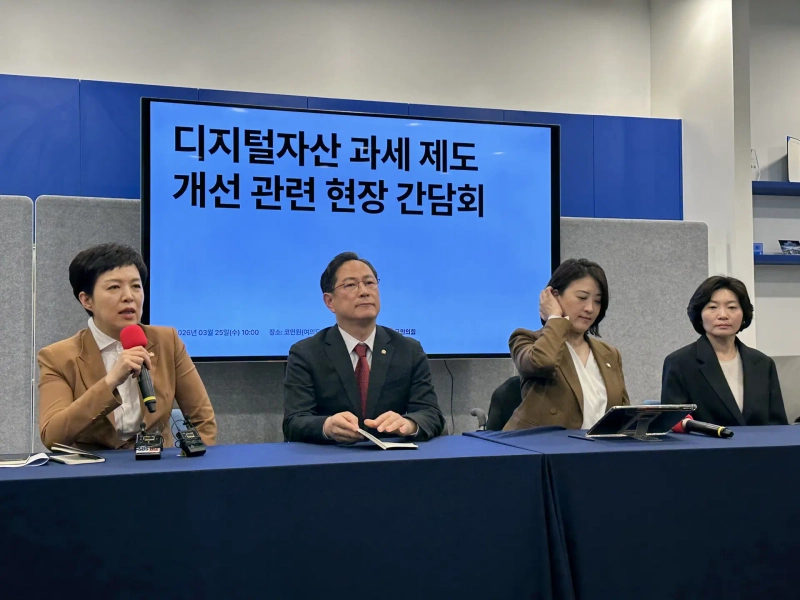
The People Power Party (PPP) has decided to make it its official party position to abolish the income tax on virtual assets (cryptocurrencies) slated to take effect next year. The decision reflects a view that, after the scrapping of the financial investment income tax, taxation should be aligned with equities and that younger generations’ opportunities to build wealth should be safeguarded.
Speaking at a press briefing following an on-site roundtable titled “Field Meeting on Improvements to the Digital-Asset Taxation System,” held on the 25th at Coinone’s headquarters in Yeouido, Seoul, PPP lawmaker Park Soo-young said, “I have already introduced a revision bill to the Income Tax Act centered on deleting the provisions for taxing virtual assets,” adding, “It is problematic to press ahead with taxation when the government’s preparations are insufficient.”
Park pointed to limitations in the tax infrastructure. “The National Tax Service lacks both understanding of virtual assets and administrative capacity—so much so that one can cite incidents such as the exposure of mnemonic (seed phrase) secrets,” he said, adding that the system for sharing transaction records under the Crypto-Asset Reporting Framework (CARF) is also “focused on aggregate data, making it difficult to identify detailed, individual-level records,” and therefore provides “insufficient grounds for taxation.”
He continued, “The NTS system can currently collect information only from the five major won-based exchanges,” warning that “if taxation is forced through, a balloon effect could emerge, with funds moving to overseas exchanges or informal channels.” He added that this “could shrink the domestic won market and lead to capital outflows.”
He also raised concerns about fairness. “For young people who find it difficult to build assets amid rising real-estate prices, virtual assets can be an opportunity,” Park said. “Abolishing the financial investment income tax while keeping taxation only on virtual assets is not equitable.”
Kim Eun-hye, the PPP’s senior deputy floor leader, pointed to logical flaws in the taxation framework. “Pushing taxation first when even the definition of virtual assets is not clearly established is not appropriate,” she said, calling the application of “uniform financial regulation as-is” an “anachronistic idea.”
She also raised the issue of double taxation. “In major countries such as the United States, there is a trend toward viewing virtual assets as commodities,” Kim said, adding that “with investors already bearing value-added tax through trading fees, there are arguments that adding income tax on top amounts to excessive taxation.” She also emphasized that “the current structure, which classifies virtual assets as other income and limits the deduction of loss carryforwards, also needs improvement.”
PPP lawmaker Choi Bo-yoon underscored the party’s commitment to fostering the digital-asset industry. “Since the presidential-election pledge stage, the party has gathered on-the-ground opinions through the Digital Asset Value-Up Special Committee,” he said. “We will move away from a regulation-centered approach and push legislation to foster the industry and improve the investment environment.” He also said, “Delays in phase-two legislation are slowing the activation of corporate and foreign investment,” adding that the party would “continue related discussions to create a safe investment environment that reflects demand from younger generations.”
Calls for cooperation from the Democratic Party and the government also followed. Park said, “We have yet to hear the ruling party’s position on abolishing virtual-asset taxation,” adding, “I hope they will clarify their stance before discussions at the tax subcommittee.” Kim said, “Phase-two legislation is as important as virtual-asset taxation,” adding, “We are ready to engage in talks at any time, but discussions are not moving forward because a single proposal has not been prepared. A forward-looking change in attitude from the government and the Democratic Party is needed.”

Doohyun Hwang
cow5361@bloomingbit.ioKEEP CALM AND HODL🍀