As Korea hesitates on stablecoins… Wall Street opens a 'won trading workaround'
Summary
- U.S.-based EDXM International said it plans to launch won-tracking perpetual futures as early as the beginning of next month, using the won stablecoin KRWQ and USDC.
- The product is blockchain-based and can cut trading costs by 50–75% versus existing NDFs, drawing attention as a factor that could affect won-dollar exchange-rate volatility and expand offshore won trading.
- However, uncertainties remain over KRWQ’s 1-to-1 value stability, institutional investor participation, and risks from Korean government FX regulations and capital controls, leaving actual trading demand and market impact unclear.
Forecast Trend Report by Period


Q&A on the soon-to-launch 'blockchain version of won NDFs'
Exploiting delays in institutionalizing 'won-denominated coins'
Foreign capital moves into the market first
U.S. won-tracking coin futures to launch next month
In focus for lower costs than existing NDFs
Korea ahead of 24-hour FX market opening
Could become an obstacle to FX-rate management

In the U.S., won-tracking derivatives using a won stablecoin are set to launch as early as the beginning of next month. As Korea fails to pick up the pace on legislating won stablecoins, there is a growing possibility that offshore trading that influences the won’s value will expand into a blockchain-based market. With Korea’s FX market set to open 24 hours a day in July, analysts say a new workaround for won trading could emerge and become a factor that amplifies volatility in the FX market.
① What product is coming
According to foreign media reports and the digital-asset industry on the 25th, EDXM International, a subsidiary of U.S.-based EDX Markets, plans to roll out a perpetual futures contract that tracks the Korean won as early as the beginning of next month. EDX Markets is an institutional-only digital asset exchange backed by major Wall Street financial firms including Citadel Securities and Fidelity Digital Assets. They plan to introduce a product whose profit and loss is determined by movements in the won-dollar exchange rate, using the won stablecoin KRWQ and the dollar stablecoin USD Coin (USDC).
② Why is it drawing close attention
The market is closely watching the launch because it is difficult to gauge the impact it could have on the FX market and the won-dollar exchange rate. In general, the won-dollar exchange rate is formed jointly in the Seoul FX market and the offshore non-deliverable forward (NDF) market. An NDF is an offshore derivative in which parties do not exchange actual won; instead, only the difference between the contracted exchange rate and the rate at maturity is settled in U.S. dollars. It is a kind of workaround used in markets where capital controls make it difficult to move currency freely across borders. According to the Bank for International Settlements (BIS), the won is the second most actively traded currency in the NDF market after the Indian rupee.
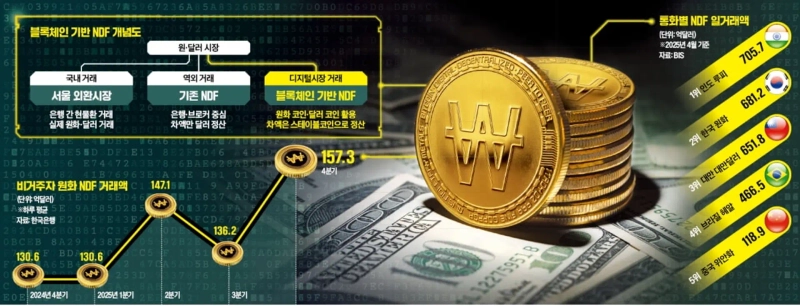
From the perspective of FX authorities, the NDF market is necessary but also an inconvenient presence. While it serves as a channel that absorbs overseas demand for won, it also front-runs exchange-rate expectations outside the authorities’ influence. The government’s plan to open the FX market 24 hours a day in July also aims to draw some won trading from the offshore NDF market into the onshore spot FX market.
The problem is that the emergence of blockchain-based won derivatives raises the possibility of yet another offshore market that can influence the won’s value. EDXM said it is targeting average daily trading volume of $500 million within the next year. That is about 3% of the average daily trading volume in non-resident won NDFs ($15.73 billion as of end-2024). If trading grows rapidly, concerns are emerging that it could have a meaningful impact on the price-formation structure of the won-dollar exchange rate and on FX-market volatility. An FX-market official said, “Even if the trading volume is small at first, if it grows to a double-digit share over the long term, it could become much more difficult to read the exchange-rate trend and respond.”
③ Will it actually trade in the market
Conventional NDF trading has been conducted mainly through banks and brokers. Although actual won is not exchanged, trades are based on interbank credit and go through multiple processes such as collateral arrangements, margin management, brokerage, and settlement at maturity. This product highlights the ability to trade and settle directly on a blockchain using stablecoins. EDXM claims it can cut trading costs by 50–75% compared with existing won NDFs.
Skepticism is also significant. That is because it has not been proven whether the won stablecoin KRWQ can reliably maintain a 1-to-1 value with the won, or whether institutional investors will participate at a meaningful scale.
There is also regulatory risk. The larger won-denominated coins and related derivatives become, the more the Korean government could raise issues from the perspective of FX regulations, capital controls, and anti-money-laundering. Still, because trading takes place offshore, some observers say it would not be easy to block trading solely through government objections.
④ Can a won coin be issued right away
The won stablecoin KRWQ used in the product design was not issued in Korea with regulatory approval. It was issued outside Korea’s regulatory framework by Brainpower Labs, a Cayman Islands entity. The company said that to peg KRWQ 1-to-1 to the won’s value, it would initially use USDC reserves as collateral and then gradually switch reserve assets to Korean government bonds and the like.
In Korea, institutionalization of won stablecoins has not fully gotten underway. The government is considering a plan to allow a bank-led consortium to issue won-denominated coins. However, the draft legislation for the Digital Asset Basic Act, which would provide the framework for institutionalization, has not yet been submitted to the National Assembly. An industry official said, “It is hard to avoid criticism that offshore players entered the market first while Korea hesitated to put the system in place.”
⑤ How will the government respond
FX authorities say it is hard to draw firm conclusions about the impact this product’s launch will have on the FX market and the won-dollar exchange rate. An FX-authorities official said, “In NDF trading, a key variable is not only cost but also which benchmark rate is used for settlement at maturity (fixing),” adding, “If won stablecoins are introduced early within the regulatory framework and the 24-hour FX market opening takes hold, the incentive to use products like this could decline to some extent.” In other words, even if fees are low, actual demand may not materialize if the settlement benchmark fails to gain market trust.
Another FX-market official said, “At a time when even a 24-hour FX market opening has limits in fundamentally replacing NDF demand, this creates a new policy challenge for FX authorities,” adding, “The fact that won coins issued overseas are difficult to regulate directly in Korea could also become a burden for the government.”
By Cho Mi-hyun / Kim Ik-hwan
▶NDF (non-deliverable forward)
Non-deliverable forward. An offshore FX derivative in which parties do not exchange actual won; instead, only the exchange-rate difference between the contract date and the maturity date is settled in U.S. dollars. Because the won is not freely traded offshore in physical form, the NDF market has developed substantially. Foreign investors can invest in exchange-rate movements or hedge FX risk without exchanging actual won. Prices formed in the NDF market influence the won-dollar exchange rate.

Korea Economic Daily
hankyung@bloomingbit.ioThe Korea Economic Daily Global is a digital media where latest news on Korean companies, industries, and financial markets.