PiCK
Binance: 'Oil price shock raises Bitcoin’s short-term volatility…institutions absorb the impact'
Summary
- Binance Research said that the surge in international oil prices caused by the Middle East conflict increased Bitcoin’s short-term volatility.
- It analyzed that during the crisis period, spot Bitcoin ETF inflows, buying in the U.S. spot market, and corporate accumulation absorbed the macro shock and then drove a rally.
- Binance Research said that an oil-price spike may become an entry opportunity for asset allocation rather than a persistent risk factor, but warned that Bitcoin’s macro sensitivity could rise in the event of a policy reversal, credit event, or liquidity crisis.
Forecast Trend Report by Period


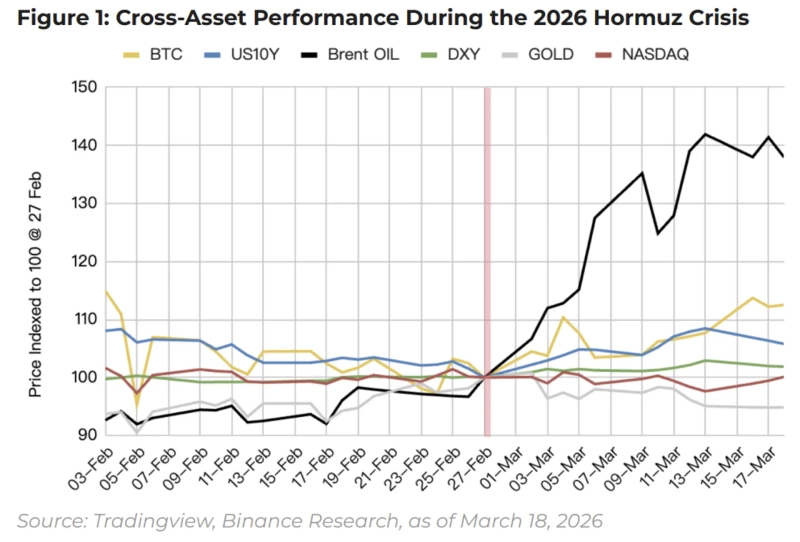
A surge in international oil prices driven by the Middle East conflict appears to have increased Bitcoin’s (BTC) short-term volatility. However, the analysis says institutional demand—such as through exchange-traded funds (ETFs)—absorbed part of the shock stemming from oil-price volatility.
Binance Research, the research arm of global cryptocurrency exchange Binance, said in a report titled “The Mechanism of Oil Prices’ Impact on Bitcoin,” released on the 25th (local time), that “Bitcoin’s response pattern to oil shocks can be summarized as ‘short-term volatility amplification followed by independent price formation over the medium term.’” Binance Research added that “both the 2022 Russia-Ukraine war and the 2026 Hormuz crisis showed the same two-stage structure,” analyzing that “after volatility rose for 1–3 days immediately following the shock, Bitcoin traded according to its own fundamentals.”
The report also found that institutional demand functioned as a shock absorber. Binance Research said that during the crisis period—from the 2nd to the 17th of this month—spot Bitcoin ETFs saw net inflows of $1.7 billion, adding that three independent demand channels—ETF inflows, buying in the U.S. spot market, and corporate accumulation—jointly absorbed the macro shock and then propelled the subsequent rally.
Binance Research’s assessment is that international oil prices do not determine the direction of Bitcoin’s price. “Oil shocks raise Bitcoin’s short-term volatility but do not determine the direction of returns,” it said, adding that “in the current structure where institutional flows form the market’s backbone, geopolitical events such as oil-price spikes are more likely to create entry opportunities for asset allocation rather than serving as persistent risk factors.”
Binance Research added that “if this structure is destabilized by a policy reversal, a credit event, or a broad liquidity crisis, Bitcoin’s macro sensitivity could increase again.”

JOON HYOUNG LEE
gilson@bloomingbit.ioCrypto Journalist based in Seoul