KOSPI falls for a second day on ceasefire uncertainty and fallout from Turbo Quant
Summary
- The KOSPI closed down for a second day, weighed by uncertainty over U.S.-Iran ceasefire talks and the impact of Google’s “Turbo Quant.”
- In the main board market, foreign investors net sold 3.877 trillion won, while institutions and individuals posted net buying of 777 billion won and 2.713 trillion won, respectively.
- On the KOSDAQ, Pearl Abyss surged, jumping nearly 50% over four sessions, while the won-dollar exchange rate ended slightly higher at 1,508.9 won.
Forecast Trend Report by Period


KOSDAQ gains
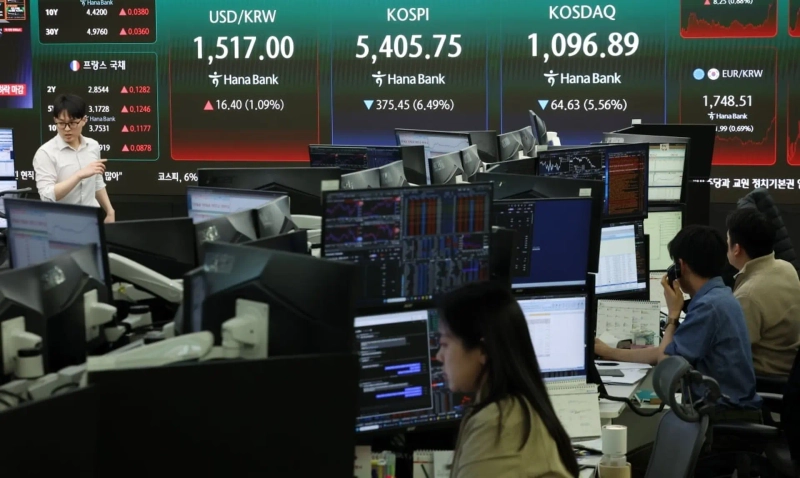
The KOSPI fell for a second straight session as uncertainty over U.S.-Iran ceasefire talks and weakened investor sentiment toward semiconductor stocks following Google’s “Turbo Quant” weighed on the market.
On the 27th, the KOSPI closed at 5,438.87, down 21.59 points (0.4%) from the previous session. After opening down 2.93%, the index slid to the 5,220 level early in the session before turning positive at one point intraday on heavy buying by individual investors. It later failed to shake off uncertainty ahead of the weekend and finished lower.
The decline was attributed to cooling risk appetite as President Donald Trump kept up pressure on Iran.
Trump further stepped up his rhetoric toward Iran, saying it would be “better to get serious before it’s too late.” At the first Cabinet meeting held since the outbreak of the Iran war, he also issued a threat, saying, “Without any interference, we will keep hitting them.”
Iran, for its part, said it is “reviewing the U.S. proposal, but Iran has no intention of talking with the United States.”
Selling in Korea’s semiconductor sector also weighed on the index after Google suggested the potential of its “Turbo Quant” technology, which could reduce memory demand by up to sixfold.
In a paper released the previous day, Google introduced a new artificial intelligence (AI) compression algorithm called “Turbo Quant.” The technology compresses data to one-sixth its size while keeping accuracy unchanged.
Google said it can sharply reduce the amount of memory required for large language models (LLMs) to deliver the same performance.
In the main board market, foreign investors net sold 3.877 trillion won worth of shares. Institutions and individuals posted net buying of 777 billion won and 2.713 trillion won, respectively.
Moves among top KOSPI market-cap names were mixed. Samsung Electronics and SK hynix fell 0.22% and 1.18%, respectively, to 179,700 won and 922,000 won. SK Square, Hanwha Aerospace and Doosan Enerbility also all dropped in the 2% range.
In contrast, Hyundai Motor (1.02%), LG Energy Solution (2.6%), Samsung Biologics (1.32%) and Kia (0.71%) rose. Hanwha Solutions, which announced a large-scale rights offering, extended losses with a 3.13% decline after plunging more than 18% the previous day, bringing its two-day drop to over 20%. Hotel Shilla surged 13.11% on news that management bought company shares.
The KOSDAQ, meanwhile, rose. The index closed at 1,141.51, up 0.43% from the previous session. On the KOSDAQ market, institutions and individuals posted net buying of 5.1 billion won and 17.0 billion won, respectively, while foreigners were net sellers by 23.4 billion won.
On news that sales of “Crimson Desert” are off to a strong start, Pearl Abyss extended gains, surging 15.75%. The stock has jumped nearly 50% over the past four sessions.
The won-dollar exchange rate edged up. In the Seoul foreign exchange market, the won-dollar rate closed daytime trading at 1,508.9 won, up 1.9 won from the previous session.
Noh Jeong-dong, Hankyung.com reporter dong2@hankyung.com

Korea Economic Daily
hankyung@bloomingbit.ioThe Korea Economic Daily Global is a digital media where latest news on Korean companies, industries, and financial markets.