[Analysis] "Bitcoin short-term holder share falls below 4%...market nearing a bottom"
Summary
- MAC D said Bitcoin’s short-term holder (STH) share fell below 4% to 3.98%, a trajectory similar to market-bottom zones based on past cycles.
- However, he noted that if capitulation occurs, Bitcoin could plunge 20–30% in a single day, so a staggered-buying strategy and opportunity costs should be considered together.
- He said that even amid coupling with U.S. equities, Bitcoin has shown stronger gains in rebound phases, and that if spot ETF net inflows and futures open interest (OI) rise in tandem, it could be read as a signal of entry into a full-fledged bullish cycle.
Forecast Trend Report by Period


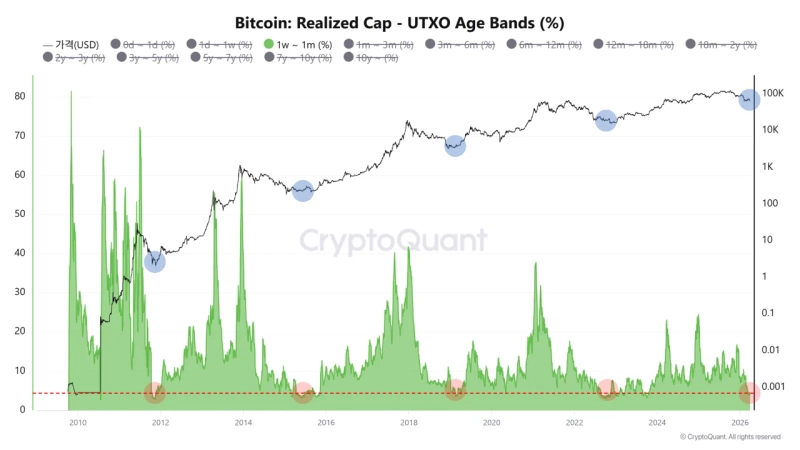
The share of Bitcoin (BTC) short-term holders (STH) has recently fallen below 4%.
MAC D, a CryptoQuant contributor, said via CryptoQuant on the 31st (local time) that "the share of short-term holders who have held Bitcoin for one week to one month has now declined to 3.98%," adding that "in past cycles, when this share dropped below 4%, it often coincided with market-bottom zones." MAC D noted that "as a cycle progresses, the share of long-term holders tends to rise naturally," and said that "the current reading can be interpreted as a meaningful signal that the market is nearing a bottom."
He also advised that downside pressure warrants caution. MAC D pointed out that "if capitulation occurs, Bitcoin can still plunge 20–30% in a single day," adding that "such declines often unfold as a sharp drop over a short period followed by a rapid rebound within minutes, making it very difficult to pinpoint the exact bottom." He continued, "Therefore, rather than trying to time the bottom in one shot, employing a staggered-buying strategy is a realistic approach," and added that "if the market rebounds, the opportunity cost of failing to buy in the current zone should also be taken into account."
He also mentioned the coupling with U.S. equities. MAC D said, "Bitcoin still shows a degree of linkage with the U.S. stock market," adding that "it tends to weaken alongside equities when stocks fall, but in rebound phases it has recently been rising more strongly." He continued that "this pattern was frequently observed in the bottom zones of past cycles," and said that "it suggests that, from a supply-demand perspective, buying pressure is gradually strengthening."
MAC D added, "If we see spot exchange-traded fund (ETF) inflows and the scale of futures open interest (OI) increase simultaneously going forward, it can be interpreted as a signal not just of a simple bottoming process but of entry into a full-fledged bullish cycle."

JOON HYOUNG LEE
gilson@bloomingbit.ioCrypto Journalist based in Seoul