"Forceful opening of the Strait of Hormuz"… UAE urges military action
Summary
- It reported that the United Arab Emirates (UAE) is urging a military role, including mine-clearing, and the formation of a military coalition to reopen the Strait of Hormuz.
- It said Brent crude futures for May delivery closed at $118.35 a barrel, up 4.94% from the previous session, and jumped 63% over March.
- It noted that after U.S. forces withdraw, security in the Strait of Hormuz is likely to become more uncertain and oil-price volatility is likely to persist.
Forecast Trend Report by Period


Proposes coalition force to Europe and Asian countries
Brent crude posts record monthly surge in March
The United Arab Emirates (UAE) has begun urging multiple countries to undertake military operations to reopen the Strait of Hormuz. The move comes as Iran has effectively blocked the strait and the likelihood of the war ending has increased.
The Wall Street Journal (WSJ) reported on the 31st (local time) that the UAE is actively reviewing plans to play a military role—including mine-clearing—to reopen the strait. It is calling not only on Gulf states but also on countries in Europe and Asia to form a military coalition to lift the blockade. In parallel, it is pursuing diplomatic efforts to secure the adoption of a UN Security Council resolution guaranteeing free passage through the Strait of Hormuz.
This reflects the view that reopening the strait is directly tied to the Gulf states’ political and economic future. The WSJ said, “In the past, the UAE regarded Iran as a troublesome neighbor, but it changed its stance after seeing Dubai hotels and the airport bombed following the outbreak of war,” adding that it has a policy of being prepared for a showdown with Iran to reopen the strait. Iran has so far fired more than 2,500 missiles and drones at the UAE—more than the number of projectiles it launched toward Israel.
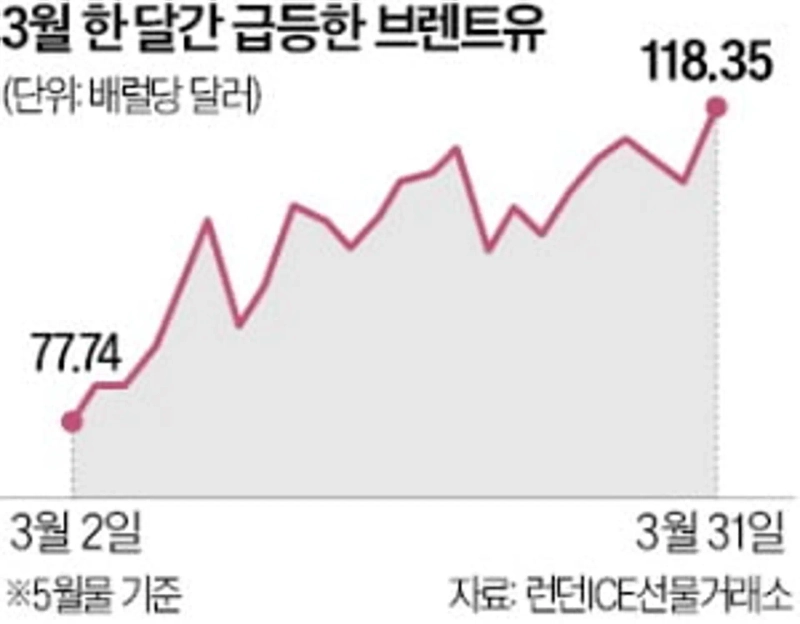
Meanwhile, Brent crude futures for May delivery closed at $118.35 a barrel, up 4.94% from the previous session. Brent gained 63% over March. That is the highest monthly increase since crude oil futures were introduced in 1988, far surpassing the previous record of 46% set in 1990 when Iraq invaded Kuwait.
The move is also seen as reflecting remarks by U.S. President Donald Trump that the war could end without securing safety in the Strait of Hormuz. After U.S. forces withdraw, security in the strait is likely to become even more uncertain, increasing the likelihood that oil-price volatility will persist.
Choi Man-soo, bebop@hankyung.com

Korea Economic Daily
hankyung@bloomingbit.ioThe Korea Economic Daily Global is a digital media where latest news on Korean companies, industries, and financial markets.