"Last Monday Was the Bottom"…Wall Street’s Growing Bottom-Call [Kim Hyun-seok’s Wall Street Now]
Summary
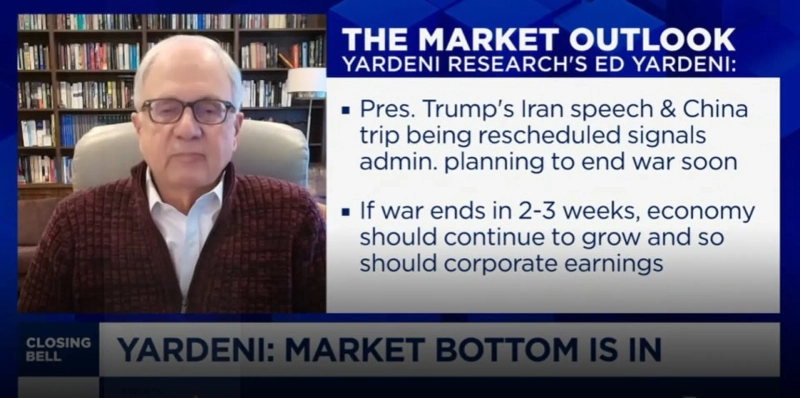
- Yardeni Research said it views last Monday as the market bottom and an inflection point, and is maintaining its year-end forecast of the S&P 500 at 7,700.
- It said that amid President Trump’s war-related remarks and the postponement of “Obliteration Day,” the worst-case scenario being pushed back is acting as a very strong positive for the market.
- Yardeni Research said the Magnificent 7 and tech stocks have entered a relatively cheap range as their P/E has fallen, and that it has shifted its view back to “market weight.”
Forecast Trend Report by Period


April 2 marked the first anniversary of “Liberation Day.” A year ago, President Trump announced extraordinarily high reciprocal tariffs. As stock and bond prices plunged, trillions of dollars were wiped out. Then, a week later on April 9, he said he would suspend the tariffs. That day alone, the S&P 500 rebounded 9.5%.
Wall Street hopes something like that can happen again. That’s why some are waiting for what’s dubbed “TACO” (Trump Always Chickens Out). Some argue the market bottomed last week. A prominent example is Ed Yardeni, founder of Yardeni Research. He said, “On April 9 last year, the market surged 10% when Trump suddenly postponed the ‘Liberation Day’ reciprocal-tariff measures. We’re seeing something similar now. In other words, ‘Obliteration Day’ has been postponed. He’s still making threats like attacking power plants, but the mere fact that the worst-case scenario has been pushed back is a very strong positive.”
President Trump said in a national address on the night of the 1st that the war had “entered the final stage.” He added, however, that if no agreement is reached he would strike hard for 2–3 weeks and “send Iran back to the Stone Age.”
Yardeni explained, “What matters is an ‘exit strategy.’ The market was deeply worried this war could drag on indefinitely. The clearest scenario was for President Trump to declare ‘we won’ and get out—and he acted that way in last night’s speech. That’s why I think last Monday was the bottom.”
On the 2nd, Iran’s IRNA news agency reported that “the Iranian government is drafting a new protocol to monitor ship passage through the Strait of Hormuz to be discussed with Oman.” Deputy Foreign Minister Kazem Gharibabadi said that if the protocol is approved, shipping companies would have to pay Iran a transit fee. In short, it was about creating rules to collect fees. If such a system is introduced, it would mean tankers and other vessels could pass through the strait by paying.
Yardeni spoke with CNBC on the 2nd. Here are his remarks.
▶Do you think the market has passed the bottom?
It’s true the market has swung quite a bit because of various comments by President Trump, but we have basically maintained our year-end forecast that the S&P 500 will reach the 7,700 level. We thought there could be a correction of about 10–15% along the way, and in fact the S&P 500 fell about 9% this time.
What matters is an “exit strategy.” That’s exactly what the market wanted. At first, it was very concerned the war could continue endlessly. That was because there was no clear exit path. The most obvious scenario was for President Trump to declare “we won” and pull out, and he acted that way in last night’s address. Various reports on Tuesday also pointed in that direction. So I view last Monday as the inflection point (the bottom).
▶What if oil prices stay quite elevated—even if the conflict doesn’t drag on?
Even if oil prices remain high at current levels, the U.S. economy can handle it. Because the United States exports oil and gas, there’s also a positive impact on the energy industry. In any case, one way or another, oil will come out of the Persian Gulf. Initially, there was analysis that 20 million barrels a day might not be supplied, but later we learned there are some pipeline bypass routes and also plenty of other oil floating in the market. So the shortfall has narrowed from 20 million barrels to around 10 million barrels.
In addition, there is news that Iran is coordinating ship passage through the strait and discussing a kind of scheduling. It’s effectively a step back from a hard-line response. (If it doesn’t do that) international pressure on Iran to “maintain order” will intensify.
▶President Trump said he would launch a stronger attack for another 2–3 weeks
Over the next 2–3 weeks, military pressure will still continue. Look back to a year ago. Around 3 p.m. on April 9—one week after “Liberation Day”—Trump postponed imposing reciprocal tariffs, and the market suddenly jumped 10%. I think something similar is happening now. In other words, “Obliteration Day” has been postponed. President Trump is still making threats like attacking power plants, but the mere fact that the worst-case scenario has been pushed back is acting as a very strong positive for the market.
▶If we’ve passed the bottom, do you expect a rebound in tech stocks to continue?
I definitely do. Tech stocks have become relatively cheap again. We said on December 7 last year it was time to cut the weighting of the “Magnificent 7.” But the price-to-earnings ratio (P/E) that was 31 times then has fallen to 25 times, and in recent days it even dropped to 22 times. So we recently moved our rating on the Magnificent 7 and the broader tech sector back to “market weight” (neutral). We think tech is now at a relatively attractive valuation. In short, the answer is “yes.”
New York=Correspondent Kim Hyun-seok realist@hankyung.com

Korea Economic Daily
hankyung@bloomingbit.ioThe Korea Economic Daily Global is a digital media where latest news on Korean companies, industries, and financial markets.