AST SpaceMobile Surges 375% in a Year on SpaceX IPO Hopes
Summary
- ASTS has drawn attention as a next-generation low-Earth orbit satellite communications infrastructure company, with its stock surging 375% over the past year and revenue soaring.
- The company is viewed as technologically competitive and as an indirect beneficiary of SpaceX IPO hopes, supported by 95% vertical integration in satellite components, its own ASIC chip, and use of SpaceX’s Falcon 9.
- Still, risks remain high, including an annual operating loss of $287.71 million, the early stage of satellite commercialization, and the need for FCC approval and global spectrum access, making close monitoring of launch schedules and quality control essential.
Forecast Trend Report by Period


Hot Pick! Overseas Stocks
AST SpaceMobile Up 375% in a Year
Direct-to-Smartphone Links Without Extra Devices
95% Vertical Integration in Components Is a Key Strength
In-House Chip Boosts High-Speed Data Processing
Revenue Has Soared, but Commercialization Remains a Challenge
Annual Operating Loss Reached $287.71 Million
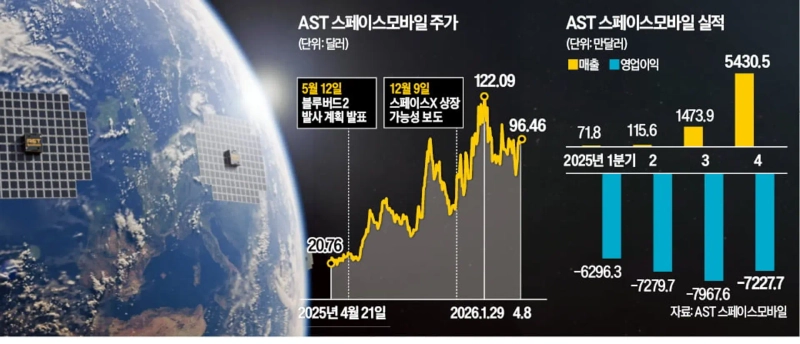
AST SpaceMobile Inc. has extended a powerful rally in US trading, drawing investor attention as a next-generation communications infrastructure company built around low-Earth orbit satellites. Optimism tied to a potential initial public offering by Elon Musk’s SpaceX has also lifted sentiment. Even so, heavy losses and technological uncertainty remain, leaving the success of satellite launches as a key driver for the stock.
Shares Climb 375% Over One Year
ASTS rose 4.2% to close at $96.46 in New York trading on June 8. The stock has retreated from its peak of $122.09, but it is still up 375% from about $20 a year ago. After struggling for years following its 2019 listing, the shares began a sharp rally in the second half of last year after the company successfully launched commercial satellites. In South Korea’s ETF market, KODEX US Space Aerospace holds about 14% of the stock, while 1Q US Space Aerospace Tech holds about 10%.
AST SpaceMobile is building a space-based communications network that enables smartphone service in areas without terrestrial base stations. Its core technology connects existing smartphones directly to low-Earth orbit satellites. That distinguishes it from conventional satellite communications, which typically require separate antennas or dedicated terminals. The company has partnerships with more than 50 mobile carriers worldwide, giving it access to a subscriber base of about 3 billion people.
Its technology is also a major investment draw. AST SpaceMobile makes 95% of its satellite components in-house through a vertically integrated structure designed to lower costs and improve performance. The company also uses internally designed application-specific integrated circuits, or ASICs, providing about 10 gigahertz of processing bandwidth per satellite. That has been cited as a key factor in raising data transmission speeds.
Some investors also view AST SpaceMobile as an indirect beneficiary of a potential SpaceX listing. The company does not have its own launch vehicle and uses SpaceX’s Falcon 9 rocket to send satellites into orbit. As SpaceX pursues a listing with a target valuation of $1.75 trillion, expectations for the broader space industry have increased. AST SpaceMobile competes with Starlink Mobile, though investors generally expect the overall market to keep expanding quickly.
Satellite Commercialization, Spectrum Access Remain Challenges
The company’s revenue has also risen sharply. Sales increased from $718,000 in the first quarter of last year to $1.156 million in the second quarter and $14.739 million in the third quarter. Fourth-quarter revenue reached $54.305 million, up about 2,731% from a year earlier. Equipment supply to mobile carriers and contracts with the US government drove the increase.
Still, the company remains in the early stages of commercialization. It needs at least 45 to 60 satellites to provide global service, but it has not yet reached that level. That means it may take time before the business can generate stable earnings.
Its loss-making structure remains a burden. AST SpaceMobile posted quarterly operating losses of about $60 million to $80 million last year. For the full year, operating loss totaled about $287.71 million. Heavy spending on satellite launches and expanded production has continued to weigh on earnings.
Brokerages say risk management remains critical despite the company’s growth potential. Kim A-ram, an analyst at Shinhan Securities, said launch schedules are the key variable for earnings visibility and investors should keep monitoring whether satellites are deployed successfully. Final approval from the Federal Communications Commission and the securing of global spectrum rights also remain unresolved. Park Ki-young, an analyst at Kiwoom Securities, said the company’s ability to manage component supply and quality control as it works toward producing six satellites a month will be a crucial factor for earnings visibility.
Park Ju-yeon, Hankyung.com reporter grumpy_cat@hankyung.com

Korea Economic Daily
hankyung@bloomingbit.ioThe Korea Economic Daily Global is a digital media where latest news on Korean companies, industries, and financial markets.