South Korea’s Digital Finance Ambitions Hinge on ‘Unlearning,’ Not Technology, Hashed Report Says
Summary
- Hashed Open Research said South Korea must rethink the existing financial system and embrace Unlearning and Relearning to emerge as a digital finance powerhouse in digital assets, real-world asset tokenization (RWA) and stablecoins.
- The report said broader institutional participation requires governance frameworks, regulatory clarity, external audits and accountability-based operating structures before market trust can form, and that blockchain must evolve to include error recovery, privacy and accountability structures.
- Hashed said EastPoint: Seoul 2025 functioned as a Web3-style learning platform where policymakers, industry and academia jointly mapped out the direction of the digital asset era, enabling a shift in thinking alongside substantive discussion and business connections.
Forecast Trend Report by Period


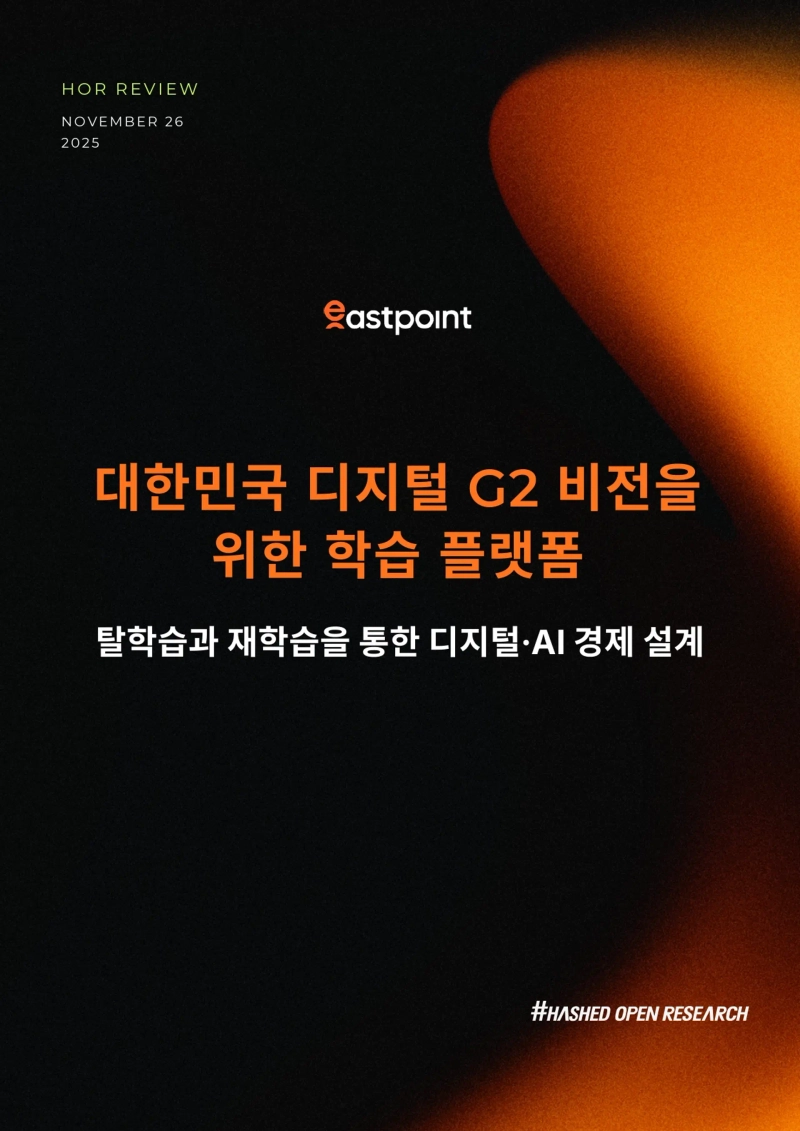
South Korea’s financial industry will strengthen its competitiveness not through faster technology adoption, but through a shift in mindset, according to a new analysis.
Hashed Open Research, or HOR, the think tank of blockchain investment firm Hashed, said in a report released May 15 that South Korea must first rethink how it views the existing financial system if it wants to become a digital finance powerhouse.
Drawing on discussions at last year’s EastPoint: Seoul 2025, the report defined the core of digital transformation as “unlearning” and “relearning.” It said South Korea needs to move beyond thinking shaped by existing systems and institutional inertia, and interpret digital assets, real-world asset tokenization, or RWA, and stablecoins from a new perspective.
The report also highlighted a gap with global trends. It said the US has made digital assets a central pillar of financial strategy through policy shifts, while South Korea remains in an early stage, still debating whether to adopt the technology.
HOR said a governance framework is essential to broaden institutional participation. Market trust, it said, depends on regulatory clarity, the ability to conduct external audits and operating structures built around accountability.
It added that blockchain must also evolve to meet institutional demand, including in error recovery, privacy and accountability structures.
HOR also pointed to EastPoint as a key example. Unlike traditional blockchain events, it said, the conference was designed around private roundtables involving policymakers, financial institutions and academia, allowing for deeper discussion of sensitive issues.
Participants moved between main sessions and roundtables as they reexamined regulatory frameworks and perceptions of the technology. HOR said that made the event a “Web3-style learning platform” that went beyond information-sharing and prompted a broader shift in thinking.
A Hashed official said the event’s 503 participants, 63 speakers and more than 50 business meetings showed that substantive discussion and business connections took place at the same time. The official added that EastPoint served as a platform where policymakers, industry and academia jointly mapped out the direction of the digital-asset era.

Suehyeon Lee
shlee@bloomingbit.ioI'm reporter Suehyeon Lee, your Web3 Moderator.