PiCK
Hashed Says Southeast Asian Governments, Institutions Are Embracing Tokenized Assets as Korea Awaits Regulatory Reform
Summary
- Governments and major financial institutions across Southeast Asia are moving to make tokenized securities (STOs), commodities and stablecoins central to national strategy.
- South Korea's positive regulatory framework has slowed institutional moves, but the industry is waiting for the market to open with passage of the Digital Asset Basic Act.
- Capital markets built on Ethereum are expected to become more sophisticated over the next two to three years, with attention also on possible market restructuring in the second half, including crypto exchange M&A and diversified asset issuance channels.
Forecast Trend Report by Period


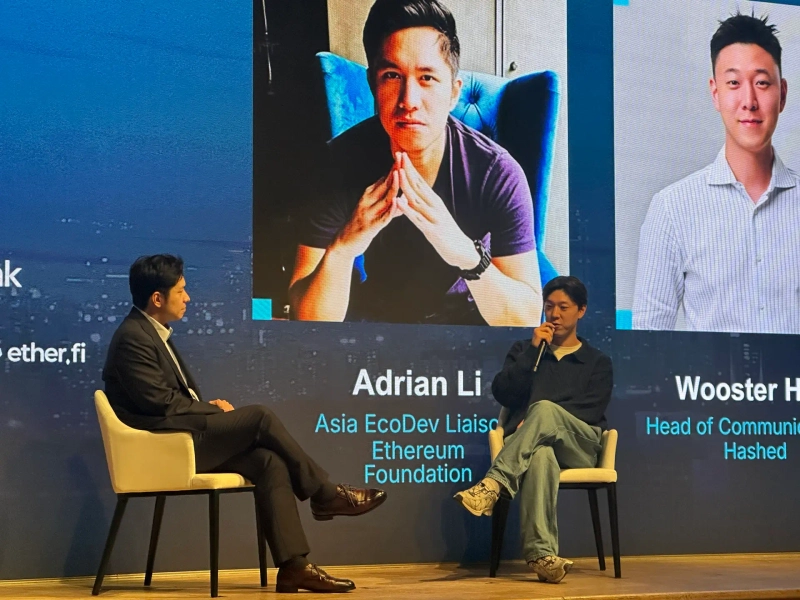
Global venture capital firm Hashed offered a detailed assessment of accelerating institutional entry into Web3 in Southeast Asia and evolving regulatory conditions in South Korea.
Speaking at the ETHCapital Summit held at Raum Art Center in Seoul's Gangnam district on April 15, Han Sang-woo, Hashed's communications lead, said governments and major financial institutions across Southeast Asia are making a broad push to place tokenized securities, commodities and stablecoins at the center of national strategy.
He added that practical use cases by local institutions could be seen at Southeast Asia Blockchain Week, which Hashed will hold in May in partnership with SCBX, Thailand's largest financial group.
Han also contrasted South Korea's regulatory approach with that of Western markets. In the US and other Western countries, institutions can run early experiments under risk controls even without explicit regulations, based on the principle that anything not prohibited is allowed, he said. South Korea, by contrast, has a strong positive-regulation framework under which only explicitly permitted activities are allowed, making institutions slower to move.
Still, South Korean institutional investors began to gain strong conviction about entering the market last year, according to Han. The industry is now waiting for the market to open after passage of the Digital Asset Basic Act, much as it did in Hong Kong, he said.
Han said the Ethereum ecosystem is more than a simple asset market. It is a vast open-source community where multiple valuation models coexist, including staking yields, platform assets and products. He said capital markets built on Ethereum would become more sophisticated over the next two to three years.
He also pointed to the possibility of market restructuring in the second half of the year, including mergers and acquisitions among virtual-asset exchanges and a diversification of asset-issuance channels.
Adrian Lee, the Ethereum Foundation's APAC ecosystem development lead, joined the discussion and echoed Han's view. With noise in the retail market subsiding, now is instead the right time for institutions and governments to focus seriously on building, he said.

Doohyun Hwang
cow5361@bloomingbit.ioKEEP CALM AND HODL🍀