Avalanche Accelerates Stablecoin Push From AI Agent Payments to Cross-Border Trade
Summary
- Avalanche is expanding its Layer 1 blockchain offering for businesses to accelerate stablecoin ecosystem expansion.
- KITE AI, Fosun Wealth and Axiym presented Avalanche-based use cases in AI agent payments, RWA-backed stablecoin (FUSD) and global remittance infrastructure.
- Speakers said stablecoins could serve as a tool for liquidity provision, reducing the cost and time of cross-border trade and remittances, and building a controllable payment infrastructure.
Forecast Trend Report by Period



Avalanche is expanding its stablecoin ecosystem by promoting custom Layer 1 blockchains for businesses as a key advantage. The network is already producing real-world stablecoin use cases on blockchains built with Avalanche.
Kim Yong-il, Avalanche’s head of Asia business, said at the "The Frontier: Global Business Strategy in the Stablecoin Era" summit held at IFC The Forum in Seoul’s Yeouido on Aug. 15 that blockchain is moving beyond a tool for new business initiatives or marketing. It is becoming a way to solve companies’ core business problems. In the future, every company will have its own Layer 1 blockchain tailored to its business and the stablecoin infrastructure to support it, he said.
The summit also showcased companies that have built stablecoin infrastructure on Avalanche and are already providing services. The cases presented included AI agent payments, real-world assets, or RWAs, and trade settlement.
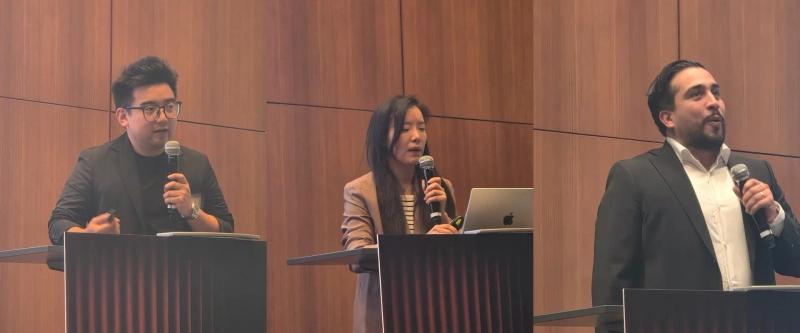
Sonia Zhang, Korea head of KITE AI, said stablecoins are the most suitable payment tool for automated payments by AI agents. KITE AI is an AI-focused Layer 1 built on Avalanche.
AI has already reached a stage where it can carry out a wide range of tasks, Zhang said. But payment infrastructure is still designed for humans, making it difficult for AI to use. As transactions between AI agents become more common, stablecoins will emerge as a core payment method, she added.
A KITE AI agent demonstrated the ability to select food on Uber Eats, place an order and complete payment without human intervention. The system remains in the demo stage. Still, blockchain and stablecoins make it possible to set detailed payment conditions for AI, including spending limits, while keeping all transactions verifiable and under control, Zhang said.
Chen Zhao, executive director of digital assets at Fosun Wealth, said stablecoins are also needed in the RWA market. Fosun Wealth is an asset manager that issues FUSD, a yield-bearing stablecoin backed by RWAs, on Avalanche.
Many institutions entering the RWA market are focused on putting assets on-chain, Zhao said. But tokenization alone does not create liquidity. Tokenized assets need liquidity support in order to trade in practice.
Stablecoins can play that role, he added. Moving capital between on-chain markets and traditional financial markets remains difficult.
Speakers also presented stablecoin use cases in cross-border trade and remittances. Pahar Rasul, co-founder of Axiym, said international transfers currently pass through multiple intermediary banks, increasing both costs and settlement times. Using stablecoins would make trade faster and cheaper, he said.
Axiym is a fintech company building global remittance infrastructure on Avalanche.
Rasul said stablecoins can give institutions greater autonomy. Under the traditional financial system, institutions conducting foreign-exchange transactions for trade have had to go through central banks in each country, creating unnecessary settlement time and cost, he said. Stablecoins would allow banks to connect directly with counterpart financial institutions, choose the venue offering the best terms and settle immediately.
"The core of stablecoins is not speed, but control," Rasul said. They can become infrastructure that makes the overall trade-settlement system more efficient.

Uk Jin
wook9629@bloomingbit.ioH3LLO, World! I am Uk Jin.