XRPL Built for Korea’s Regulatory Environment, Could Serve as Institutional Infrastructure, XRPL Korea Says
Summary
- Jake Ku said XRPL is a public layer-1 blockchain launched in 2012 and uses XRP as its native token.
- He said XRPL includes compliance-related features such as Trustline, RequireAuth, Freeze and Clawback, making it usable for issuing stablecoins and real-world assets (RWA).
- XRPL Korea said it is promoting digital-asset-based business initiatives and investment support for traditional financial institutions and Web2 companies through the K-FI 2026 acceleration program.
Forecast Trend Report by Period


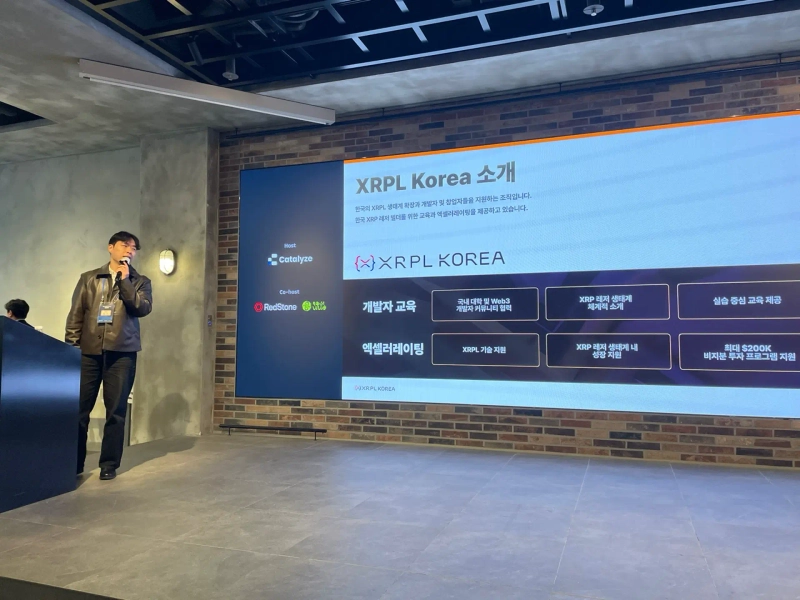
AI/InfraCon, an event focused on applications of AI and Web3 infrastructure, was held on May 15 at Dreamplus in Seoul’s Gangnam district. The event was part of BUIDL Week and featured discussions on perpetual decentralized exchanges, real-world assets, stablecoins and AI agents. Jake Ku, growth head at XRPL Korea, gave a presentation titled “Building Digital Asset Businesses on XRPL.”
Ku used the presentation to distinguish between Ripple, XRP and the XRP Ledger, or XRPL, while outlining the network’s technical structure. XRPL is a public layer-1 blockchain launched in 2012. Ripple is the company developing financial solutions based on the network, and XRP is the blockchain’s native token.
XRPL was designed as a non-EVM blockchain, meaning it is not compatible with the Ethereum Virtual Machine. Rather than allowing developers to deploy smart contracts directly, it uses Python- and JavaScript-based libraries to call functions. Ku said that structure improves accessibility for developers. The network relies on validators that operate without separate rewards, including universities, companies and financial institutions. Transactions are finalized in about three to five seconds.
Ku also highlighted compliance-related features. XRPL uses a trustline structure that requires prior approval before users can receive tokens from a specific issuer. The mechanism restricts the transfer of unsolicited tokens and resembles contract-based transactions between financial institutions.
The protocol also includes RequireAuth, which allows only approved accounts to receive assets; Freeze, which can halt assets when suspicious transactions occur; and Clawback, which allows issuers to recover leaked assets. Ku said those features can technically support know-your-customer and anti-money-laundering requirements in the issuance of stablecoins and real-world assets.
He also said XRPL provides automated market maker, or AMM, and decentralized exchange, or DEX, functions at the network layer. That, he added, could allow companies to explore digital-asset use cases within regulatory boundaries.
XRPL Korea also introduced its ecosystem expansion strategy through the K-FI 2026 acceleration program. The program is designed to provide education and networking for traditional financial institutions and Web2 companies considering digital-asset-based businesses.
Current partners include Industrial Bank of Korea, Toss, KPMG and law firm Bae, Kim & Lee. The program will also provide investment support through venture capital networks. A demo day for teams advancing to the final round is scheduled for June 25 at IFC in Yeouido.

Minseung Kang
minriver@bloomingbit.ioBlockchain journalist | Writer of Trade Now & Altcoin Now, must-read content for investors.