LayerZero to Pursue Gold Tokenization With Korea Gold Exchange, Launch ‘Zero’ Mainnet This Year
Summary
- Alex Lim, LayerZero's head of Asia, said stablecoins and real-world asset tokenization (RWA) are driving a structural shift in global financial infrastructure.
- LayerZero said it will work with Korea Gold Exchange to advance tokenization of physical gold and expand blockchain-based conversion of real-world assets including stocks, bonds and real estate.
- LayerZero said it plans to launch its Layer 1 blockchain Zero this year, with 100 times the performance of existing systems, to build on-chain infrastructure for institutional capital and trillions of dollars in assets.
Forecast Trend Report by Period


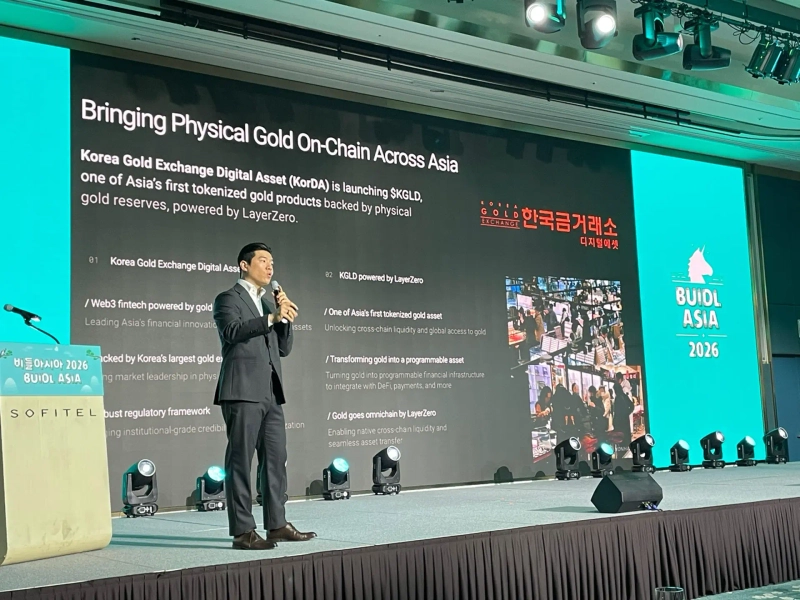
"Stablecoin transaction volumes have already surpassed legacy payment networks such as Visa, showing that the way value is transferred is changing," Alex Lim, LayerZero's head of Asia, said at BUIDL Asia 2026 in Seoul on June 16. "Stablecoins and real-world asset tokenization are not a passing trend. They represent a structural shift in global financial infrastructure."
BUIDL Asia 2026, attended by major Asian blockchain projects and developers, was held at Sofitel Ambassador Seoul on June 16. In his keynote address, Lim said stablecoins and real-world assets are fundamentally reshaping how capital moves.
Stablecoin payment volumes have been exceeding those of major card networks since 2024, Lim said. As of January, monthly transaction volume had surpassed $10 trillion. He added that the figure is significant even relative to global GDP and underscores a shift in the center of gravity for money flows.
Lim also pointed to inefficiencies in the traditional financial system and highlighted the potential for stablecoins to expand real-time settlement. Traditional finance has long relied on complex intermediaries and delayed settlement systems. Stablecoins are shifting that structure toward real-time settlement and changing the financial experience, he said. In Asia, particularly in Singapore, Hong Kong and Japan, stablecoins tied to national currencies are gaining traction, a trend he said could eventually influence the structure of foreign-exchange markets.
LayerZero also unveiled plans to work with Korea Gold Exchange on tokenizing physical gold on blockchain. Lim said he expects the partnership with Korea Gold Exchange, which leads South Korea's gold market, to become a flagship Asian example of gold tokenization. Beyond gold, the company plans to expand blockchain-based conversion of real-world assets including equities, bonds, real estate, commodities and private equity. Gold trading has historically been conducted largely offline, but tokenization could significantly improve accessibility and reshape distribution and trading.
LayerZero is promoting its OFT standard, a framework designed to connect assets across multichain environments. Hundreds of asset issuers have adopted the standard, supporting transfers across more than 100 chains, Lim said. The system uses a burn-and-mint structure to move assets, helping ease liquidity fragmentation. He added that LayerZero uses a validator network to improve messaging reliability and gives institutions a structure that allows them to retain direct control over their assets.
The company also laid out plans to launch its own Layer 1 blockchain, Zero, within the year. Traditional financial institutions and large asset managers need infrastructure that can meet institutional requirements, Lim said. LayerZero is focused on building an environment where global assets can trade on-chain. Zero is targeting performance 100 times higher than existing systems and is designed to accommodate institutional capital. The company is preparing for a market in which assets worth trillions of dollars trade on-chain.

Minseung Kang
minriver@bloomingbit.ioBlockchain journalist | Writer of Trade Now & Altcoin Now, must-read content for investors.