OpenGradient Says AI Needs Verifiability, Not Just Performance, to Earn Trust
Summary
- OpenGradient said it is building a verifiable AI infrastructure that ensures the integrity of AI outputs by separating computation from verification.
- OpenGradient said applying AI models to a Uniswap V4 AMM to adjust dynamic fees reduced impermanent loss for liquidity providers by about 16% to 17%.
- OpenGradient said it plans to boost network reliability by introducing a system that uses the OPG token to slash nodes that submit incorrect computation results.
Forecast Trend Report by Period


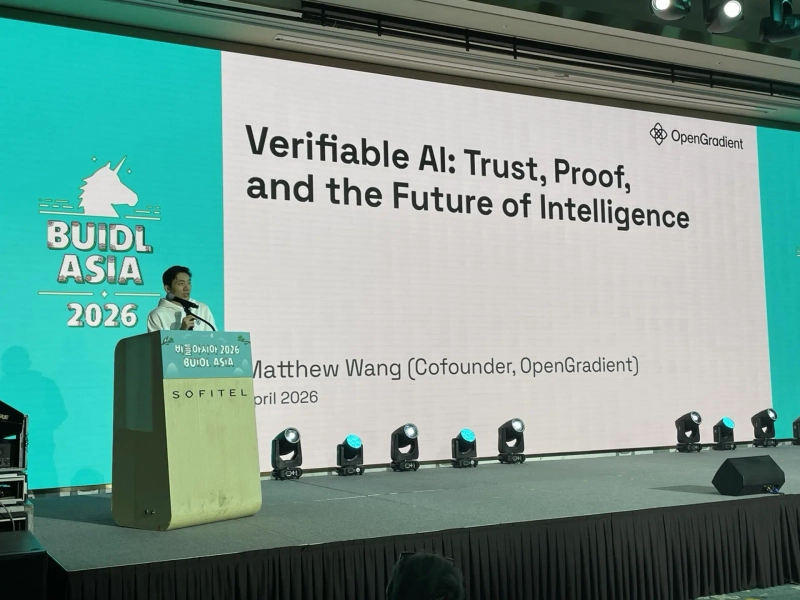
“As AI takes on more decision-making, what matters is no longer performance but verifiability. Without verification, users cannot know whether a cheaper model has been substituted or whether data has been distorted. We are building infrastructure that guarantees the integrity of results by separating computation from verification.”
BUIDL Asia 2026 was held at Sofitel Ambassador Seoul on April 16. In a keynote speech, OpenGradient co-founder Matthew Wang said verifiability is becoming a core infrastructure requirement as AI becomes more deeply involved in personal data and corporate decision-making.
He said users should be able to verify which model and data were used when an AI agent generates a research report. In a system that cannot be verified, the output is difficult to trust, he added.
To address that, OpenGradient has introduced what it calls a node-specialization architecture. Computation is handled on an infrastructure layer made up of GPU and trusted execution environment, or TEE, nodes, while results are verified on a blockchain layer.
Wang said the structure allows high-cost computation to be processed in one environment and verification to be carried out on a low-cost blockchain, securing both efficiency and trust. A TEE is a secure enclave that performs computation while protecting data from external access.
Wang also presented real-world use cases. OpenGradient said it applied AI models to a Uniswap V4 automated market maker, or AMM, to adjust dynamic fees, reducing impermanent loss for liquidity providers by about 16% to 17%.
In the Filecoin ecosystem, the technology is also being used to improve incentive distribution by evaluating node performance. Impermanent loss refers to the potential loss liquidity providers incur from price swings compared with simply holding the assets.
OpenGradient’s model hub has expanded into a platform offering more than 4,000 AI models. Wang said the company is building an environment where developers can easily use a range of models and integrate them into decentralized applications in verifiable form.
The company also introduced personalized AI services, including wallet-based portfolio management agents and services that create digital twins by integrating user data. Wang said TEE-based computation keeps personal data fully protected and accessible only to the user.
OpenGradient also unveiled a token economy model aimed at strengthening security. The company plans to use its OPG token to slash nodes that submit incorrect computation results.
Wang said economic incentives that enforce accurate computation and verification would improve network reliability.
“What matters more than making AI smarter is making AI trustworthy,” he said. “Verification and privacy need to be solved at the infrastructure layer for AI to be used safely across finance and industry.”

Minseung Kang
minriver@bloomingbit.ioBlockchain journalist | Writer of Trade Now & Altcoin Now, must-read content for investors.