Bitcoin Touches $75,000 on Ceasefire Hopes; Ethereum Accumulation Builds, XRP Rebounds
Summary
- Bitcoin rebounded as $75,000, easing Middle East risks, inflation data, rate-cut expectations, and hopes for regulatory clarity came together.
- Ethereum is showing signs of structural strength as the $2,300 level, the long-term investment case, staking and DeFi use, rising buying pressure, and leverage unwinding converge.
- For XRP and Humidify, real-world use expectations, spot-led accumulation, a 70% drop in open interest, key support and resistance zones, and a volume-driven speculative rally are the main variables.
Forecast Trend Report by Period


**
<Lee Su-hyun's Coin Radar> is a weekly column tracking the cryptocurrency market and explaining the forces behind it. It goes beyond listing price moves to analyze global macro issues and investor behavior, offering insight into where the market may be headed.
Major Coins
1. Bitcoin (BTC)
Bitcoin rebounded this week and briefly touched $75,000. As of June 17, it was trading near $74,000 on CoinMarketCap.
The rally appears to reflect a familiar mix of macro tailwinds. Hopes for easing tensions in the Middle East improved market sentiment. In an interview with Fox Business on June 14, US President Donald Trump said the war would end soon and oil prices would fall sharply once it did. The White House also said negotiations were progressing productively, adding to expectations for lower regional tensions. West Texas Intermediate crude fell as low as $86 a barrel that day, pointing to some relief in energy costs. That reinforced hopes for softer inflation and supported Bitcoin.
Inflation data also helped calm markets. The US Bureau of Labor Statistics said on June 14 that the March producer price index rose 0.5% from the previous month, well below market expectations of 1.1%. From a year earlier, it rose 4%, also below the 4.6% forecast. Markets read the report as a sign that price pressures were not as hot as feared. Expectations for interest-rate cuts revived, helping fuel Bitcoin's rebound.
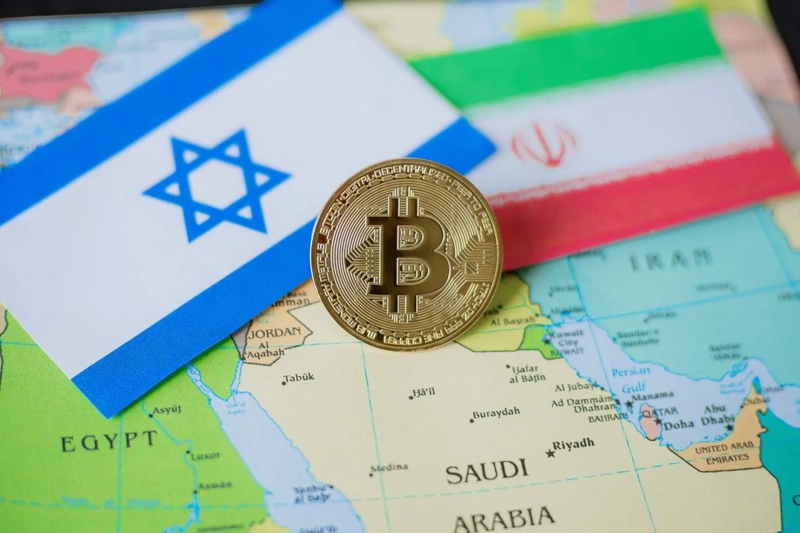
News of a 10-day ceasefire between Israel and Lebanon overnight also lifted investor sentiment. The truce was reported to have followed mediation efforts by Trump, who spoke directly with the leaders of both countries. Still, the ceasefire does not guarantee lasting stability. Hezbollah, the Iran-backed armed group in Lebanon, and Israel remain at odds over the terms, leaving room for renewed clashes. Trump also urged Hezbollah to avoid further killing and called for peace, highlighting lingering uncertainty around the negotiations.
On the regulatory front, negotiations over the CLARITY Act, a US crypto market structure bill, have entered the final stretch, according to JPMorgan. The bank said major sticking points had narrowed to two or three. Differences over stablecoin interest payments and supervisory authority have largely been resolved, reviving hopes for greater regulatory clarity. The US midterm elections in November remain a variable. With the campaign season set to intensify in the second half, the market increasingly views May or June as the window to move the bill forward.
For now, $76,000 is the key resistance level. Crypto analyst Michaël van de Poppe said a large number of sell positions had built up around that area, and a breakout could open the way to as high as $88,000. Wells Partners said inflation and rates remain the main variables. If disinflation continues, expectations for easier monetary policy could lift Bitcoin demand further.
2. Ethereum (ETH)

Ethereum has held relatively steady near $2,300. As of June 17, it was trading around that level on CoinMarketCap.
The most notable development for Ethereum this week was not its price action but renewed focus on the long-term investment case. At an Ethereum Korea One, or EK1, panel discussion held at DSRV's headquarters in Seoul on June 16, SharpLink CEO Joseph Chalom said he does not care at all about Ethereum's price yesterday, today or tomorrow. He described the investment as a bet on the future of finance, compared Ethereum with Amazon and Nvidia, and called it infrastructure capable of reshaping the financial system rather than just another asset.
Chalom also said the company is pursuing active strategies including staking Ethereum and deploying it in decentralized finance. That suggests institutional investors increasingly view Ethereum as both a long-term holding and a usable financial asset. He added that Ethereum has more than 1 million validators across over 80 countries, making it a network with the reliability and liquidity institutions value most.
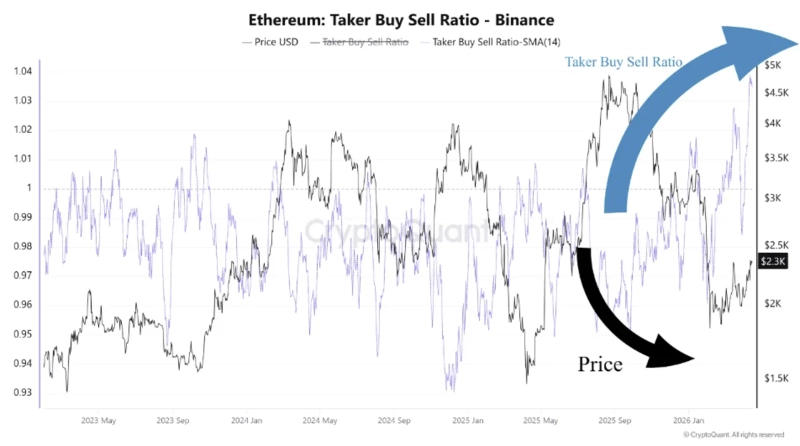
On-chain data also point to a recovery in buying interest. CryptoOnchain, a contributor to CryptoQuant, said buying pressure is increasing after Ethereum corrected from the $4,000 range to the $2,000 range. On Binance, the buy-to-sell ratio rose to 1.036, indicating buying has overtaken selling. CryptoOnchain described the current phase as one in which smart money is absorbing supply. In other words, prices have corrected, but accumulation at lower levels is taking place within the market.
In derivatives, excessive leverage is being cleared out. CryptoQuant contributor Amr Taha said open interest has declined on major exchanges including Binance and OKX. He characterized the move as a cleanup of overheated positions rather than a bearish turn. That points to healthier market structure than before.
In the near term, the key question is whether Ethereum can break above $2,400. NewsBTC analyst Aayush Jindal said a move through that level could open the way to $2,480, $2,550 and as high as $2,600. If $2,300 gives way, however, Ethereum could retreat to the low-$2,200 range. On-chain analytics firm Santiment also pointed to room for further gains from a sentiment standpoint. Santiment said investors view the roughly 19% rise over the past two weeks as a fake rally, and that skepticism itself could become fuel for another leg higher.
3. XRP

XRP broke out of its long-held $1.30 range this week and briefly climbed to the $1.40 level. As of June 17, it was still trading around $1.40 on CoinMarketCap.
The main driver was optimism over real-world use. On June 14, news that Japan's Rakuten is pushing to add XRP to its payment application boosted sentiment. Rakuten is a major platform with about 44 million users and more than 5 million merchants. If the payment function is introduced, XRP's real-world use base would expand. After the news broke, XRP rose from $1.32 to $1.38.
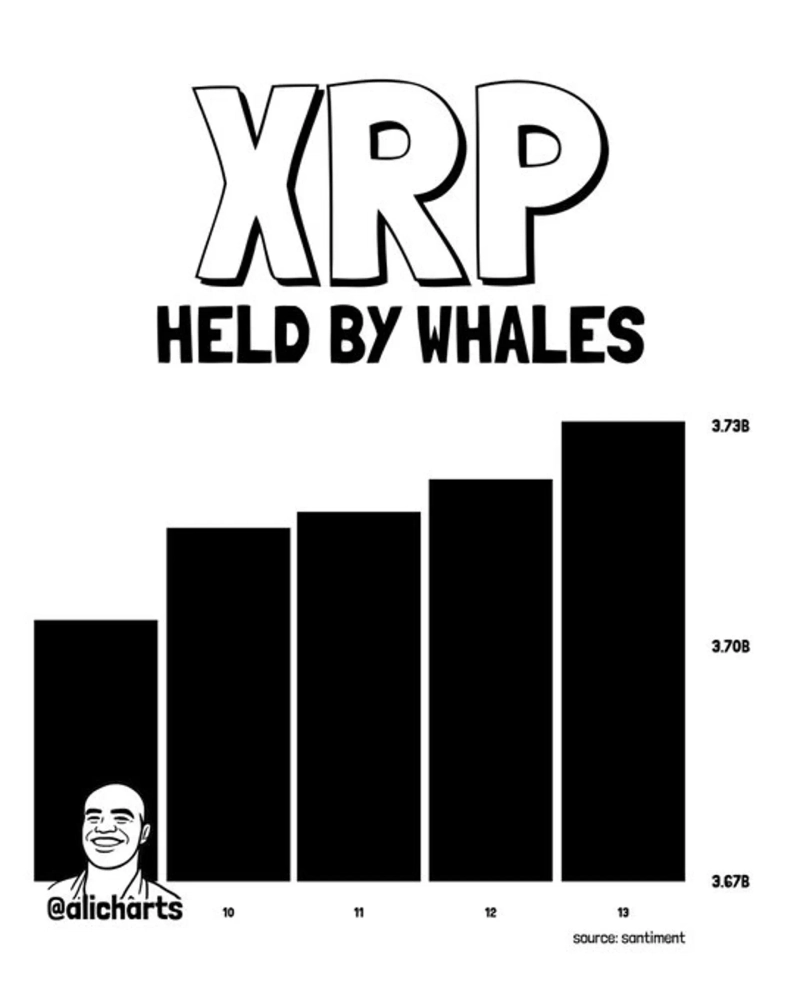
On-chain signals are mixed. Santiment data show whales accumulated about 20 million XRP last week. Transfers between large wallets have increased, suggesting market energy is building. Santiment said the pattern resembles accumulation seen ahead of past sharp rallies. But the derivatives market shows weaker speculative demand. According to Glassnode, open interest in XRP perpetual futures fell from about 7 billion XRP at one point to roughly 1.5 billion XRP now. That marks a decline of more than 70%, suggesting leveraged positions have been flushed out and new capital inflows remain limited. The current market structure points to stronger spot-led accumulation but weaker derivatives activity.
In the near term, $1.37 is the key support level. CoinDesk said the current uptrend could continue if that area holds. The $1.40 to $1.42 range is an important resistance zone that will help determine whether the trend can turn decisively higher. If XRP fails to break through that band, the move could remain a short-term bounce. A drop below $1.32 to $1.30 could send it back into its previous range.
Crypto market analyst Sam Daodu also laid out a more bullish scenario. He said that if XRP breaks above $1.45 and holds there, the next target could extend beyond $1.55.
Coin in Focus
1. Humidify (WET)
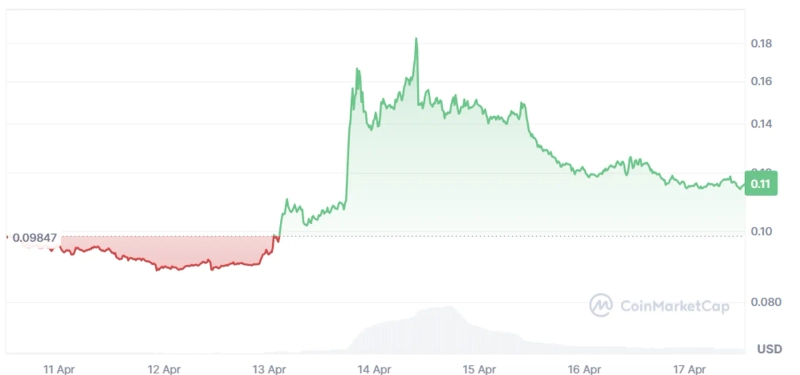
This week's coin in focus is Humidify (WET). The token rose about 16% over the past week on CoinMarketCap. On Upbit, it briefly surged 45%, drawing market attention. As of June 17, it was trading around $0.114 on CoinMarketCap.
The rally was not driven by any clear fundamental change or positive news catalyst. It was closer to a textbook speculative move fueled by trading volume. On June 14, the token rose 45% in 24 hours on Upbit alone, while trading volume jumped 1,332% to $160 million. A price surge accompanied by volume that is unusually high relative to market capitalization typically appears when fresh money rushes in and short-term momentum builds quickly.
Still, the move appears to have been driven more by flows than by any clear news catalyst or ecosystem change. That means the next move will depend on whether current trading volume can be sustained. If volume holds up, there may be room for further gains. If it fades quickly, volatility could increase, making volume the key factor to watch.

Suehyeon Lee
shlee@bloomingbit.ioI'm reporter Suehyeon Lee, your Web3 Moderator.