Shin Hyun-song Says Existing Framework Falls Short on Risk, Signals Bigger BOK Financial-Stability Role
Summary
- Governor Shin said he would reinforce the Bank of Korea’s financial-stability role by strengthening oversight of nontraditional financial products, the non-bank sector, and early-warning functions.
- Shin said he would discuss with relevant agencies ways to expand the Bank of Korea’s authority, including inspection and sanction powers over financial companies, to strengthen its financial-stability role.
- Shin said he would pursue cautious and flexible monetary policy to support price stability and financial stability, while continuing research and policy proposals on structural issues such as polarization, home prices, and household debt.
Forecast Trend Report by Period


Shin Hyun-song takes office as Bank of Korea governor
Plans broader access to non-bank data
Signals talks on inspection and sanction powers over financial firms
Vows cautious, flexible monetary policy
Says structural-reform research will continue
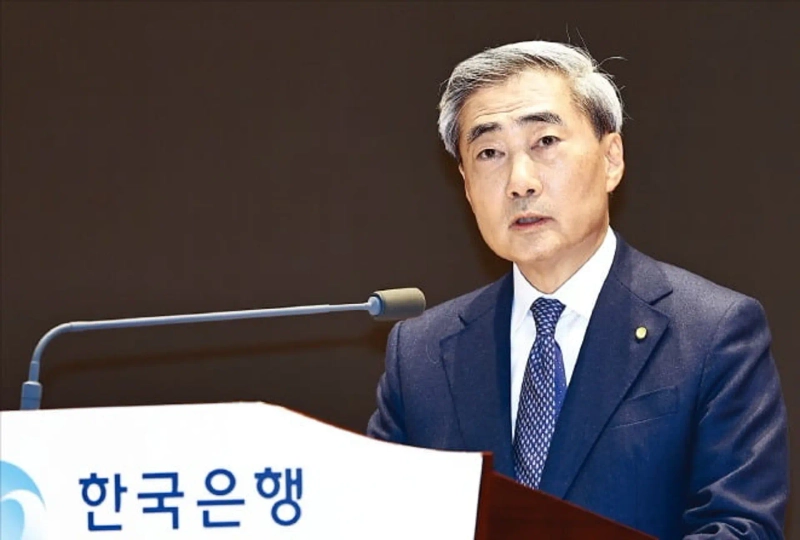
Shin Hyun-song, the new governor of the Bank of Korea, used his inaugural address to pledge stronger analysis of nontraditional financial products, including hedge fund products, and a more robust early-warning system as part of a broader push to reinforce the central bank’s role in safeguarding financial stability. He also said he would discuss with the government ways to expand the BOK’s authority to help stabilize financial markets.
At an inauguration ceremony at the BOK’s annex building on Namdaemun-ro in Seoul on April 21, Shin said the central bank would improve its access to information on the non-bank sector as that part of the financial system grows and connections across markets deepen. The scope of analysis also needs to widen to cover off-balance-sheet transactions at financial companies and nontraditional financial products, he said. He added that the BOK would make more active use of market-price indicators alongside existing prudential gauges to strengthen its early-warning function. That suggests the central bank aims to use not only stock prices, bond yields and the won-dollar exchange rate, but also soft data such as credit-card data in its early-warning system.
Shin said he would discuss with relevant agencies ways to strengthen the BOK’s financial-stability role, signaling that talks on giving the central bank broader supervisory powers could begin in earnest. That points to possible discussions over whether the BOK should also hold powers to inspect and sanction financial companies, authority now held by the Financial Services Commission and the Financial Supervisory Service. In his 2011 paper, “Macroprudential Policies Beyond Basel III,” Shin argued that preserving financial stability requires macroprudential tools covering the financial system as a whole, including lending by financial institutions and foreign-currency funding.
He said the case for expanding the BOK’s role reflects how much harder it has become to detect risks in financial markets under the existing regulatory system. Boundaries between banks and non-banks, and between domestic and overseas sectors, are eroding rapidly, he said. Financial markets are also becoming more tightly linked to asset markets, increasing their spillover effects on the real economy. That calls for a new perspective on financial stability, Shin said.
On monetary policy, Shin said uncertainty over the path of inflation and growth had increased further because of supply shocks stemming from the war in the Middle East. The BOK would pursue cautious and flexible monetary policy to support price stability and financial stability, he said. Shin also pledged to continue the structural-reform research emphasized by former Governor Rhee Chang-yong. Polarization, home prices and household debt are key structural variables shaping the environment for monetary policy, he said. The BOK will continue in-depth research and policy proposals on structural reform tasks, he added.
Shim Sung-mi, Hankyung.com reporter smshim@hankyung.com

Korea Economic Daily
hankyung@bloomingbit.ioThe Korea Economic Daily Global is a digital media where latest news on Korean companies, industries, and financial markets.