[Exclusive] Nvidia Camps Near Korean Plants as Big Tech Lines Up for AI Parts
Summary
- Korean component makers such as Samsung Electro-Mechanics and LG Innotek have emerged as key partners in the global AI supply chain and as “super suppliers.”
- Big tech companies are checking production schedules and factory utilization in real time to secure supply as high-performance parts such as FC-BGA and MLCC remain in short supply.
- With factories running at full capacity, pricing power is shifting to component makers, and the AI spillover effect is spreading to companies such as Isu Petasys, Daeduck Electronics and Amotech.
Forecast Trend Report by Period


Semiconductor INSIGHT
Without Korean Components, AI Grinds to a Halt
Electronic Parts Makers Come Into Their Own
Samsung Electro-Mechanics to Supply Broadcom With AI Substrates
Big Tech’s Key Partners Gain the Upper Hand in the Supply Chain
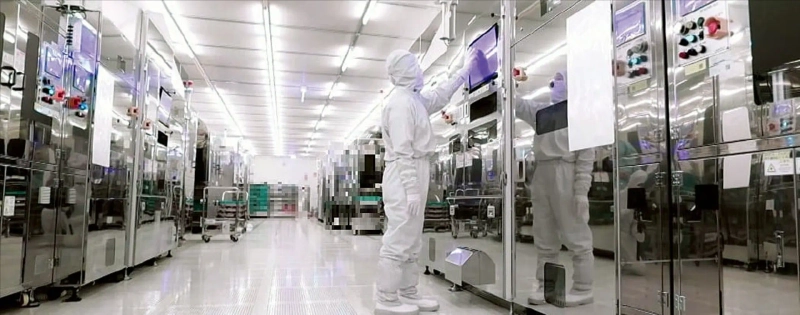
The artificial-intelligence boom is pushing South Korea’s electronic-component makers, not just memory chip companies, to the center of the global materials, parts and equipment supply chain. Samsung Electro-Mechanics Co. and LG Innotek Co. have emerged as key partners for big tech companies trying to ease AI bottlenecks. That marks a break from the old subcontracting model, in which parts makers depended on orders from finished-goods manufacturers. The shift has opened an era in which component suppliers hold the upper hand.
Samsung Electro-Mechanics has won Broadcom Inc. as a new customer for flip-chip ball grid array, or FC-BGA, substrates used in AI semiconductors, according to industry officials on April 21. Broadcom joins a customer list that already includes Nvidia Corp., Google, Amazon and Apple. Samsung Electro-Mechanics plans to begin supplying substrates for Broadcom’s cutting-edge AI accelerators in the second half of this year.
FC-BGA is a core component that connects semiconductor chips to mainboards and transmits electrical signals and power. Only a handful of companies can make the substrate, including Samsung Electro-Mechanics, LG Innotek, Japan’s Ibiden Co. and Shinko Electric Industries Co.
The multilayer ceramic capacitor, or MLCC, market is also undergoing a shake-up. Samsung Electro-Mechanics is supplying large volumes of ultra-high-capacity MLCCs for AI servers to Nvidia and other global big tech companies. AI servers use more than three to four times as many MLCCs as conventional servers. The parts must withstand high temperatures and high voltage, requiring advanced manufacturing technology. As a result, they sell for three to five times more than standard products. That helps explain why Korean companies with specialized technology, including Amotech Co., are fielding strong demand from big tech customers.
The global AI supply chain is also being recast in a way that cannot function without Korean component makers, according to industry officials. Korean companies hold specialized technologies that address the bottlenecks that determine AI accelerator performance.
“Korean companies have proved they have irreplaceable technology in high-performance substrates and materials, and they are now entering an unprecedented golden window,” an industry official said.
Korean Component Makers Become the Fix for AI Bottlenecks as Global Big Tech Queues Up
Samsung Electro-Mechanics and LG Innotek Rise as ‘Super Suppliers’ in the AI Boom
“Find out the production schedules at Samsung Electro-Mechanics and LG Innotek first.”
That has become a common instruction among hardware design teams at global big tech companies. Production schedules at companies making components such as MLCCs and FC-BGA substrates for AI semiconductors have become so critical that checking them is now treated as a key performance indicator.
The old order has been flipped. In the past, finished-goods makers handed blueprints to suppliers and demanded delivery dates and prices. Now big tech companies cannot design AI accelerators without first understanding the process limits of component makers. That is why engineers from Silicon Valley are camping near major Korean component plants and working side by side with supplier engineers.
The balance of power in the global AI supply chain is shifting. Korean component makers are no longer contract manufacturers producing to order. They have become the companies solving the bottlenecks that define the limits of AI performance. Industry officials say Korean suppliers that grew rapidly through the smartphone supply chain are now ushering in an era of “super suppliers” on the back of the AI boom.
◇ No Design Is Possible Without Knowing a Supplier’s Process
Big tech companies are lining up at Korean component makers because the technical difficulty of AI server parts has reached a critical threshold. Power efficiency and heat control are becoming decisive factors in AI server performance. That is pushing big tech companies into customized partnerships with suppliers from the design stage.
When Samsung Electro-Mechanics and LG Innotek design FC-BGA substrates, engineers from big tech companies now have to get involved from the earliest stages. If circuits are not designed around a supplier’s manufacturing capabilities, yields may not reach viable levels and product launches can fail. Even if a server maker has stockpiled huge quantities of Nvidia graphics processing units, it still cannot complete a data center without high-performance MLCCs and substrates from Korean companies.
That is also making just-in-time production, long a manufacturing bible, obsolete in the AI era. Instead of minimizing inventories to maximize efficiency, companies are now racing to stockpile parts. Big tech companies overhauled procurement strategies after data-center completions were delayed by more than six months because a single critical component was unavailable.
“Samsung Electro-Mechanics’ high-performance MLCCs and LG Innotek’s substrates are no longer parts you can buy whenever you want,” an industry official said. Big tech companies are monitoring factory utilization in real time and fighting to secure supply, the person added.
◇ Plants Running at Full Capacity as Pricing Power Shifts to Suppliers
As leverage shifts to component makers, pricing power is moving with it. Murata Manufacturing Co., which dominates the global high-performance MLCC market, has signaled a price increase for May. Samsung Electro-Mechanics is preparing to follow.
Factory utilization has climbed above 90%. Samsung Electro-Mechanics Chief Executive Officer Chang Duck-hyun said the company’s substrate production lines will run at full capacity in the second half and that it will push ahead with expansion. LG Innotek CEO Moon Hyuk-soo said in March that the company plans to double substrate production capacity by the second half of next year.
Mid-sized and smaller suppliers are also benefiting. Isu Petasys Co., which has a strong presence in multilayer boards for AI accelerators, is drawing interest from both Nvidia and Google. Daeduck Electronics Co., which specializes in automotive substrates, and Amotech, which recently began supplying MLCCs for data centers to Marvell Technology Inc., are also enjoying the spillover from AI demand.
Demand for Korean components, which began with AI servers, is spreading to autonomous driving and robotics. Carmakers such as Tesla Inc. and robotics companies are lining up at Korean suppliers to secure camera modules for advanced driver-assistance systems, or ADAS, and sensing cameras for humanoid robots. “Component makers that once had to watch what device manufacturers wanted in the smartphone era can now name prices to big tech companies around the world,” an industry official said.
Kim Chae-yeon / Won Jong-hwan / Kang Hae-ryeong

Korea Economic Daily
hankyung@bloomingbit.ioThe Korea Economic Daily Global is a digital media where latest news on Korean companies, industries, and financial markets.