PiCK
Altcoins Suffer ‘Worst April’ as $630 Million in DeFi Hack Losses Deepen Selloff
Summary
- DeFi hacks and allegations of insider involvement in some altcoins pushed the DeFi market index lower and accelerated liquidity outflows.
- Bitcoin has remained relatively resilient, but broad weakness across altcoins and mounting downside pressure could limit the market’s overall upside.
- With macro uncertainty rising and the CLARITY Act delayed, the crypto market’s rebound is tracking the broader risk-asset move in equities, making risk management during rebounds more important than chasing gains.
Forecast Trend Report by Period



Geopolitical tensions in the Middle East and hacks in decentralized finance, or DeFi, are rattling the altcoin market. Selling pressure is intensifying, reinforcing what traders are calling the market’s worst April.
Altcoins Hit by Double Blow as DeFi Hacks, Insider Allegations Add Pressure
Bitcoin gained about 3% over the past week and remained relatively steady. Altcoins, by contrast, faced growing downside pressure as DeFi hacks coincided with allegations of insider involvement in some tokens.
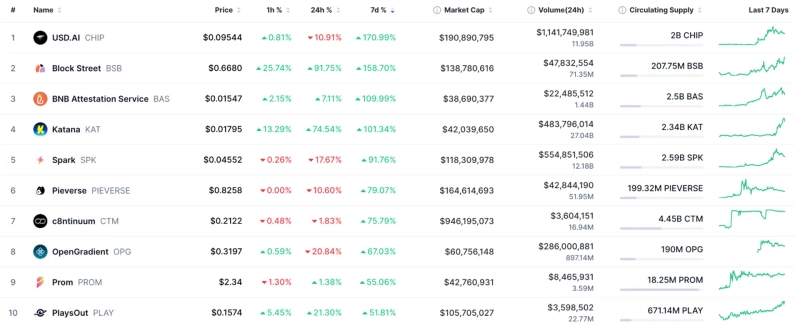
Data from global crypto tracker CoinMarketCap on April 24 showed the week’s top altcoin gainers included ASTEROID (+583%), BSB (+112%), WHITE (+101%), SPK (+90.7%) and PIEVERSE (+78.5%). The biggest losers included RAVE (-94.3%), ORDI (-34.3%), WLD (-17.4%) and ZRO (-17.2%). Among mid-cap altcoins, STABLE (+25.7%), M (+27.4%) and CHZ (+18.1%) outperformed, while AAVE (-18.6%), WLD (-17.4%) and ZRO (-17.2%) lagged. Extreme moves in both directions highlighted widening volatility across tokens.
The DeFi sector posted the biggest losses among major segments. On-chain data platform SoSoValue showed its DeFi market index fell about 5% over the past week. The decline followed the exploitation of a security flaw tied to KelpDAO’s liquid restaking token rsETH, causing about $292 million in losses and triggering broader liquidity withdrawals.
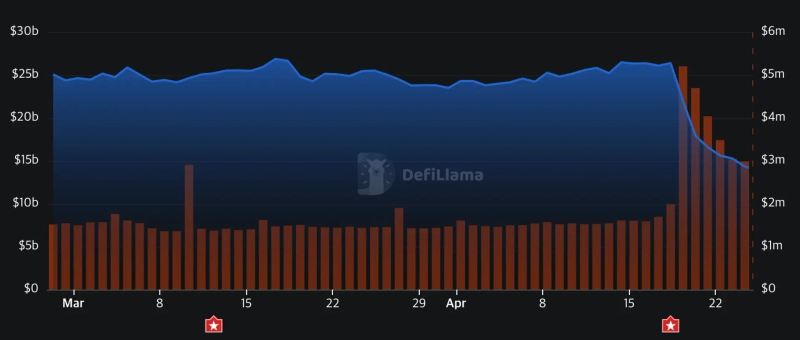
rsETH is a liquid restaking token issued when users deposit Ether with KelpDAO. The structure allows those assets to be used across other protocols while they remain deposited. The exploit accelerated liquidity outflows and sent shock waves through the broader DeFi market. DefiLlama data showed total value locked, or TVL, fell from $26.4 billion on April 18 to about $20 billion a day later. Over the same period, the AAVE token dropped about 18%.
The fallout spread across lending protocols more broadly. CoinDesk reported that the KelpDAO security incident tightened liquidity across DeFi and triggered outflows from lending protocols. Crypto research firm Memento Research estimated DeFi hack losses this year at about $795 million. This month alone accounted for about $630 million, the largest monthly loss on record, after major incidents involving Drift and KelpDAO.
RAVE, which plunged more than 90%, also came under scrutiny after wallets tied to its earlier surge were seen moving funds to exchanges. That fueled speculation about insider involvement and an attempt to engineer a short squeeze. Major exchanges have opened investigations into related trading activity. RaveDAO said it was not involved in the recent price swings and bore no responsibility.
Bitcoin-Led Rebound Leaves Altcoins Behind, Making Chasing Gains Risky
Investors should be cautious about chasing altcoins higher because a Bitcoin-led rebound has not been matched by broader market strength.
Alex Kuptsikevich, chief market analyst at FxPro, said the total crypto market capitalization slipped modestly to about $2.6 trillion as altcoins remained under pressure, even as Bitcoin stayed relatively resilient and supported the broader market. The current setup, with Bitcoin leading gains while altcoins remain weak, is relatively unusual. Investor sentiment is improving, but the market’s upside may remain limited as long as altcoin weakness persists.
Signs are also emerging that renewed selling pressure is overtaking the recent bounce in altcoins. Altcoin Vector said altcoins have failed to keep pace with Bitcoin’s rise and continue to show relative weakness. Altcoin momentum typically strengthens when Bitcoin tests resistance, but this time the rebound faded quickly and downside pressure appears to be regaining the upper hand. The recent short-term bounce could reverse quickly, making aggressive entries risky.
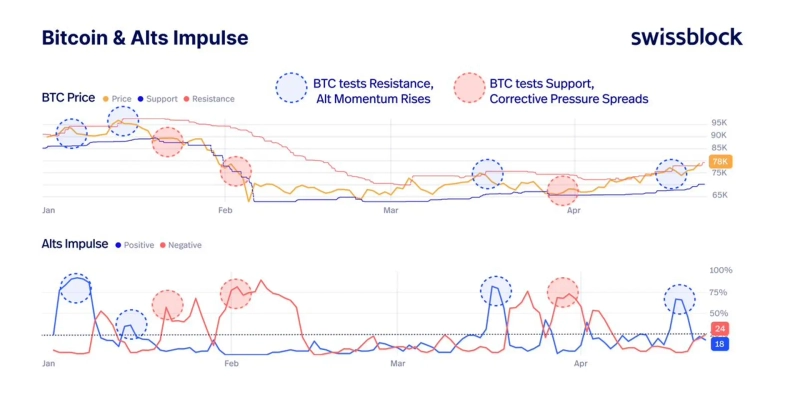
Over the medium term, seasonal weakness is also back in focus. That view supports the argument that this could be the market’s worst April. Crypto analyst Benjamin Cowen said Bitcoin is following a rebound pattern seen in past US midterm-election cycles, but the move looks more like a rally within a bear market than a trend reversal. In prior cycles, rebounds after February and April lows were often followed by renewed weakness after summer. He added that the current rebound could also prove temporary, and that risk assets including altcoins may face further corrections as market attention and liquidity fade.
Rising tensions in the Middle East are adding to macro uncertainty, while policy developments are also weighing on the market. President Donald Trump ordered tighter control of the Strait of Hormuz, increasing military pressure. Iran responded with stepped-up maritime controls and the reactivation of its air-defense network, leaving negotiations deadlocked. At the same time, the CLARITY Act, a bill to establish a market-structure framework for digital assets, is unlikely to pass in April as further negotiations collide with a limited legislative calendar.
That sensitivity to the macro backdrop is also raising questions about how durable the rebound can be. Mike McGlone, a Bloomberg Intelligence strategist, said the recent recovery in the broader crypto market, including Bitcoin, has depended on gains in equities and looks more like a reflexive move alongside risk assets than a standalone show of strength. Risk management during rebounds matters more than chasing prices higher, he said, and investors should stay open to further declines.
Kang Min-seung, Blomingbit reporter minriver@bloomingbit.io

Minseung Kang
minriver@bloomingbit.ioBlockchain journalist | Writer of Trade Now & Altcoin Now, must-read content for investors.