DeepSeek Cuts V4 API Input Prices to 1/40 of List to Woo US Startups
Summary
- DeepSeek is targeting startups with a steep discount campaign that cuts V4 model API input prices to as low as 1/40 of the list price as it seeks to expand market share.
- DeepSeek said V4 Pro input costs are about one-third of OpenAI GPT-5.5 and Opus 4.7 at list price, and fall to 1/137 of those models after discounts.
- DeepSeek has built a cost advantage through the Ascend domestic AI chip, Chinese government support and tax benefits, and adoption of Chinese-made AI models by startups is increasing.
Forecast Trend Report by Period


Discount push targets startups
New V4 model priced at 1/40 of list
Company goes after businesses under cost pressure
Chinese artificial intelligence company DeepSeek has launched a steep discount campaign to lure customers to its new V4 model, targeting startups squeezed by rising costs. The broader aim is to expand market share.
DeepSeek announced on X on April 27 that it would cut input costs for the V4 model’s application programming interface, or API, to one-tenth of the list price through May 5. APIs let companies connect AI models to their applications, while input refers to prompts sent to the model. A day earlier, the company had already slashed V4 API prices, including both input and output, by 75%. Combined, the discounts reduce input prices to one-fortieth of the list price.
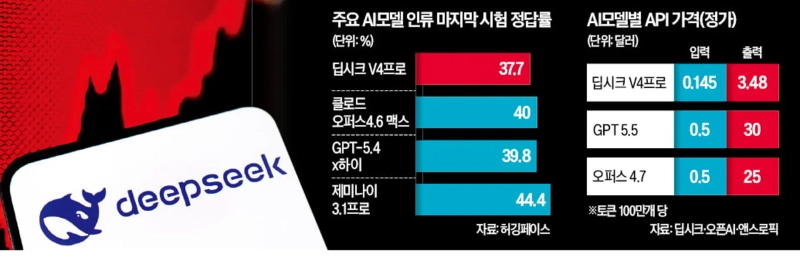
The list price for API input on DeepSeek’s V4 Pro model is $0.145 per 1 million tokens, the basic unit of AI computing. That is roughly one-third of the $0.50 charged by OpenAI’s GPT-5.5 and Anthropic’s Opus 4.7. After the discounts, the price falls to $0.003625, or about one-137th of GPT-5.5 and Opus 4.7. Output pricing is $3.48 for DeepSeek V4 Pro, compared with $30 for GPT-5.5.
The model, unveiled on April 24, has drawn criticism that its performance fell short of expectations. Its market impact has also been limited compared with the V2 model, which triggered what became known as the “DeepSeek shock.” In Humanity’s Last Exam, or HLE, a benchmark of 2,500 questions across subjects including mathematics, physics and biology, V4 Pro posted a 37.7% accuracy rate. That trailed Google’s Gemini 3.1 Pro at 44.4% and Opus 4.6 at 40%.
DeepSeek’s edge lies in pricing. MIT Technology Review wrote on the day of the V4 launch that the model was “extremely inexpensive” compared with similar offerings from OpenAI and Anthropic. It added that the lighter V4 Flash was among the cheapest top-tier models on the market. More startups are adopting Chinese AI models such as DeepSeek as cost pressure mounts.
DeepSeek’s cost advantage rests on training based on US AI models, the use of Chinese semiconductors and support from the Chinese government. Like earlier versions, DeepSeek V4 was developed by distilling advanced AI models from OpenAI and Anthropic, according to the report.
Distillation is a method of training smaller models using the outputs of more advanced ones. It can sharply reduce the data and computing resources needed for training. Anthropic said in February that three Chinese companies — DeepSeek, Moonshot AI and MiniMax — created more than 24,000 fake accounts and used them to extract more than 16 million conversation records from its models for distillation.
DeepSeek used Chinese semiconductors to train the V4 model. Yuyuantantian, a social media account affiliated with China Central Television, reported on April 26 that domestic computing power supported V4. The chip was identified as Huawei Technologies Co.’s Ascend AI processor. That allowed DeepSeek to avoid the high margins attached to Nvidia GPUs while also benefiting from local government subsidies on electricity costs for data centers that use domestic AI chips.
DeepSeek’s parent, High-Flyer Quant, has been designated a High and New Technology Enterprise, making it eligible for tax breaks as well as government and research subsidies.
Kim In-yeob, Silicon Valley correspondent, Korea Economic Daily, inside@hankyung.com

Korea Economic Daily
hankyung@bloomingbit.ioThe Korea Economic Daily Global is a digital media where latest news on Korean companies, industries, and financial markets.