Fed Debate Shifts From Rate Cuts to Potential Hikes
Summary
- The U.S. central bank is shifting its policy signal from discussions of rate cuts toward a stance that also includes possible rate hikes.
- As debate grows inside the Fed over removing its existing easing-biased language and shifting to a neutral bias, officials are increasingly wary of sending markets the wrong signal on the rate path.
- If the closure of the Strait of Hormuz is prolonged, the Fed may need a series of rate increases, including the possibility of consecutive hikes, to respond to the energy shock and resulting inflation shock.
Forecast Trend Report by Period


The Federal Reserve’s internal debate over interest rates is shifting from cuts toward possible hikes. An energy shock stemming from a closure of the Strait of Hormuz could disrupt the inflation path, prompting the Fed to keep the door open to tighter policy.
Three regional Fed presidents oppose language implying cuts
Powell says committee center is moving toward neutral
Prolonged Hormuz closure could require response to inflation shock
Consecutive hikes also raised as a possibility
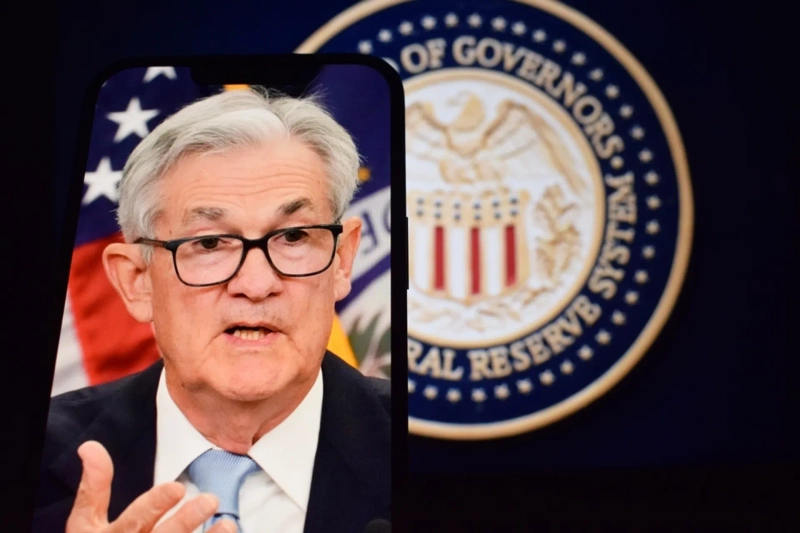
Fed officials are no longer debating only when to resume rate cuts. They have also begun discussing the conditions under which rate increases might be needed, the Wall Street Journal reported on May 4. That shift became clearer on May 1, when three regional Federal Reserve Bank presidents issued separate dissents.
Dallas Fed President Lorie Logan said in a statement that, depending on how the economy evolves, the next move in rates could be either up or down. She opposed language that could be read as suggesting the Fed’s next move was more likely to be a cut. Cleveland Fed President Beth Hammack and Minneapolis Fed President Neel Kashkari also dissented over the same issue.
The debate suggests the Fed has entered a three-stage transition in how it signals the rate path to markets. The first stage points to additional cuts. The second moves to a neutral signal. The third opens the door to potential rate increases. This meeting showed the Fed moving from the first stage to the second.
Fed Chair Jerome Powell described that process directly on Wednesday. If the central bank wanted to raise rates, he said, it would first move to a neutral bias before shifting to a hiking bias. The remarks did not amount to a signal of an imminent rate increase. They did indicate that the Fed can no longer strongly defend language that treats rate cuts as the default outcome.
Powell acknowledged that officials had an active debate over whether to remove a key phrase from the policy statement. The phrase refers to the “extent and timing of additional adjustments” to rates. It has appeared in every statement since the Fed began cutting rates in 2024. Markets have interpreted it as a signal that further cuts are more likely than hikes.
Powell said the center of the committee is moving to a “more neutral place.” At the same time, he said no one at this meeting called for a rate hike. In January and March, only a small number of officials argued for removing the phrase. In recent weeks, more policymakers have come to support a change. As a result, the decision to keep the wording in this week’s statement was much harder than it had been in March.
Powell also did not strongly defend the Fed’s existing easing bias. He cited a procedural reason, saying policymakers did not want to change the signal too quickly and then have to reverse course. He added that the opposing view was “entirely reasonable.” That shows how the case for language implying cuts has weakened inside the Fed.
The direction of the debate has shifted from three months ago. Officials worried about labor-market weakness and inclined toward lower rates had previously focused on why additional cuts might be needed. Now they are increasingly making the case for why rate hikes could backfire.
Behind that shift is a growing view that the Fed may not be able to look through an energy shock the way it has past supply disruptions. With the Strait of Hormuz effectively closed, crude oil and other commodities produced in the Middle East would be harder to deliver to global markets through alternative routes. That has raised concern that the price shock may not remain a temporary supply disruption and could have a deeper effect on inflation expectations and policy decisions.
Statements issued by regional Fed presidents on May 1 laid out that concern more clearly. Hammack and Logan said in separate statements that language left over from the three rate cuts last fall no longer fits the current outlook. In their view, keeping wording from an earlier easing cycle could send the wrong signal to markets.
Kashkari went further and outlined two scenarios. In the more favorable case, the Strait of Hormuz reopens quickly, the price shock fades and the Fed could resume gradual rate cuts after an extended pause. If the closure drags on, however, a series of rate increases may be needed even at the cost of further weakening in the labor market, he said.
The discussion will now pass to Kevin Warsh, the incoming Fed chair. President Donald Trump has nominated the former Fed governor to succeed Powell. Warsh is scheduled to face Senate confirmation after May 11, and Powell’s term as chair ends on May 15. The next Federal Open Market Committee policy meeting is due about a month later.
Hwang Jung-soo, Hankyung.com reporter hjs@hankyung.com

Korea Economic Daily
hankyung@bloomingbit.ioThe Korea Economic Daily Global is a digital media where latest news on Korean companies, industries, and financial markets.