Kospi Nears 7,000 as SK Hynix Market Cap Tops $696 Billion
Summary
- The Kospi index closed at 6,936.99 after jumping 5.12%, raising expectations for a break above 7,000.
- SK Hynix’s market capitalization topped 1,000 trillion won, while Samsung Electronics advanced and foreign and institutional investors posted 5 trillion won in net buying, driving the rally.
- Global investment banks have raised earnings forecasts for Samsung Electronics and SK Hynix and say valuation pressure remains limited.
Forecast Trend Report by Period


Kospi jumps 5.12% to 6,936.99
Big Tech strength boosts sentiment for chip stocks
Foreign and institutional investors buy nearly 5 trillion won
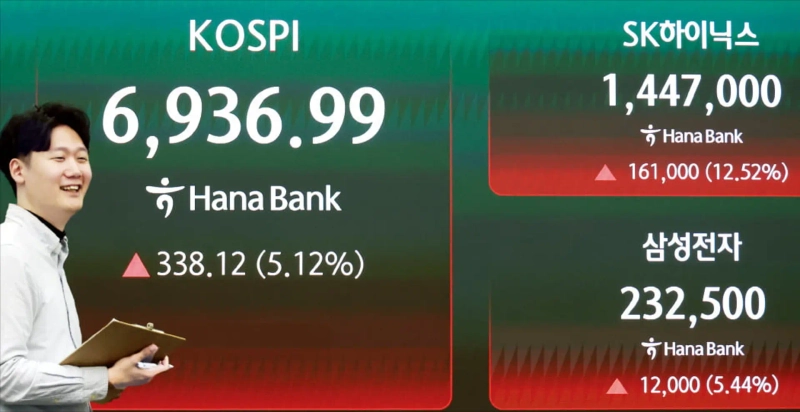
The Kospi rose 5.12% to close at 6,936.99 on May 4, leaving South Korea’s benchmark stock index within sight of 7,000. The index is displayed on a board in the dealing room of Hana Bank in Seoul. Choi Hyuk/Korea Economic Daily
Breaking with the long-held market adage of “Sell in May,” the Kospi climbed above 6,900 on May 4, the first trading day of the month. South Korean markets had been closed for three days over the Labor Day holiday. During the break, US technology stocks rebounded, spurring nearly 5 trillion won ($3.48 billion) of combined buying by foreign and institutional investors. Global investment banks have also sharply raised earnings forecasts for market heavyweights Samsung Electronics and SK Hynix, adding to expectations that the Kospi could break through the symbolic 7,000 level as early as this week.
The Kospi finished up 5.12% at 6,936.99. Foreign investors bought heavily from the opening bell, lifting the index past its previous record of 6,750.27. It then moved above 6,800 before crossing 6,900 in afternoon trading. The benchmark now stands just 63.01 points short of 7,000.
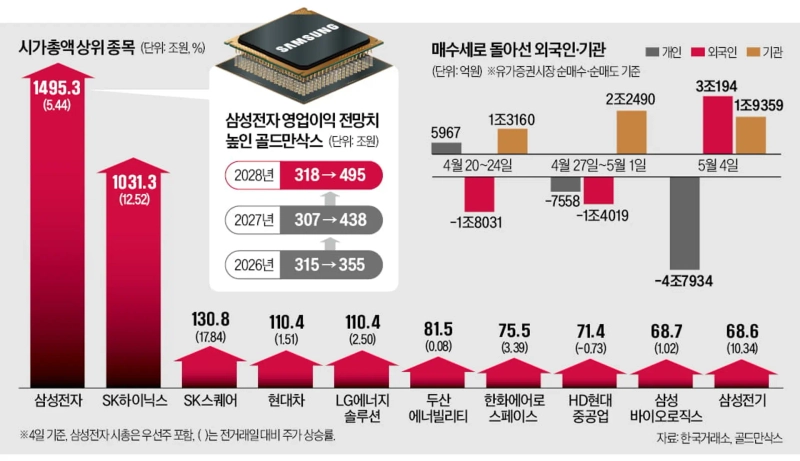
SK Hynix led the rally. The stock surged 12.52%, reaching 1.4 million won a share and pushing its market capitalization above 1,000 trillion won ($695.7 billion). Its market value has swelled by 100 trillion won ($69.6 billion) in just four trading sessions after topping 900 trillion won on April 27. Samsung Electronics gained 5.44% to 232,500 won, brushing aside concerns over a possible union strike.
Investors were encouraged by expectations that spending tied to artificial intelligence will continue after major US technology companies posted strong earnings during the holiday. The Philadelphia Semiconductor Index rose 2.26% on April 30 and added 0.87% on May 1.
Analysts expect the two chipmakers to keep leading the market even if the Kospi enters the 7,000 era. Lee Young-gon, head of research at Toss Securities, said semiconductor shares have already surged this year, but earnings forecasts are rising even faster, leaving valuations from looking overly stretched. That suggests further upside for large-cap stocks. Goldman Sachs said in a recent report that it raised its 2027 and 2028 operating profit forecasts for Samsung Electronics by 40% to 50%.
Foreign investors buy 3 trillion won of Samsung and SK Hynix on bets chip shortage will worsen
Kospi rally defies expectations, leaving index 63.01 points short of 7,000
Would “Sell in May,” one of the stock market’s oldest sayings, hold true again this year? That was the focus across the securities industry at the end of April ahead of the Labor Day holiday. The Kospi had already run from the 5,000 range to the 6,600 range during April, leading many to expect Samsung Electronics and SK Hynix to pause. Concern also deepened because May typically marks the end of earnings season, a period when the broader market often weakens.
Instead, the Kospi hit another record on May 4 and moved to the brink of 7,000. SK Hynix and Samsung Electronics, which many had expected to cool, rose about 12% and 5%, respectively, in a single session and led the advance. A series of strong earnings reports from global Big Tech companies over the holiday strengthened expectations that an AI-driven semiconductor supercycle will continue.
Foreign investors pile into Hynix amid lower labor risk
Foreign and institutional investors drove the rally on the main board. Korea Exchange data showed foreigners were net buyers of 3.0194 trillion won ($2.1 billion) on May 4, while institutions bought a net 1.9359 trillion won ($1.35 billion). Retail investors were net sellers of 4.7934 trillion won ($3.33 billion). Foreign net buying was the second-highest since Oct. 2, 2025, when it reached 3.1265 trillion won.
SK Hynix drew the biggest foreign inflows, with net purchases of 1.7759 trillion won ($1.24 billion). Samsung Electronics followed with 1.2052 trillion won ($839 million), ahead of Samsung Electronics preferred shares at 162.8 billion won ($113 million) and Hanwha Aerospace at 122.1 billion won ($85 million).
That buying helped SK Hynix clear both the 1.4 million won share-price milestone and a market capitalization above 1,000 trillion won. Its 12.52% gain was the second-largest on record after a 12.77% jump on April 8. That was more than double Samsung Electronics’ 5.44% rise. SK Square, the parent company of SK Hynix, also surged 17.84%.
Lee said expectations for continued AI-related investment by Big Tech companies are driving semiconductor shares higher. Both Samsung Electronics and SK Hynix stand to benefit. SK Hynix appears to be attracting stronger buying because it faces less uncertainty than Samsung Electronics, including a lower risk tied to a possible union strike.
Optimism around AI has outweighed external uncertainty, analysts said. Na Jung-hwan, an analyst at NH Investment & Securities, said factors such as war risks and oil-price moves would normally weigh on Korean equities, but expectations for earnings at the country’s two biggest chipmakers had already been priced in and were driving the rally. Gains in the S&P 500 and Nasdaq over two straight sessions during the holiday, after Apple and other Big Tech companies reported stronger-than-expected earnings and unveiled large AI data-center expansion plans, also helped lift the Korean market.
Short-selling balances swell as stocks climb
Even after the sharp rally, global investment banks and local brokerages continue to argue that Korean equities remain cheap. Their central case is that earnings forecasts for the large semiconductor stocks leading the market are rising faster than share prices.
In a recent report on Samsung Electronics, Goldman Sachs raised its 2027 operating profit forecast to 438 trillion won ($304.8 billion) from 307 trillion won and its 2028 estimate to 495 trillion won ($344.5 billion) from 318 trillion won. The bank said the memory market in 2027 will face a more severe supply shortage than it does now. Goldman also lifted its target price to 320,000 won from 285,000 won. As of May 4, Samsung Electronics traded at 6.11 times 12-month forward earnings, while SK Hynix was at 5.07 times.
More investors are also betting on a temporary pullback in the Kospi. Korea Exchange data showed outstanding short positions on the benchmark market topped 20 trillion won ($13.9 billion) on April 27.
Lee Sun-a, Oh Hyun-a and Cho A-ra, Korea Economic Daily reporters suna@hankyung.com

Korea Economic Daily
hankyung@bloomingbit.ioThe Korea Economic Daily Global is a digital media where latest news on Korean companies, industries, and financial markets.