PiCK
Bitcoin Rebounds on Institutional Inflows, With Middle East Risks in Focus
Forecast Trend Report by Period


Bitcoin Holds in the 110 Million-Won Range on Hopes for an End to the War
BlackRock, Strategy Accelerate Buying
US Investment Bank Says Bull Market Will Continue
Stalled Nuclear Talks May Keep Traders on the Sidelines
Bitcoin has been rising since April. The cryptocurrency held above 100 million won even in the immediate aftermath of the US-Iran war, then extended its gains throughout April as the conflict eased. Heavy institutional buying has helped build a firmer floor under prices, according to market watchers. Optimism has also grown as debate over formalizing crypto regulation in the US gathers pace, though some expect broader macro risks to keep investors cautious for now.
Back Near Levels Seen Before the Selloff
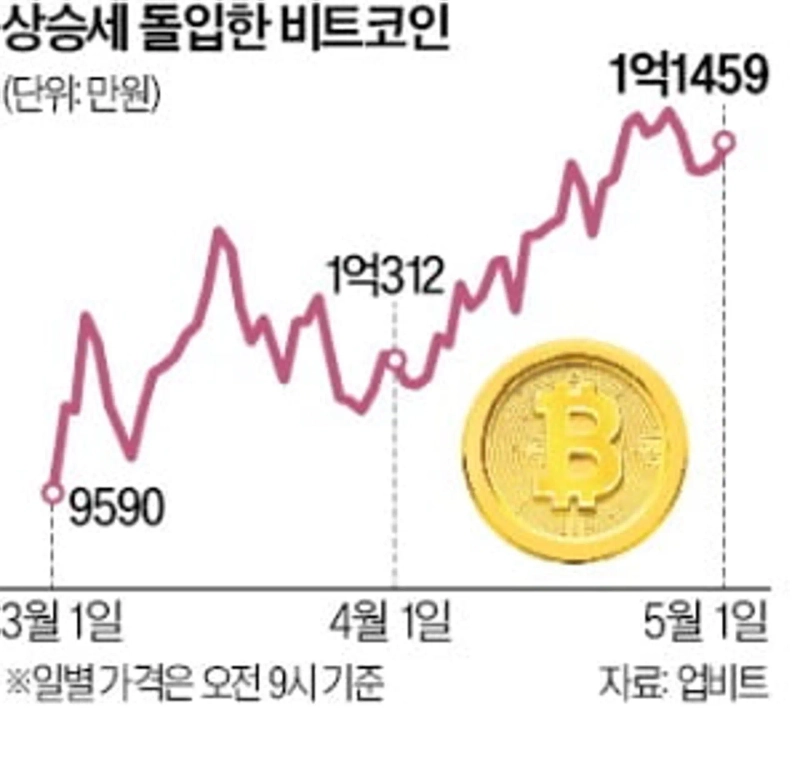
According to South Korean crypto exchange Upbit, Bitcoin traded at 114.72 million won on May 1. Measured by the first day of each month, the recovery has been clear. Bitcoin began Jan. 1 at 102.88 million won, then fell to 101.134 million won on Feb. 1. It dropped to 95.9 million won on March 1, immediately after the Iran war on Feb. 28, but began rebounding after topping 103.12 million won on April 1.
Unlike March, when the war was at its height, Bitcoin stayed relatively elevated in April as hopes grew for an end to the Iran conflict. It traded in the 110 million-won range for 16 straight trading days from April 15 to April 30. Although it slipped to 97.84 million won by March 8, it has closed above 100 million won for nearly two months since then.
The uptrend is also clear in dollar terms. CoinMarketCap data show Bitcoin started April 1 at $66,552 and climbed to $76,292 by May 1, a gain of about 14%. That amounts to an increase of nearly $10,000 in a month. Bitcoin is now trading near levels seen in late January and early February, just before the sharp selloff. It fell to as low as $62,700 on Feb. 6.
Money Pours Into Bitcoin
Large inflows have been a key driver of Bitcoin's advance. Investment platform Farside Investors said the 12 spot Bitcoin exchange-traded funds listed in the US posted net inflows for nine straight trading days from April 14 through April 24. Those funds drew $2.111 billion over the period, or an average of $234.57 million a day. BlackRock, the world's largest asset manager, accounted for the biggest share at $1.609 billion.
Strategy, the world's largest corporate Bitcoin holder, has also stepped up purchases. The company disclosed that it spent $2.54 billion in the week through April 20 to buy 34,164 Bitcoin, its biggest purchase since November 2024. It then bought another 3,273 Bitcoin for about $255 million through April 27.
The Fear & Greed Index compiled by crypto data firm Alternative stood at 26 on May 1, a level classified as fear. That was nearly triple the reading of 8 on April 1, which marked extreme fear. The gauge had also risen as high as 47, or neutral, on April 27. The index measures market sentiment on a scale in which readings closer to 0 indicate fear and those nearer 100 signal greed. Lower readings are generally associated with stronger selling pressure, while higher ones can point to overheating.
Bernstein said in a recent report that Bitcoin's bull market will last longer than in past cycles. The bank said ETF inflows from major asset managers and brokerages have strengthened downside support. It also pointed to the fact that more than 60% of Bitcoin's circulating supply has not moved for more than a year, arguing that the market has shifted toward longer-term holders.
Stack of Risks Could Keep Investors Waiting
A growing number of prominent investors have made a long-term bullish case for Bitcoin. Rising stablecoin supply has also fueled interest in and demand for digital assets. Paul Tudor Jones said on a recent podcast that Bitcoin is the best inflation hedge and superior to gold. He cited Bitcoin's more limited issuance relative to gold supply and added that equities look overvalued.
The market is now watching the CLARITY Act, which is pending in the US Senate. Expectations are building that the Senate Banking Committee could schedule a vote in May, bringing a full Senate vote closer. The bill's core provision would split oversight of cryptocurrencies between the Securities and Exchange Commission and the Commodity Futures Trading Commission. Passage would reduce regulatory uncertainty, encourage broader participation by traditional financial firms and bolster sentiment toward Bitcoin.
Still, some expect macro risks to push investors back into wait-and-see mode. The Trump administration has maintained a ceasefire with Iran, but negotiations over limits on Tehran's nuclear activity remain deadlocked. Concerns also persist over Middle East-driven oil-price volatility as maritime blockades continue. Kevin Warsh, who is set to take office as Federal Reserve chair on May 15, has emerged as another variable. Markets are watching whether the traditionally hawkish policymaker would cut rates if oil prices surge.
Park Si-on, Hankyung.com reporter ushire908@hankyung.com

Korea Economic Daily
hankyung@bloomingbit.ioThe Korea Economic Daily Global is a digital media where latest news on Korean companies, industries, and financial markets.