Gold Rises 5.8%, Silver Gains 9.7% as Bargain Buying Returns
Summary
- Gold and silver prices rose 5.8% and 9.7%, respectively, after plunging in March as bargain buying returned.
- The US-Iran ceasefire, easing dollar strength, and an increase in central bank net gold purchases are supporting the recovery in gold and silver prices.
- Analysts said global oil prices, inflation trends, and US-Iran negotiations to end the war will be the key variables for gold and silver going forward, while Shinhan Securities projected gold prices at $4,300 to $5,200 an ounce over the next three months.
Forecast Trend Report by Period


Inflation fears and dollar strength ease
Gold up 5.8%, silver up 9.7%
Ceasefire talks and oil moves remain key variables
Gold and silver prices are gradually recovering after a sharp slide in March. The rebound reflects easing fears that inflation would accelerate after the ceasefire between the US and Iran. As concerns about inflation driving a stronger dollar and higher interest rates have subsided, bargain-buying funds have flowed back into the market. Analysts still advise caution, saying tensions in the Middle East remain elevated and could lead to another price correction.
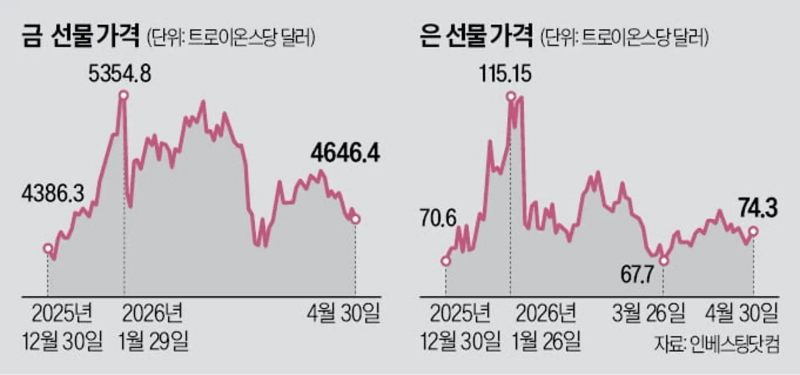
According to COMEX data cited on May 6, June gold futures stood at $4,646.4 a troy ounce on April 30, up 5.8% from $4,392.3 on April 26, when prices fell to their lowest level this year. Silver, which also has industrial uses, rebounded more sharply. Silver futures rose 9.7% over the same period to $74.3 an ounce. Gold and silver had repeatedly set record highs through January before entering a correction and then falling sharply in the aftermath of the US-Iran war. Fears that surging oil and consumer prices would drive market interest rates sharply higher weighed on the metals. Their appeal as inflation-hedging physical assets was overshadowed by the fact that they do not pay interest and tend to lose favor when rates rise.
The decline in gold and silver prices stopped after tensions in the Middle East eased somewhat following a ceasefire agreement between the US and Iran early last month. Expectations that relations between the two countries would not deteriorate further prompted many investors to buy on weakness. Gold has also been supported by steady purchases from major central banks. World Gold Council data showed net gold purchases by central banks and other public-sector institutions totaled 244 tons in the first quarter, up 36 tons from 208 tons at the end of last year.
A retreat in dollar strength also improved sentiment toward gold and silver. The dollar index, which measures the US currency against six major peers, climbed to 100.36 on March 13 before falling to 98.04 on April 30. A surge in the dollar driven by stronger demand has undermined the relative appeal of gold and silver.
Analysts said the path of gold and silver prices will hinge on how much inflation, fueled by higher global oil prices, begins to ease. Negotiations between the US and Iran to formally end the war remain the biggest variable. Shinhan Securities projected gold at $4,300 to $5,200 a troy ounce over the next three months, a range that also reflects downside risk. “Gold prices may rise gradually for the time being or fluctuate near recent highs,” Ha Geon-hyung, a Shinhan Securities analyst, said.
Kim Jin-sung, Hankyung.com reporter, jskim1028@hankyung.com

Korea Economic Daily
hankyung@bloomingbit.ioThe Korea Economic Daily Global is a digital media where latest news on Korean companies, industries, and financial markets.