Biopharma Slump Leaves Kosdaq Up Just 1% This Month, Far Behind Kospi
Summary
- The Kosdaq Index has risen only 30% this year, trailing the Kospi Index’s 60% gain and leaving the government’s “Kosdaq 3,000” target looking distant.
- Weakness in the biopharma sector, which accounts for about 30% of Kosdaq market capitalization, along with declines in large-cap names such as Samchundang Pharm and ABL Bio, has limited the index’s gains.
- Experts said that amid high volatility in the Kosdaq, stronger earnings visibility, improved fund flows and government support measures will be key to any rebound.
Forecast Trend Report by Period


Up 1% this month, versus a double-digit gain for the Kospi
Earnings visibility and improved fund flows are key
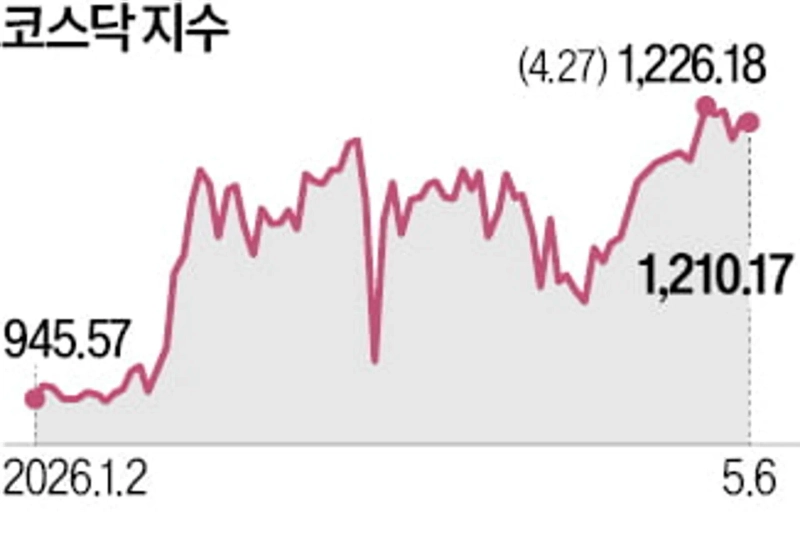
South Korea’s Kosdaq Index fell on May 6 even as the benchmark Kospi touched 7,400, underscoring the widening gap between the country’s main board and its junior market. The Kosdaq has risen 30% this year, only half the Kospi’s 60% gain, prompting doubts about the government’s goal of lifting the index to 3,000.
Brokerages say weakness in biopharma stocks, which account for about 30% of the Kosdaq market’s capitalization, is holding back the index.
According to the Korea Exchange, the Kosdaq closed at 1,210.17 on May 6, down 0.29% from the previous session. The index climbed above 1,200 on April 24 for the first time in 25 years and eight months, driven by gains in semiconductor materials, parts and equipment shares as well as biotech stocks. That momentum has recently faded. The Kosdaq rose 13% last month and is up only about 1% so far this month. The Kospi, by contrast, surged 30.6% last month and has gained more than 10% this month.
Market participants say weakness in biotech shares has recently capped gains in the Kosdaq. A leading example is Samchundang Pharm, the Kosdaq’s fifth-largest company by market value. Its stock, which climbed to 1.184 million won on March 30, has plunged to the 400,000-won range as various questions surrounding its contracts and technology remain unresolved. ABL Bio, ranked ninth by market capitalization, tumbled 19.28% in a single session on April 28. On May 6, Samchundang Pharm fell 0.85% and ABL Bio dropped 3.70%. Alteogen, the Kosdaq’s third-largest company by market value, declined 2.55%, while seventh-ranked Kolon TissueGene lost 1.15%.
The Kosdaq’s sluggish performance is also feeding losses for the retail investors who have been propping up the market. Korea Exchange data show institutions were net sellers of about 2 trillion won on the Kosdaq over the past month, while foreign investors sold more than 190 billion won. Individuals were net buyers of 3.11 trillion won. Investors are growing more anxious as the rally in large-cap stocks cools. Over the past month, the large-cap index rose 10.14%. Mid-cap stocks gained 18.99% and small-cap shares advanced 14.31%. In January, large caps had climbed 32.81%, outpacing mid-caps at 21.86% and small caps at 10.98%.
Experts say the market’s next move will hinge on clearer earnings visibility and improved fund flows, with Kosdaq volatility still high. They also expect policy support to be a key variable if the government pushes ahead in the second half with plans to split the Kosdaq into first and second sections based on market capitalization, financial conditions and corporate governance. “Until the government’s support measures for the Kosdaq become more concrete, the slowdown in gains could continue,” a financial investment industry official said.
Bae Seong-su, Hankyung.com reporter baebae@hankyung.com

Korea Economic Daily
hankyung@bloomingbit.ioThe Korea Economic Daily Global is a digital media where latest news on Korean companies, industries, and financial markets.