Kospi Tops 7,000 With 8.1 Forward P/E, Fueling Calls for 8,695 — and Even 10,000
Summary
- The Kospi has broken above 7,000, yet it is still seen as undervalued with a forward P/E of 8 times compared with overseas markets.
- Backed by the semiconductor supercycle, operating profit consensus for Samsung Electronics and SK Hynix has risen sharply over the past month.
- Brokerages say the Kospi could reach 8,695 if a forward P/E of 9 times is applied, and that investors should stay open to further upside and buy aggressively.
Forecast Trend Report by Period


S&P 500 and Nikkei Trade at More Than 20 Times Earnings, While the Kospi Sits at Just 8
AI-Driven Semiconductor Supercycle Remains Intact
Samsung Electronics 2026 Operating Profit Forecast at 332 Trillion Won
Up by More Than 100 Trillion Won From a Month Earlier
A Conservative Kospi Target Is 8,700
Some Are Even Raising the Possibility of 10,000 This Year
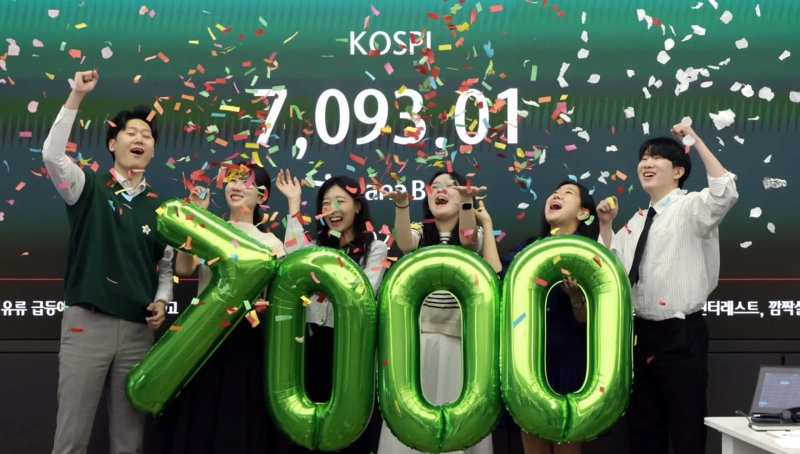
Calls for a “Kospi 7000” began to emerge last year. After the benchmark index broke above 4,000 in October 2025 and extended its rally, some in the securities industry cautiously raised the possibility that it could reach 7,000.
Most dismissed that as a radical target that would only be possible years later. Earlier this year, politicians said the index could also top 7,000 if it were valued using the forward price-to-earnings ratio and price-to-book ratio seen in developed markets, but investors remained unconvinced.
On May 6, the Kospi finally broke through the 7,000 mark, overcoming those doubts. Samsung Electronics Co. and SK Hynix Inc., the two largest stocks by market capitalization, led the rally with double-digit gains on the day.
Even after the relentless advance, brokerages say it is not yet time to talk about a peak. Their view rests on the rapid growth in semiconductor earnings and the argument that South Korean equities remain undervalued compared with markets in the US, Japan and Taiwan.
Foreign Investors Buy 3.14 Trillion Won of South Korean Stocks
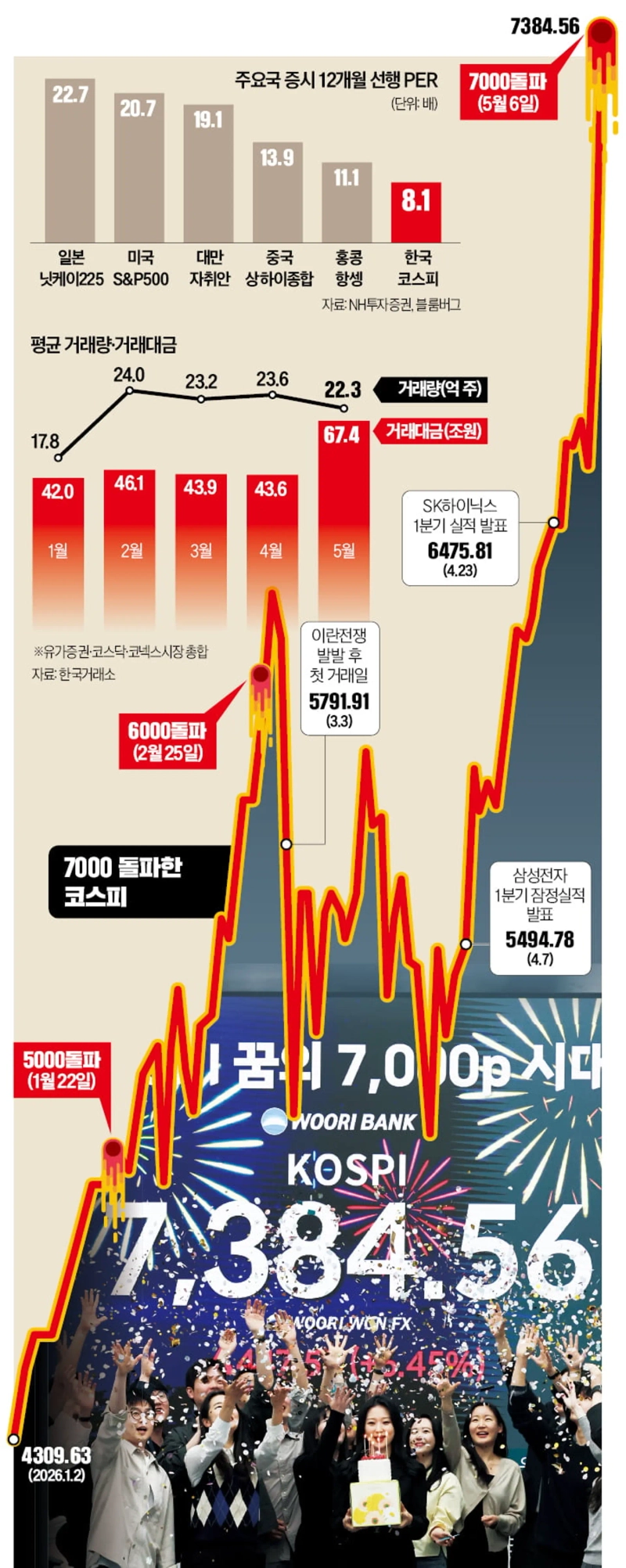
The Kospi opened at 7,093.01 on May 6. Backed by strong foreign buying, it moved through 7,000 and 7,300 in succession and climbed as high as 7,426.60 during the session. Profit-taking emerged late in the day, but the index still closed up 6.45% from the previous session at 7,384.56. The 447.57-point advance was the second-largest on record.
As the rally accelerated, retail and institutional investors were net sellers of nearly 3 trillion won, while foreigners alone bought a net 3.1357 trillion won, helping prop up the index.
Semiconductors were the clear theme of the day. After the S&P 500 and Nasdaq closed at record highs the previous day and expectations grew for chip cooperation between Intel Corp. and Apple Inc., Samsung Electronics jumped 14.41% and SK Hynix gained 10.64%. Both stocks hit all-time highs.
Samsung C&T Corp., which owns stakes in the two companies, rose 17.34%. Samsung Life Insurance Co. gained 12.45%, while SK Square Co. added 9.89%.
Reuters reported on May 6 that South Korea's stock market, with its heavy weighting in semiconductor shares, had become the world's best-performing market.
Even with the Kospi at a record high, investors still describe the market as cheap. Bloomberg data show the 12-month forward price-to-earnings ratio for companies listed on the main Kospi board stood at 8.1 on May 6. That was below the level in January, when the index moved above 5,000 and the multiple stood at 10.
The valuation is also far below that of major markets in Asia and the US. The S&P 500, which set a record high the previous day, traded at 20.7 times earnings. Japan's Nikkei 225 stood at 22.7, Taiwan's Taiex at 19.1 and China's Shanghai Composite at 13.9.
Earnings Are Rising Faster Than Share Prices
The Kospi has been climbing, but corporate earnings are rising even faster.
Daishin Securities said the Kospi's 12-month forward earnings per share had more than doubled from the end of last year as the first-quarter earnings season got into full swing. An unprecedented semiconductor supercycle has continued to drive up consensus estimates for the two chipmakers.
EpicAI, an AI-based investment information service, put consensus 2026 operating profit at 332 trillion won for Samsung Electronics and 248 trillion won for SK Hynix on May 6. That compares with forecasts of 228 trillion won and 173 trillion won a month earlier.
Park Yeon-joo, head of research at Mirae Asset Research Center, said AI penetration relative to total demand is still estimated in the low single digits, leaving substantial room for growth.
Attention is now turning to how high the Kospi can go. Lee Kyung-min, an analyst at Daishin Securities, said the index could reach 8,695 even if investors apply a target forward price-to-earnings ratio of 9. Even allowing for short-term volatility, he said, investors need to stay open to further upside and buy aggressively.
Research centers at securities firms have begun discussing higher Kospi targets. Some are also raising the possibility that the index could reach 10,000 this year.
Lee Sun-a, Korea Economic Daily reporter suna@hankyung.com

Korea Economic Daily
hankyung@bloomingbit.ioThe Korea Economic Daily Global is a digital media where latest news on Korean companies, industries, and financial markets.