JPMorgan, Mastercard Complete First Real-Time Cross-Border Payment Using Tokenized US Treasury Fund
Summary
- JPMorgan and Mastercard completed the first real-time cross-border payment using Ondo Finance’s tokenized US Treasury fund (OUSG).
- The test demonstrated the feasibility of real-time cross-border settlement linking a public blockchain, Mastercard’s Multi-Token Network, and JPMorgan’s Kinexys.
- Tokenized real-world assets (RWA) excluding stablecoins are now worth about $31.1 billion, but regulatory uncertainty and the need for clearer rules remain obstacles to large-scale capital inflows.
Forecast Trend Report by Period


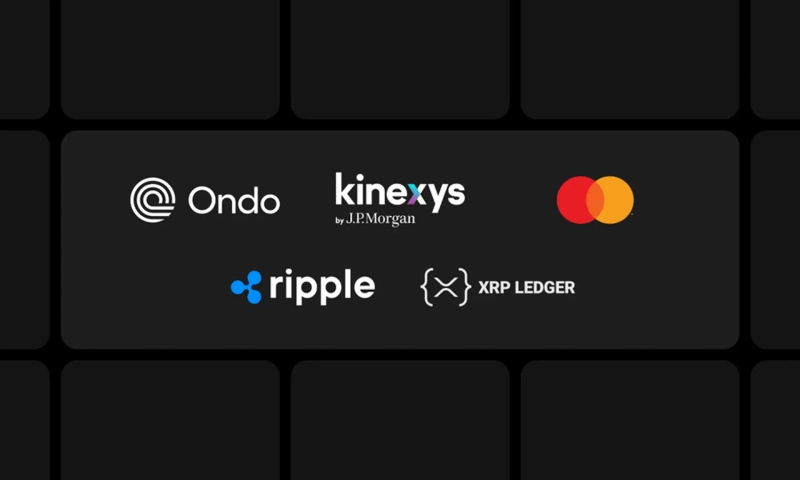
JPMorgan Chase & Co. and Mastercard Inc. have completed what Ondo Finance described as the first cross-border, cross-bank payment test conducted in real time using a tokenized US Treasury fund.
Cointelegraph reported on May 6 that the trial used Ondo Finance’s tokenized short-term US Treasury fund, OUSG, which was redeemed to Ripple.
The transaction was processed on Ripple’s XRP Ledger. Mastercard’s Multi-Token Network then sent payment instructions to Kinexys, JPMorgan’s blockchain platform, and US dollar funds were ultimately transferred to Ripple’s account in Singapore.
Ondo Finance said the transaction marked the first time a tokenized fund was used for a real-time cross-border settlement that combined a public blockchain with global banking infrastructure.
The test underscores expanding cooperation between traditional financial institutions and the digital-asset industry. It also showed the potential to build a faster, more efficient settlement system without the time constraints of traditional banking hours.
Interest in tokenization is also growing. Tokenized real-world assets excluding stablecoins are currently valued at about $31.1 billion, and some forecasts project the market could grow into the trillions of dollars.
Regulatory uncertainty remains a challenge. In a recent report, the International Monetary Fund said tokenization could shift risks in the banking system to smart contracts and distributed ledgers, potentially making crisis responses more difficult. The IMF also said the market could fragment if legal ownership and settlement finality are not clearly defined.
The industry is also calling for clearer rules. Investor Kevin O’Leary said large-scale capital is unlikely to flow into the tokenization market until the US puts in place crypto market-structure legislation and aligns it with securities regulation.

Suehyeon Lee
shlee@bloomingbit.ioI'm reporter Suehyeon Lee, your Web3 Moderator.