National Pension Service Weighs Trimming Korean Stocks After $181 Billion Gain
Forecast Trend Report by Period


"Domestic stock exposure has become too large"
The National Pension Service's dilemma after a $181 billion gain
Korean equity weighting is more than 10 percentage points above target
Markets focus on whether the fund committee will rebalance this month
A rally in the Kospi has pushed the National Pension Service's domestic equity weighting well above its target range. Under its long-term asset-allocation principles, the pension fund has reached a point where it would normally cut its Korean stock holdings. How to handle the asset class that drove the outsized gains is emerging as a contentious issue.
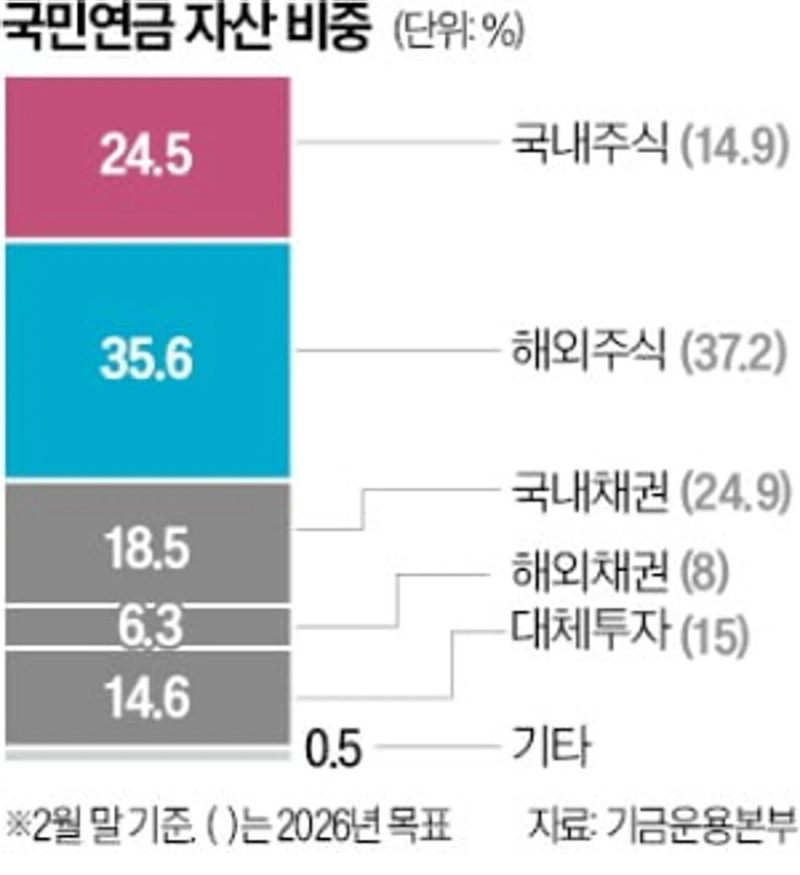
The National Pension Service's allocation to domestic equities rose above 25% as of the end of April, according to government officials on May 7. That exceeded this year's target of 14.9% by more than 10 percentage points. The increase reflects a semiconductor-led Kospi rally and the fund management committee's decision in January to postpone rebalancing. The pension fund has earned about 250 trillion won ($181 billion) this year, taking total assets above 1,700 trillion won ($1.23 trillion).
The problem is that the fund's concentration in domestic equities has increased too quickly. South Korean stocks make up about 1.5% to 1.8% of the MSCI All Country World Index, the global benchmark. Even accounting for a re-rating of the Korean market on improved earnings and broader shareholder returns, the National Pension Service's domestic equity weighting remains far above that level.
Rebalancing is a basic principle of managing a giant pension fund. When markets overheat, managers trim assets that have risen. In downturns, they buy them back to protect long-term returns and portfolio stability. With domestic equities now well above target, cutting the excess would be the natural step under that principle. Delaying sales would leave the fund carrying greater concentration and volatility risk.
The National Pension Service also changed its domestic equity rebalancing rules in 2021 amid a retail-investing boom and political pressure. It widened the permitted range under its strategic asset allocation framework to plus or minus 3 percentage points from plus or minus 2 percentage points, allowing it to hold Korean stocks longer. The stated goal was to limit market shock, but the move also reduced pressure on the fund to sell into a rising market. When global monetary tightening took hold in 2022, returns on domestic equities plunged 22.76%, and the overall fund return fell to minus 8.22%. Industry officials said the fund did not lock in enough gains near the peak and then had limited cash to buy as markets fell.
The industry is watching this month's meeting of the fund management committee as a key moment for the pension fund's asset allocation. Every May, the committee sets target weightings and investment direction for each asset class over the next five years through its mid-term asset-allocation plan. "The committee's decision will have a meaningful impact on supply and demand in the stock market," an investment-industry official said.
Min Kyung-jin

Korea Economic Daily
hankyung@bloomingbit.ioThe Korea Economic Daily Global is a digital media where latest news on Korean companies, industries, and financial markets.