Bithumb Rolls Out Campaign Against AI-Driven Voice Phishing
Summary
- Bithumb said it has launched the “Complete Guide to Voice Phishing” campaign, which includes prevention guidelines for new types of financial fraud that misuse AI.
- The company said cases are rising in which scammers target virtual asset (cryptocurrency) investors by impersonating exchange employees, financial institutions or family members and inducing them to install remote-control apps, share OTP codes, or send funds to specific wallet addresses.
- Bithumb said it emphasized the three core security rules: do not share OTP codes or passwords, do not click links from unclear sources, and refuse requests to transfer assets to wallet addresses provided by others.
Forecast Trend Report by Period


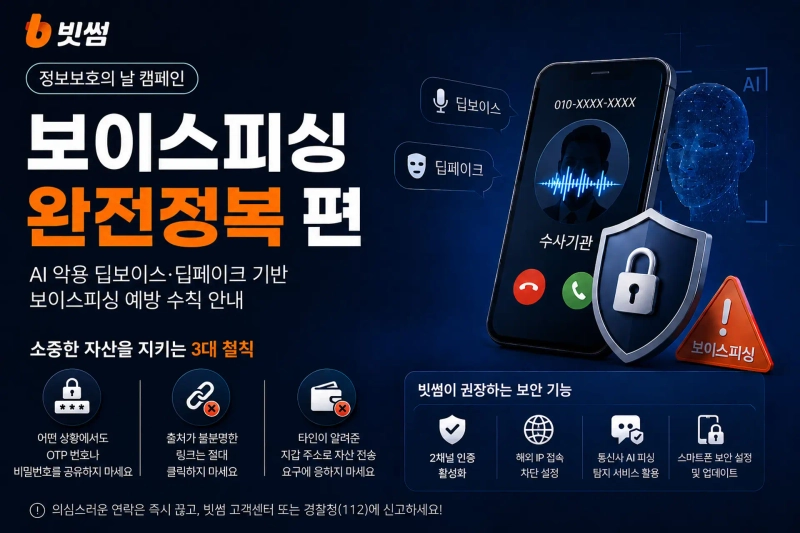
Bithumb said May 14 that it has launched a “Complete Guide to Voice Phishing” campaign with prevention guidelines for new forms of financial fraud that exploit artificial intelligence.
The campaign is part of Bithumb’s monthly Information Security Day initiative. The exchange has been continuously providing security-related content to help prevent data theft caused by malicious text messages and emails, illegal software and weak security settings, while strengthening users’ response capabilities.
After introducing the emerging phishing method ClickFix and the information-stealing malware Infostealer last month, Bithumb is now focusing on the risks of voice phishing that uses AI-based deepvoice and deepfake technology.
Voice-phishing crimes have recently evolved to the point where criminals use AI to mimic in real time the voices and faces of family members or people claiming to represent investigative agencies. In Hong Kong, a victim was deceived by an AI-manipulated video conference into transferring about $29 million.
Bithumb said such cases are increasing, especially those targeting virtual-asset investors. Scammers impersonate exchange employees, financial institutions or family members and pressure victims to install remote-control apps, share one-time passwords, or transfer funds to specific wallet addresses.
Bithumb highlighted what it called the three core security rules: never share OTP codes or passwords, never click links from unclear sources, and refuse requests to transfer assets to wallet addresses provided by others.
It also urged users to make use of exchange security features such as two-factor authentication and blocking overseas Internet Protocol access. The company also shared everyday precautions, including telecom carriers’ AI phishing-detection services and smartphone security settings.
A Bithumb official said rapid advances in AI have made finance more convenient, but crimes exploiting the technology have also grown far more sophisticated, heightening investor anxiety. The company added that it will continue security campaigns to create an environment in which users can trade with confidence.

Suehyeon Lee
shlee@bloomingbit.ioI'm reporter Suehyeon Lee, your Web3 Moderator.