Canton Network Says Institutional Blockchain Adoption Has Begun as Finance Turns to Connectivity
Summary
- Canton Network said it is an enterprise blockchain infrastructure built around demand from institutional investors, processing more than 1 million transactions a day and about $9 trillion in monthly settlements.
- Canton Network said institutional-grade privacy and atomic settlement are key conditions for institutional adoption, enabling real-time financial transactions while meeting both transparency and privacy requirements.
- Chou said tokenization, the buildout of a coordination layer, regulatory frameworks across jurisdictions, and South Korea's efforts to establish rules for tokenized securities and stablecoins are central to expanding on-chain finance.
Forecast Trend Report by Period


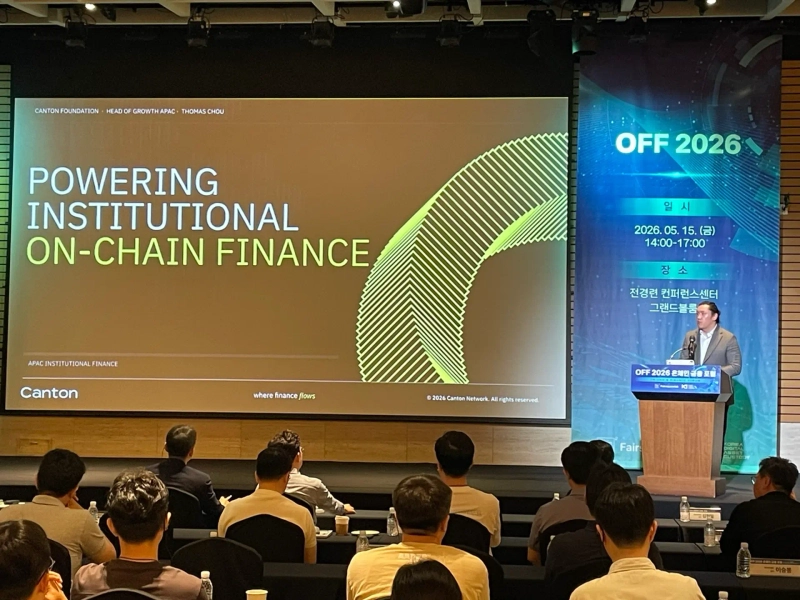
"Over the past few years, blockchain was in the phase of proving its potential. Now it has moved into actual implementation and operation. The market's core challenge is no longer the technology itself, but how to connect different financial systems."
Thomas Chou, head of Asia-Pacific growth at the Canton Foundation, made the remarks on May 15 at OFF 2026, or On-chain Finance Forum 2026, at FKI Tower in Seoul's Yeouido district.
Chou said institutional investors' stance has shifted quickly. Where discussions once centered on explaining what blockchain is, they are now focused on how it can be adopted and deployed in practice.
He added that blockchain is moving beyond experimentation and becoming part of core business infrastructure as more discussions bring in teams from treasury, operations and marketing.
Canton Network is an enterprise blockchain infrastructure built to meet that institutional demand. Since its official launch in 2024, major financial firms including DTCC, Broadridge and JPMorgan have joined the network. It now processes more than 1 million transactions a day and about $9 trillion in monthly settlements.
On a cumulative basis, about $60 trillion in transactions have been processed on-chain, and more than 700 institutions now participate in the network.
Chou described institutional-grade privacy as Canton Network's key differentiator. Participants can set disclosure parameters at the transaction level, with only necessary information selectively shared with counterparties and regulators. That structure, he said, is essential for institutional adoption because it satisfies both transparency and privacy requirements.
He also highlighted the network's atomic settlement function, which allows assets and cash to settle simultaneously. That, in turn, enables real-time financial transactions.
Chou said the blockchain industry has entered a new phase. In the early stage, crypto-asset trading and stablecoins demonstrated the possibility of transferring value. More recently, tokenization has expanded blockchain into capital markets. Even so, the market remains fragmented because different systems are still not well connected.
Even when assets are tokenized, liquidity, regulation and settlement systems remain separate, creating inefficiencies, he said. The next priority is not tokenization itself, but building a coordination layer that links those systems.
He also pointed to the policy environment as an important variable. Regulators across jurisdictions are actively building frameworks, while banks and market-infrastructure providers are moving beyond pilot programs into live operations. In his view, technological maturity and policy conditions are now aligning.
Canton Network is already being used in live financial infrastructure. DTCC operates same-day settlement systems for US Treasuries and equities. JPMorgan has issued its own digital asset for inter-institution settlement. HSBC is also processing digital bond issuance and settlement on Canton Network.
Chou also underscored Asia's importance. Major markets including South Korea, Japan, Hong Kong and Singapore have different regulatory regimes, but they are ultimately trying to solve the same problem: how to connect disparate systems.
In South Korea, in particular, the potential for on-chain finance is expanding quickly as the country works to establish rules for tokenized securities and stablecoins.
"Financial infrastructure is no longer evolving as a set of standalone networks, but as an interconnected structure," Chou said. "Blockchain will not replace existing systems. It will connect and expand them."

Minseung Kang
minriver@bloomingbit.ioBlockchain journalist | Writer of Trade Now & Altcoin Now, must-read content for investors.