Qivalis Says 12 European Banks Are Developing Euro Stablecoin for Cross-Border Payments, Tokenized Asset Settlement
Summary
- Twelve European banks are jointly developing a MiCA-based euro stablecoin to build infrastructure for cross-border payments and tokenized-asset settlement.
- Qivalis said its EMT-form stablecoin could expand across a range of financial services, including cross-border payments, foreign-exchange (FX) trading and tokenized securities settlement.
- Qivalis said it is seeking a Dutch regulatory license within the year and plans to expand a global payments network, supported by interest income from reserve-asset management.
Forecast Trend Report by Period


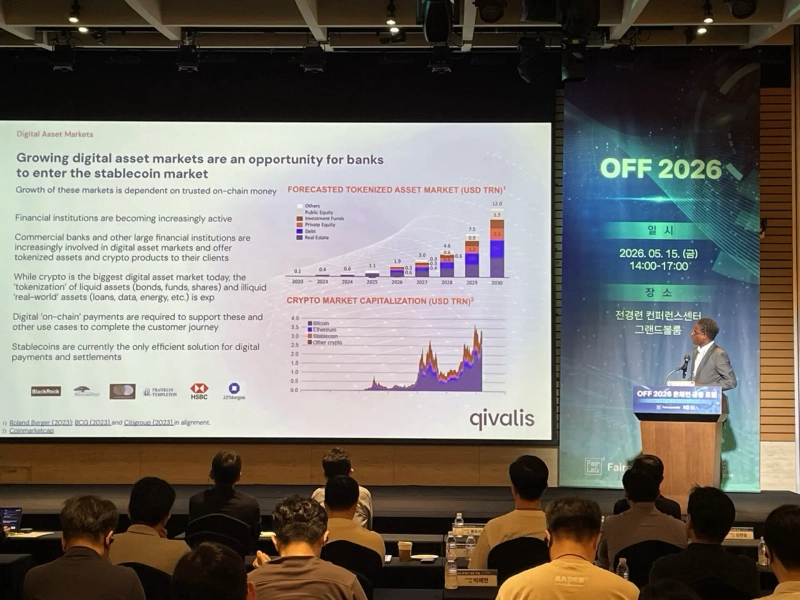
"Stablecoins are the most efficient and scalable form of digital cash. They will become core infrastructure for cross-border payments and tokenized-asset settlement."
Jean-Luc Gustave, Qivalis's Asia-Pacific head, made the remarks at OFF 2026, or On-chain Finance Forum 2026, held at FKI Tower in Seoul's Yeouido district on May 15.
Gustave introduced a euro stablecoin project being jointly pursued by major European banks and said the digital-asset market is rapidly expanding beyond virtual-asset trading into tokenization. Financial institutions once found it difficult to handle crypto assets directly, but have now shifted to a more strategic approach, he added.
Qivalis is building the stablecoin as a consortium of 12 European banks, including ING and BNP Paribas. The token will take the form of an electronic money token, or EMT, under MiCA, the European Union's crypto regulatory framework. The structure is designed to let banks share and use a single asset through joint infrastructure.
Gustave identified cross-border payments as one of the main use cases for stablecoins. Annual money flows between Europe and Asia total about $5 trillion, and the market remains highly inefficient, leaving significant room for improvement.
He also sees broader applications in foreign-exchange trading, tokenized securities settlement, e-commerce payments and programmable payments. He identified Japan, South Korea, Singapore and Hong Kong as key expansion markets in Asia.
Stablecoins will coexist with other forms of digital assets, including a digital euro, central bank digital currencies, or CBDCs, and tokenized deposits, Gustave said. But he said stablecoins are the segment most capable of changing the market quickly because of their efficiency and scalability.
Qivalis has adopted a two-tier distribution structure that separates issuance from distribution. The issuer handles only minting and redemption, while crypto-asset service providers, or CASPs, manage customer-facing distribution. The model is intended to support both regulatory compliance and wider circulation.
Its revenue model is based on interest income generated from reserve-asset management. Gustave said network building and partnership expansion are the immediate priorities. The company is also considering transaction fees or premium services in the future.
Nine banks have already signed participation agreements, and talks with additional banks are under way. Qivalis is seeking a regulatory license through the Dutch financial authorities and aims to secure it within the year.
"Stablecoins are infrastructure that complements the existing financial system rather than replacing it," Gustave said. "Through cooperation with Asian markets, including South Korea, we plan to expand a global payments network."

Minseung Kang
minriver@bloomingbit.ioBlockchain journalist | Writer of Trade Now & Altcoin Now, must-read content for investors.