Kaleido Says Tokenized Finance Depends on Connectivity, Points to BIS Agora as Model
Summary
- Sharon Yuen said tokenization and programmable finance have moved beyond experimentation and into real-world implementation, with stablecoins and tokenized assets already being used in settlements worth tens of billions of dollars.
- She said the Bank for International Settlements' Project Agora is both a test case for a programmable settlement model involving more than 40 major global banks and seven central banks and an important signal for how cross-border payments infrastructure could be reshaped.
- She said Kaleido provides infrastructure supporting public, private and consortium networks to enable interoperability and collaborative structures, and that the expansion of tokenized finance will depend not on technology itself but on those connective frameworks.
Forecast Trend Report by Period


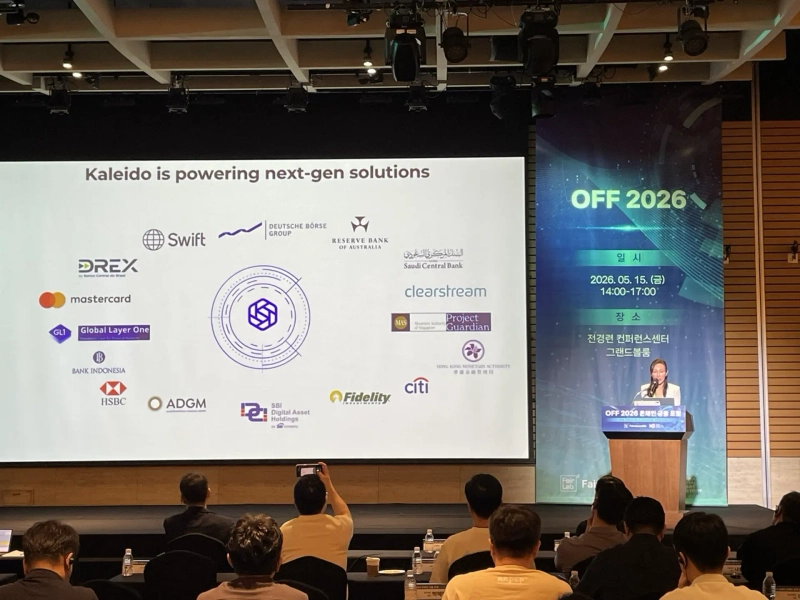
"Tokenization is not an experiment by a single institution. It is a network issue that requires many participants to connect," Sharon Yuen, Kaleido's head of Asia-Pacific, said at OFF 2026, the On-chain Finance Forum 2026, held at FKI Tower in Seoul's Yeouido district on May 15.
"The Bank for International Settlements' Project Agora shows how financial infrastructure could be reshaped in the future," she added.
Yuen said tokenization and programmable finance have moved beyond the experimental stage and into real-world implementation. Stablecoins and tokenized assets are already being used in settlements worth tens of billions of dollars, with adoption expanding rapidly among financial institutions and fintech companies.
She highlighted Project Agora, led by the Bank for International Settlements, as a key example of the shift in global financial infrastructure. The project brings together more than 40 major global banks and seven central banks to improve the traditional correspondent banking-based settlement structure and test a programmable settlement model.
Agora is not just a technical experiment, Yuen said. It is also testing legal structures, governance and operating models. That makes it an important signal for how cross-border payments infrastructure could be reorganized.
The global payments system currently remains fragmented across multiple blockchain networks and legacy financial systems, creating costs and delays. Yuen said the biggest problem is that digital assets and existing systems remain separated like islands. Interoperability, she said, will be a core task for the next stage of financial infrastructure.
She also cited SWIFT's CBDC gateway project. The initiative built infrastructure linking different blockchains with existing payment networks and conducted tests involving 38 banks and 11 central banks.
For tokenized finance to scale, Yuen said, it is not enough simply to digitize assets. What is needed is a structure that allows a wide range of participants to connect in a trusted way.
Kaleido is responding to that need by providing chain-agnostic underlying infrastructure. It supports public, private and consortium networks, while integrating the security, governance and operational functions institutions require.
Financial infrastructure will evolve into a connected architecture of multiple systems rather than a single network, Yuen said. The success of tokenization will depend not on technology itself, but on interoperability and collaborative structures.

Minseung Kang
minriver@bloomingbit.ioBlockchain journalist | Writer of Trade Now & Altcoin Now, must-read content for investors.