Lawmakers’ Restaurant Map Pulled From Toss a Week After Launch
Summary
- Blockchain tech startup Arcpoint said its Toss mini app, Lawmakers’ Restaurant Map, was taken down one week after launch for violating Toss’s service operating policy.
- The map used AI to analyze 26,457 meal receipts and data from 7,550 restaurants drawn from political fund income-and-expenditure reports disclosed by the National Election Commission, then sorted the top 431 locations into restaurant picks by political leaning.
- Chief Executive Officer Oh Tae-wan said the app could be relaunched through a personal mobile site instead of Toss. He said the project gave him know-how and confidence in building Toss apps with AI, and showed that anyone can use AI to build apps and earn some pocket money.
Forecast Trend Report by Period


A restaurant map built from South Korean lawmakers’ meal receipts was abruptly taken offline just one week after launch.
According to a May 16 report by Hankyung.com, the “Lawmakers’ Restaurant Map” app developed by blockchain tech startup Arcpoint was shut down a week after its release. Arcpoint Chief Executive Officer Oh Tae-wan had launched the map service as a mini app within the Toss app.
Toss notified Oh at about 11 p.m. on May 14 that the service would be suspended, citing a violation of its service operating policy. In a post on Remember Connect, Oh wrote that he had received the message from Toss at 11 p.m., exactly one week after the app was launched.
The Toss mini app had been attracting hundreds of visitors a day, he wrote. The idea was simple: to see where “the most powerful people in our country” eat. Publicly disclosed spending records from lawmakers’ corporate cards were organized with artificial intelligence and packaged with a user-friendly interface.
Oh said the app was not intended to expose wrongdoing and was instead driven by curiosity. He added that the restaurants were not especially expensive and that many were hidden neighborhood spots.
He said he respects Toss’s decision and policies, though he was personally disappointed. He had been preparing the next version as the user base grew, but no longer had a platform to publish it on.
If the opportunity arises, the only alternative would be to relaunch it through a personal mobile site after the June election, he said. He also said the project left him with know-how and confidence. Anyone can use AI to build apps and make some pocket money, he wrote, adding that while the app had been deleted, the know-how and confidence he gained from building a Toss app with AI remained.
Oh said he created the app without writing a single line of code. While sharing the basic prompt used to make a Toss app, he said his role was to know exactly what he wanted to build and to change direction when the AI got stuck.
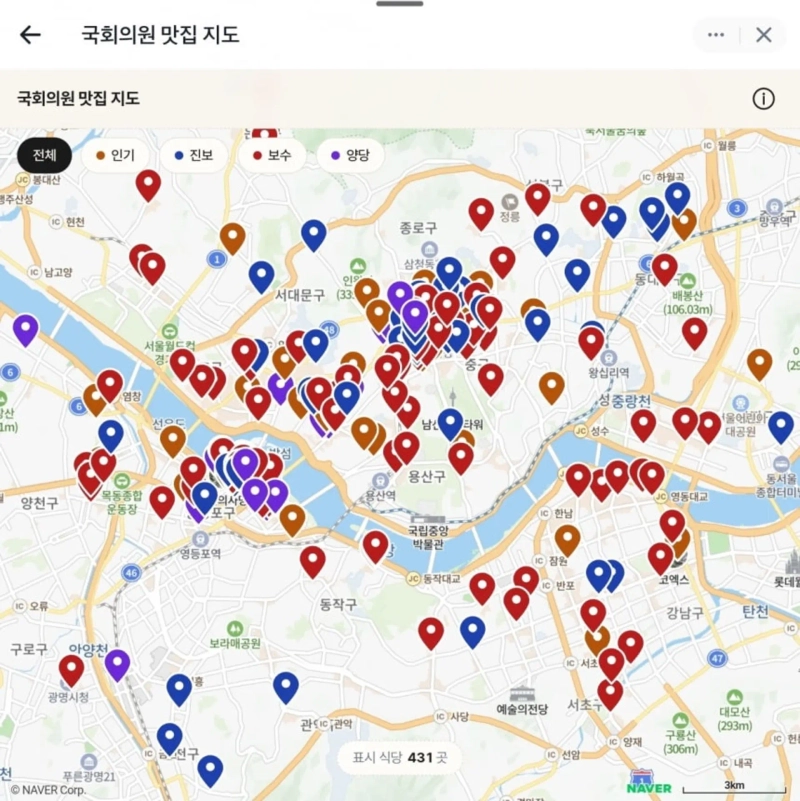
The map was built using political fund income-and-expenditure reports disclosed by the National Election Commission. It analyzed 26,457 meal receipts covering 7,550 restaurants.
Arcpoint evaluated the restaurants using five indicators: lawmaker diversity, visit frequency, repeat-visitor ratio, recency and party representation. After excluding restaurants that had gone out of business, it plotted the top 431 on the map and categorized them as conservative, progressive or bipartisan picks.
Before the app was taken down, Oh had described it as an information app rather than a tool to expose or criticize lavish meals. He said it was designed to let ordinary citizens view public data at a glance and try restaurants frequently visited by lawmakers. The selections were based on actual spending data, not advertising or reviews.
Kim Dae-young, Hankyung.com reporter kdy@hankyung.com

Korea Economic Daily
hankyung@bloomingbit.ioThe Korea Economic Daily Global is a digital media where latest news on Korean companies, industries, and financial markets.