PiCK
Strategy Bitcoin Sale, Middle East Tensions Keep Pressure on Crypto as Bitcoin Slips to $62,000
Summary
- Bitcoin weakened to the $62,000 level as Strategy's Bitcoin sale and Middle East geopolitical risk hurt investor sentiment.
- Ethereum fell below $1,800 amid spot ETF net outflows, institutional money leaving the market and whale selling, though BitMine continues its accumulation strategy through a preferred stock offering.
- Hyperliquid surpassed Solana's price, supported by surging trading volume and market share and the launch of an institutional ETF, though investors should watch for rising volatility and profit-taking risk after the sharp rally.
Forecast Trend Report by Period


**
<Lee Su-hyun's Coin Radar> is a weekly column that tracks moves in the cryptocurrency market and explains the forces behind them. It goes beyond price moves to examine global economic issues and investor positioning, offering insight into where the market may be headed.
Major Coins
1. Bitcoin (BTC)
Bitcoin briefly fell to the $62,000 level this week, further denting investor sentiment. As of June 5, it was trading at $62,592.47 on Binance's USDT market, down 2.08% from a day earlier.
The main catalyst for the week's drop was Strategy's disclosed sale of Bitcoin. Crypto outlet BlockBeats reported on June 1 that the company sold 32 Bitcoin for about $2.5 million between May 26 and May 31. The sale was small in size, but it still shook the market because Strategy had long symbolized the so-called "Never Sell" approach.
It was only the second time Strategy has sold Bitcoin since the 2022 FTX collapse. The company recently indicated it could consider selling Bitcoin if needed to increase Bitcoin holdings per share and strengthen its financial position, signaling a more flexible treasury strategy.
Geopolitical tensions in the Middle East also weighed on risk appetite. Iran's Islamic Revolutionary Guard Corps said on June 3 that it had attacked U.S. military bases in Kuwait and Bahrain in retaliation for a U.S. strike. The development stoked concern that any escalation around the Strait of Hormuz could disrupt oil supplies and intensify inflation pressure.

Policy developments, however, offered a more supportive backdrop. The U.S. Securities and Exchange Commission on June 2 designated digital assets and distributed ledger technology as core policy priorities in its "Fiscal Years 2026-2030 Strategic Plan." The agency said digital assets and distributed ledger technology are changing how capital is raised and securities are traded, and that it will pursue a clearer regulatory framework for the related market.
The industry has also focused on the SEC's move away from regulation by enforcement toward a more consistent, principles-based framework. The agency said it will work on rules covering tokenized assets, on-chain financial infrastructure, crypto custody and staking services. It also said it plans to clarify jurisdictional issues with the Commodity Futures Trading Commission.
The shift is widely viewed as part of a broader push to bring digital assets more fully into the U.S. financial system. President Donald Trump said in late May that he wanted to make the U.S. the world's crypto capital, reaffirming his support for the industry. SEC Chair Paul Atkins also said in May that an innovation-friendly regulatory framework was needed. Investors have taken the SEC's strategic plan as a concrete step in that direction.
Near-term views remain split between warnings of more downside and arguments that the recent wave of selling may be signaling a bottom. David Morrison, senior market analyst at Trade Nation, said Bitcoin could fall further toward its February low of $60,000 if it stays below $65,000 for an extended period.
Some analysts, however, view the selloff as a late-stage bear-market signal. Ed Engel, an analyst at Compass Point, said 26% of Bitcoin sold over the past month came from investors who bought above $90,000. Those buyers who entered near the top are now approaching this cycle's new lows and capitulating, he said, adding that such selling can signal that the bear market is entering its later stages.
2. Ethereum (ETH)
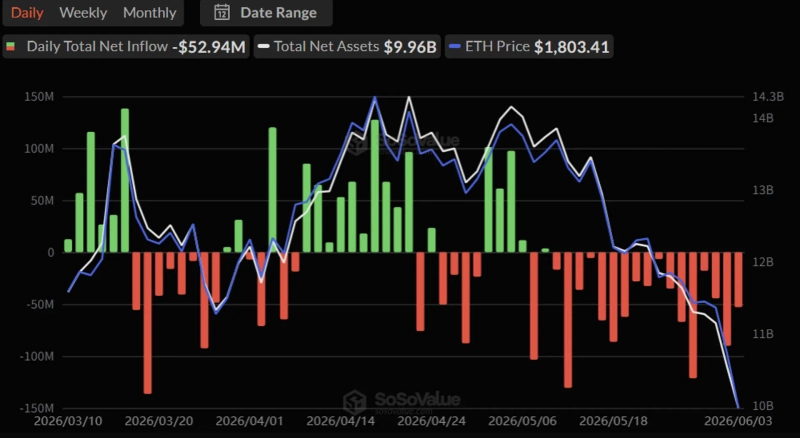
Ethereum also extended its weekly decline, falling below $1,800. As of June 5, it was trading at $1,734.22 on Binance's USDT market, down 3.55% from a day earlier.
The main drag was weaker demand as institutional money left the market and whale selling picked up at the same time. U.S. spot Ethereum exchange-traded funds recorded net outflows of $52.91 million as of June 3. Of that total, BlackRock's ETHA accounted for $51.58 million, extending its run of net outflows to 17 straight trading days.
Some market participants say institutional money is rotating into newer growth themes such as Hyperliquid and artificial intelligence-related tokens. Joshua Lim, co-head of markets at FalconX, said recent flows suggest institutions are shifting away from Bitcoin and Ethereum toward AI-related tokens and Hyperliquid ETFs.
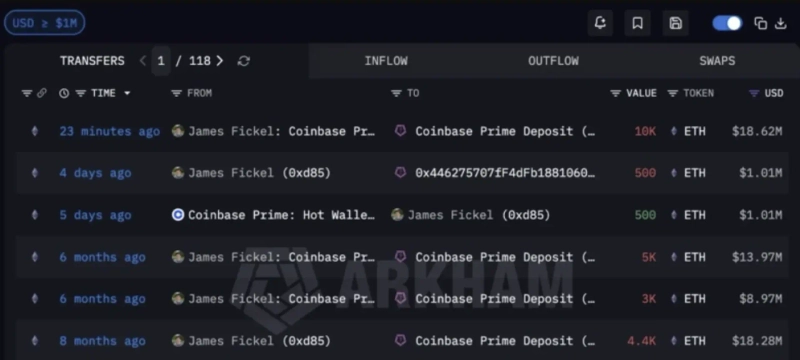
Whale selling has added to the pressure. On-chain data platform Arkham said on June 2 that James Fickel, known as a long-term investor, recently transferred about 10,000 Ether to a Coinbase address. At current prices, the stake is worth about $18.6 million. Another early Ethereum investor also sold roughly 5,000 Ether more recently. Onchain Lens said that investor has sold a total of 60,000 Ether and about 9,400 wsETH, bringing cumulative sales to about $146 million.
Still, BitMine, a digital-asset treasury company focused on Ethereum, has continued building its holdings for the long term. On June 3, the company disclosed plans to issue up to $300 million of perpetual preferred stock. It plans to raise the funds by selling 3 million preferred shares with a par value of $100 each. The shares carry an annual dividend rate of 9.5%.
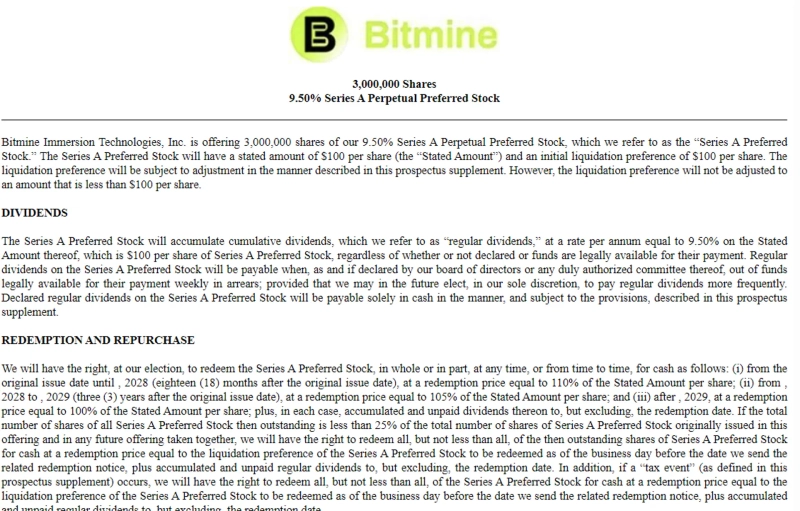
The structure mirrors the way Strategy raised funds through preferred stock to buy Bitcoin. Strategy has recently used preferred products such as STRC and STRK to secure large sums and increase its Bitcoin holdings. BitMine is pursuing a similar strategy, using money raised through preferred stock to expand its Ethereum holdings.
The outlook remains divided. Crypto analyst Ali Martinez said Ethereum has already broken below its key support at $1,825, leaving room for a further slide to $1,500.
Longer term, the view is more positive. Geoffrey Kendrick, global head of digital assets research at Standard Chartered, said Ethereum could outperform Bitcoin by more than 40% by year-end. He set a price target of $4,000 for the end of 2026.
3. XRP
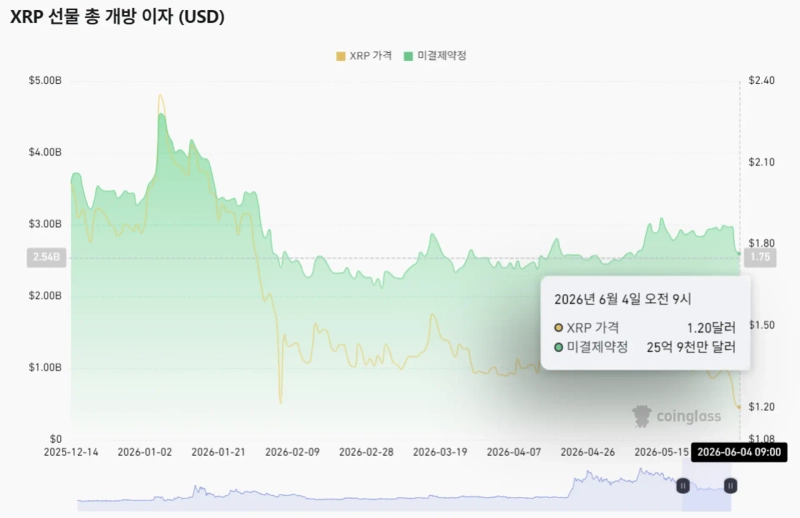
XRP also succumbed to the broader market selloff, dropping to the $1.10 level this week. As of June 5, it was trading at $1.1357 on Binance's USDT market, down 5.95% from a day earlier.
XRP is also showing signs of weaker demand as both retail and institutional investors pull back.
CoinGlass data showed XRP futures open interest fell from $2.97 billion at the start of the week to about $2.59 billion as of June 4. That suggests leveraged traders are cutting back their bets.
After XRP fell below $1.25, about $18.57 million of long positions were liquidated. Short liquidations totaled just $1.15 million, underscoring the market's broader bearish bias.
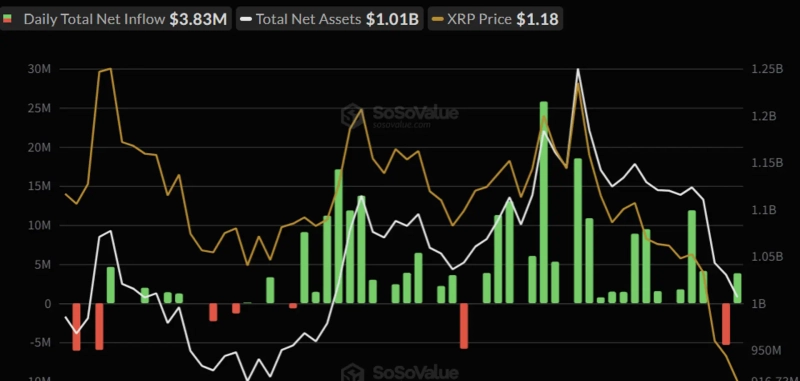
Institutional demand has also cooled. SoSoValue data showed spot XRP ETFs posted net outflows of $5.34 million on June 3. The amount was modest, but it marked the first break in a run of net inflows that had continued since late April.
The near-term focus is whether XRP can reclaim $1.20. Crypto outlet U.Today said failure to recover that level could open the way for a further decline toward the psychologically important $1 mark.
Some analysts, however, argue the recent drop looks less like a broad market breakdown than a washout of excessive leverage. Amar Taha, a contributor at CryptoQuant, said Bybit's open interest fell by about $67 million as XRP dropped toward $1.20, while Binance open interest rose by about $20 million. He said that pointed to healthy deleveraging concentrated at some exchanges rather than a full collapse in the XRP derivatives market.
Coin in Focus
1. Hyperliquid (HYPE)

This week's coin in focus is Hyperliquid. Even as the broader crypto market remained weak, Hyperliquid continued to outperform and raise its profile. As of June 5, however, it had surrendered part of its recent advance and was trading around $62, according to CoinMarketCap.
The biggest talking point was its move above Solana's price. On June 4, Hyperliquid rose as high as $74.67 intraday, surpassing Solana for the first time on a price basis. By market capitalization, however, the gap remains wide. Solana's market value stands at about $42 billion, compared with roughly $16 billion for Hyperliquid.
Even so, the market has treated the price crossover as a symbolic milestone. Hyperliquid has gained about 24% over the past month, while Solana has fallen about 14%. That relative strength stood out as Bitcoin and Ethereum entered a recent correction.
Hyperliquid is a decentralized exchange project. Its main feature is bringing perpetual futures trading, typically associated with centralized exchanges such as Binance, onto the blockchain. Trading volume and user activity have risen rapidly, helping it steadily gain market share.
The growth is already showing up in the data. The Block reported that Hyperliquid's share of the global perpetual futures market climbed to a record 6.63% last month. Monthly trading volume also exceeded $62 billion. Investors are focusing on how rising protocol usage is feeding demand for the Hyperliquid token.
Institutional interest is also increasing. Grayscale recently launched HYPG, a Hyperliquid staking ETF. Grayscale's head of research described Hyperliquid as one of the biggest success stories of this cycle. CoinShares also said cases like Hyperliquid, where protocol activity translates into token value, are rare, and set a 2031 price target of $147.
Still, the token's sharp run-up means volatility may stay elevated in the near term. On June 4, BitMEX co-founder Arthur Hayes sold all of his Hyperliquid holdings, sending the price down more than 15% intraday. The move highlighted the risk of profit-taking and sharper swings after the recent rally.

Suehyeon Lee
shlee@bloomingbit.ioI'm reporter Suehyeon Lee, your Web3 Moderator.