Summary
- A bill dubbed the American Reserve Modernization Act, or ARMA, aimed at building a federal Bitcoin reserve in the US House of Representatives has been made public.
- The bill would establish a Strategic Bitcoin Reserve and a Digital Asset Stockpile, while restricting the sale of Bitcoin and its use as collateral for at least 20 years.
- The ARMA bill also mandates a study on additional Bitcoin acquisition measures using a budget-neutral approach, and mentions the potential to strengthen financial resilience and lead global financial innovation.
Forecast Trend Report by Period


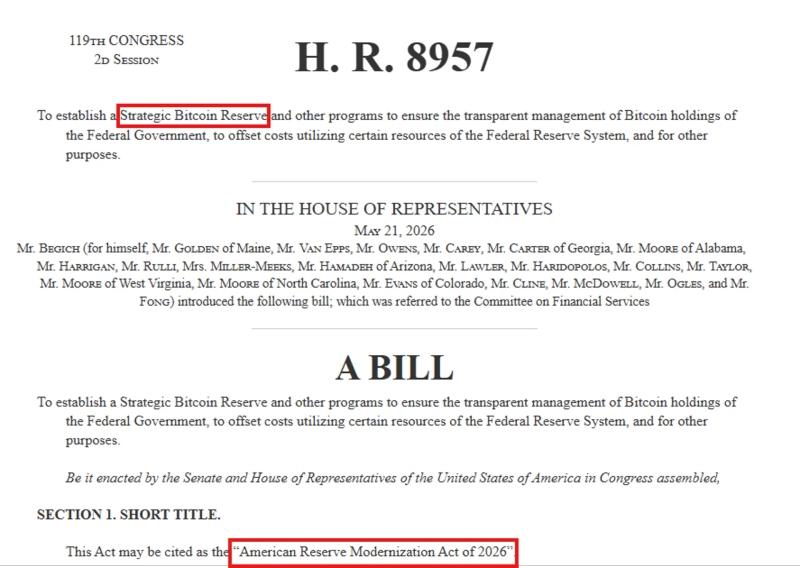
A bill introduced in the US House of Representatives to establish a federal strategic Bitcoin reserve has been made public.
The full text of the American Reserve Modernization Act, or ARMA, posted on the congressional website on June 5, would create a Strategic Bitcoin Reserve and a Digital Asset Stockpile under the Treasury Department. The measure would also consolidate management of Bitcoin and other digital assets held by the federal government.
Under the bill, Bitcoin obtained through criminal and civil forfeiture proceedings would be transferred to the Strategic Bitcoin Reserve. Digital assets other than Bitcoin would be stored and managed separately in the Digital Asset Stockpile. Bitcoin placed in the reserve could not be sold or used as collateral for at least 20 years. After that period, disposals would still be capped at no more than 10% of total holdings over the following two years.
Assets generated by forks and airdrops tied to the government's Bitcoin holdings would also have to be held for at least five years.
The Treasury Department would be required to publish a quarterly proof-of-reserve report detailing Bitcoin holdings, transaction records and control of private keys. The report would also have to be verified by an independent auditor.
The ARMA bill also calls for a review of ways to acquire additional Bitcoin. Under the measure, the Treasury Department and the Commerce Department would have 180 days after enactment to jointly study how to expand Bitcoin holdings without increasing the national debt or imposing new taxes. Options for review include converting the government's non-Bitcoin digital assets, using assets obtained through criminal and civil forfeiture, and tapping tariff revenue and donations.
Representative Nick Begich, the Republican lawmaker who introduced the bill, said Bitcoin has served as a store of value for more than a decade. Including Bitcoin among national assets could strengthen US financial resilience and help the country lead global financial innovation, he added.

Uk Jin
wook9629@bloomingbit.ioH3LLO, World! I am Uk Jin.