PiCK
US Law Enforcement Groups Raise Concerns Over Clarity Act, Say BRCA Provision May Hinder Crypto Crime Cases
Summary
- Major US law enforcement groups raised concerns that the Clarity Act and BRCA Section 604 could make it harder to investigate and prosecute illicit financial activity.
- The groups said the provision could create gaps in oversight and accountability while effectively excluding some digital-asset participants from KYC and AML requirements.
- The letter has made the BRCA provision one of the biggest sticking points in negotiations over bringing the Clarity Act to a full Senate vote.
Forecast Trend Report by Period


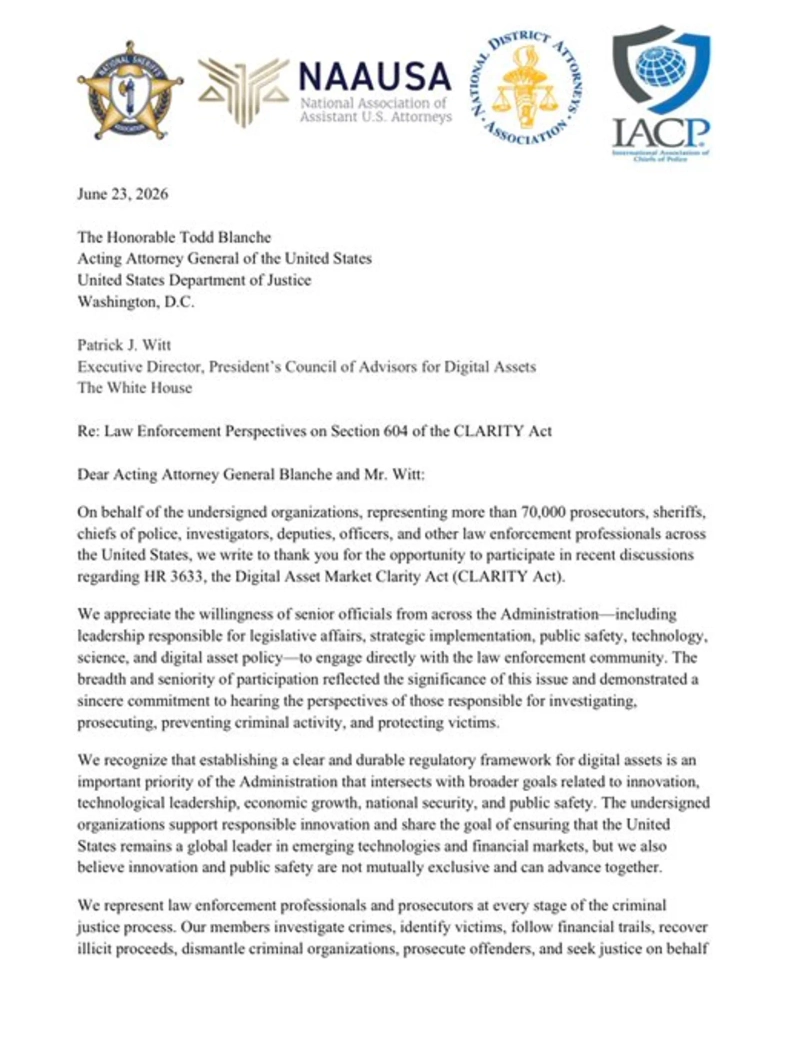
Major US law enforcement groups have raised concerns about the Clarity Act, a digital-asset market structure bill, injecting a new complication into negotiations ahead of a potential Senate floor vote.
Eleanor Terrett, host of CryptoAmerica, reported on June 23 that four major police and law enforcement coalitions recently sent a letter to the US administration arguing that parts of the Clarity Act could make it harder to investigate and prosecute illicit financial activity.
The groups took issue with Section 604, which includes the Blockchain Regulatory Certainty Act, or BRCA. They wrote that the provision could create gaps in oversight and accountability, ultimately undermining investigations into illegal activity and law enforcement efforts.
They also argued that the Clarity Act does not provide safeguards comparable to those applied to traditional financial institutions. Some digital-asset participants could, in effect, be excluded from know-your-customer, or KYC, and anti-money laundering, or AML, requirements.
The letter became public after weeks of discussions among law enforcement groups, the administration, Congress and the crypto industry over the measure's key provisions. The BRCA language has become one of the main sticking points in negotiations over whether to bring the Clarity Act to the Senate floor.
Still, the Grand Lodge Fraternal Order of Police, or GLFOP, the largest police organization in the US, and the National Association of Police Organizations, or NAPO, which have both been active in the talks, did not sign the letter, according to the report.

Suehyeon Lee
shlee@bloomingbit.ioI'm reporter Suehyeon Lee, your Web3 Moderator.