PiCK
Bitcoin Breaks Below $60,000 as ETF Outflows, Stronger Dollar Weigh on Sentiment [Lee Su-hyun’s Coin Radar]
Summary
- Bitcoin posted a sixth straight week of outflows, with spot ETF outflows, dollar strength and the possibility of rate hikes cited as drivers of weaker sentiment and the risk of further declines.
- Ethereum fell to its lowest level this year amid foundation leadership instability, restructuring and spot ETF net outflows, reinforcing the view that the broader trend still favors the downside.
- XRP and Tron showed contrasting drivers, with XRP pressured by the fight over the $1 support level and worsening on-chain indicators, while Tron found downside support from rising active addresses and buying by a listed company.
Forecast Trend Report by Period


**
<Lee Su-hyun’s Coin Radar> is a weekly column that tracks moves in the digital-asset market and explains the forces behind them. It goes beyond price action to examine global macro developments and investor behavior, offering a broader read on market direction.
Major Coins
1. Bitcoin (BTC)
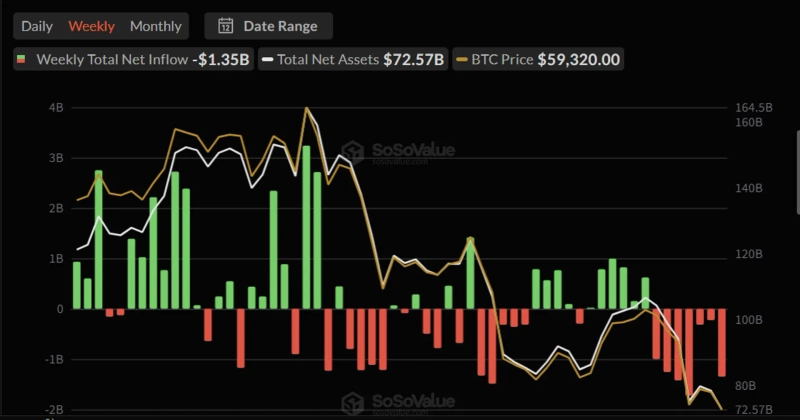
Bitcoin briefly broke below $60,000 this week, dealing a fresh blow to investor sentiment. As of June 26, it was trading at $60,153.78 on Binance’s USDT market, down 2.56% from a day earlier.
The biggest driver of the drop appears to be institutional outflows. US spot Bitcoin exchange-traded funds recorded net outflows of $228 million last week alone. That marked a sixth straight week of net outflows and brought cumulative net outflows to about $5.94 billion.
The macro backdrop was also unfavorable. JPMorgan Chase & Co., Bank of America Corp. and Goldman Sachs Group Inc. have recently issued calls for further dollar strength. JPMorgan said in particular that the Federal Reserve had “reactivated” the dollar bull market. Bloomberg reported that the dollar index rose more than 2% in June, putting it on course for its strongest monthly gain since last year. Resilient US growth, expanding investment in artificial intelligence and fund flows into US equities have all been cited as support for the greenback.

The possibility of higher rates under the new Federal Reserve regime has also added pressure. TD Securities said a hawkish policy stance could persist, while Bank of America forecast three rate hikes this year. A stronger dollar and rising rates are typically negative for risk assets such as Bitcoin.
The outlook remains cautious. Alex Kuptsikevich, a market analyst at FXPro, identified $61,800 to $62,000 as key near-term resistance. If Bitcoin fails to reclaim that range, it could fall further toward $55,000.
Markus Thielen, founder of 10x Research, also said Bitcoin may form a bottom between late August and October when liquidity and macroeconomic conditions are taken into account. In the near term, he projected a pullback to around $55,000.
2. Ethereum (ETH)
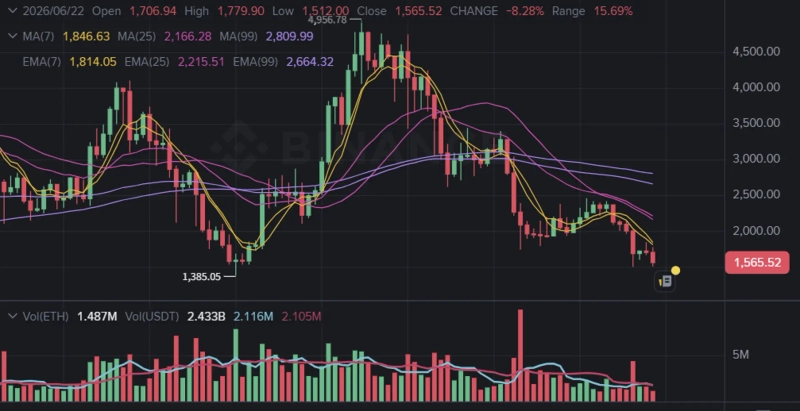
Ethereum remained under pressure this week, falling as low as $1,537 at one point to hit its lowest level of the year. As of June 26, it was trading at $1,565.52 on Binance’s USDT market, down 5.43% from the previous day.
The biggest headwind has been instability in the Ethereum Foundation’s leadership. Hsiao-Wei Wang, the foundation’s executive director, said she intended to step down. That brings the number of senior executives and researchers who have left the foundation this year to at least eight. Former Ethereum Foundation researcher Dankrad Feist said the issue was not a new strategy but management, adding that the loss of key talent could hurt the project’s long-term competitiveness.
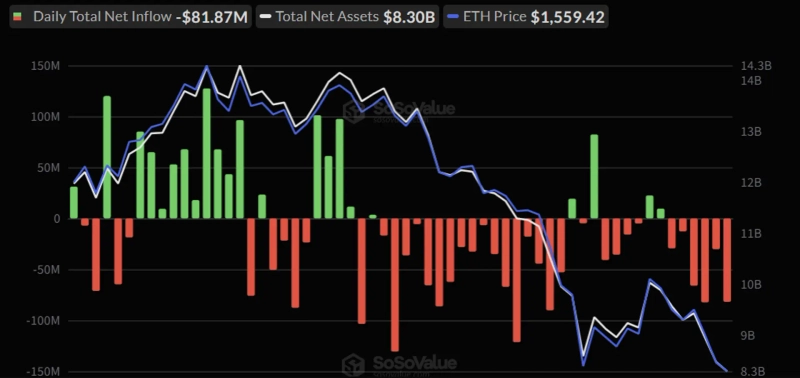
Institutional money has also continued to leave. US spot Ethereum ETFs posted about $81.9 million in net outflows on June 25, extending the streak to six consecutive trading days. Even so, recent weekly net outflows totaled about $66 million, down from $255 million in mid-May, indicating that the pace of withdrawals has eased somewhat.
The Ethereum Foundation also announced a restructuring that will cut 54 jobs, or about 20% of its workforce. The foundation said its “Lean Ethereum” strategy is aimed at improving operating efficiency and reducing annual operating costs to about 5% of current assets from roughly 15%. The market took the move as a sign of belt-tightening, and Ether fell about 7% in a single day after the announcement.
The outlook is cautious. Crypto outlet FXStreet identified $2,000 as key resistance, followed by the 50-day moving average at $1,864, the 100-day line at $2,036 and the 200-day line at $2,317. On the downside, the area around $1,532 is acting as a near-term reference point, while buying interest could emerge around $1,385. Even so, the broader trend is still tilted lower.
3. XRP
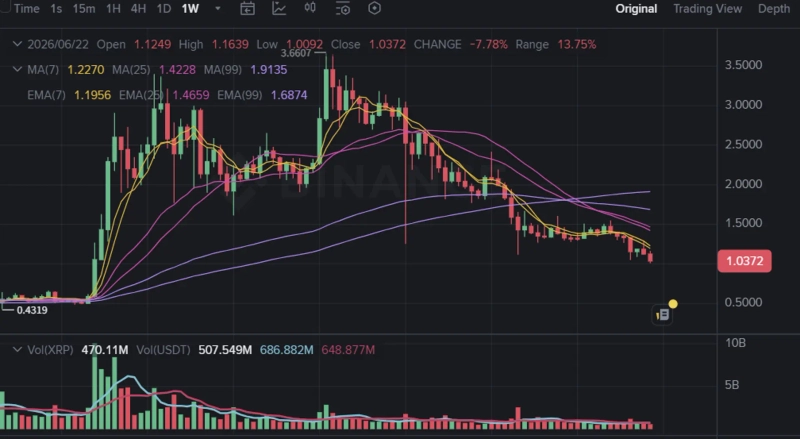
XRP was also swept up in the broader market weakness, falling as low as $1.0116 during the session. As of June 26, it was trading at $1.0372, down 3.34% from a day earlier.
The slide accelerated on concern that the token could break below the psychologically important $1 level. Crypto outlet CoinDoo said stop-loss orders were triggered as that support came under threat, intensifying the selloff. Technical indicators also remain weak. The 50-day, 100-day and 200-day moving averages are all above the current price, while the relative strength index has fallen to 30, close to oversold territory.
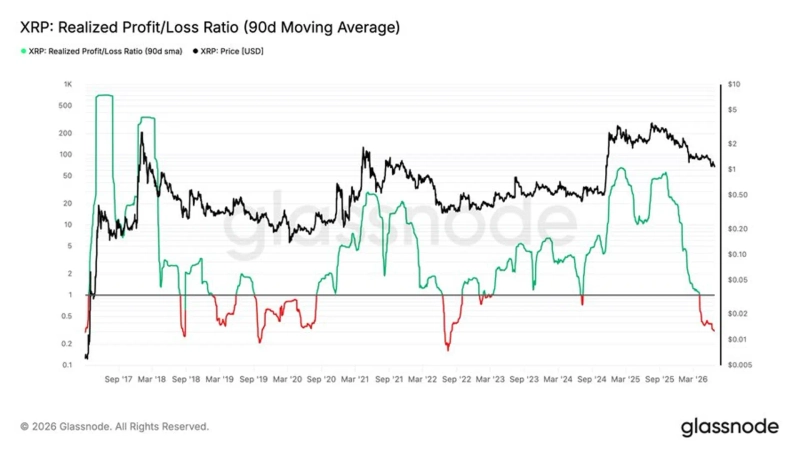
On-chain data also points to worsening sentiment. XRP’s 90-day realized profit-loss ratio fell to 0.33, according to Glassnode. That means loss-making sales have been running at roughly three times the pace of profit-taking transactions. The market has interpreted that as a sign that more investors are exiting at a loss, adding to selling pressure.
Whether XRP can hold support at $1 is now the key variable. CoinDoo said the token could attempt a rebound toward $1.10 to $1.12 if that floor holds. If it breaks, additional downside pressure could build. FXStreet said XRP would need to reclaim $1.25 and then break through $1.35 and $1.50 in sequence for its medium- to long-term trend to improve.
Issue Coin
1. Tron (TRX)
Tron was relatively resilient this week even as the broader market weakened, with its weekly loss limited to about 1%. As of June 26, it was trading at $0.3225 on Binance’s USDT market, down 2.12% from the previous day.
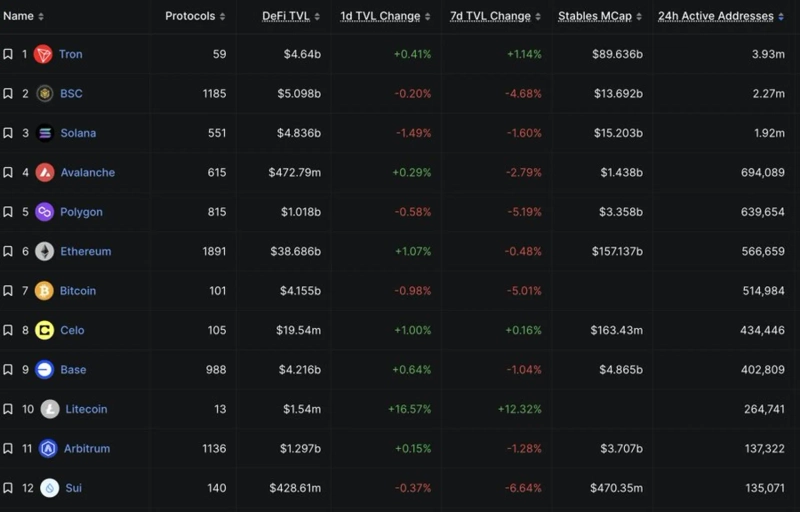
One reason has been active network usage. Tron had about 3.93 million active addresses as of June 23, according to Lookonchain. That was more than BNB Chain, Solana and Ethereum, showing that user activity has remained steady even in a weak market.
Its stablecoin payments ecosystem has also continued to grow. The market capitalization of stablecoins on the Tron network stands at about $89.6 billion. The industry has cited expanding demand for payments and remittances as support for the network’s competitiveness.
Continued purchases by listed company Tron Inc. have also been positive. The company bought another 149,927 TRX this week at an average price of $0.3335, bringing its total holdings to more than 702.3 million TRX. Tron Inc. said it plans to continue increasing its TRX holdings under its digital-asset treasury strategy. The market has viewed the company’s steady purchases as a factor that could help support the token on the downside.

Suehyeon Lee
shlee@bloomingbit.ioI'm reporter Suehyeon Lee, your Web3 Moderator.