K-Content Tokenization Needs Tailored Valuation, Rules, Industry Says
Summary
- Industry participants said cultural and artistic content will need a distinct valuation framework and regulatory design from traditional financial assets if it is to be used as underlying assets for security tokens (STOs).
- Musicow Chair Jung Hyun-kyung said music copyrights are competitive as an investment asset because they generate recurring royalty income, have low correlation with the macroeconomy, and draw on the global K-pop fandom. He added that the current legal framework and copyright trust structure remain obstacles to asset securitization and funding for small and mid-sized entertainment companies.
- Panelists and government officials said they will pursue both market development and investor protection by upgrading the cultural content valuation system and establishing qualitative assessment standards for the securitization of intangible assets at the pre-production stage.
Forecast Trend Report by Period


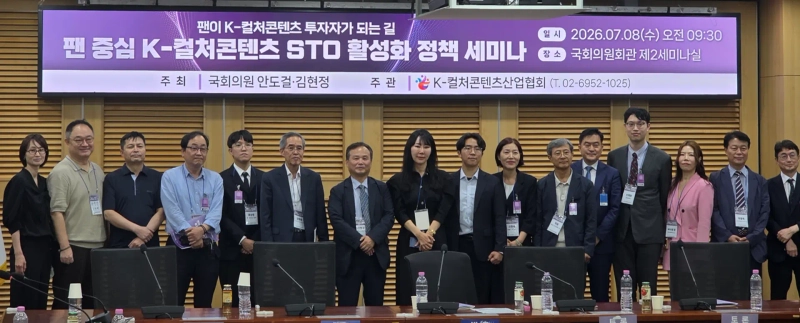
Using cultural and artistic content as underlying assets for security tokens, or STOs, will require a valuation framework and regulatory design distinct from those used for traditional financial assets, industry participants said. They argued that cultural content demands a different approach because fandom and cultural value sit at the core of its worth.
A policy seminar titled “How Fans Can Become Investors in K-Culture Content” was held on July 8 at the National Assembly Members’ Office Building in Yeouido, Seoul. The event was hosted by Democratic Party lawmakers Ahn Do-geol and Kim Hyun-jung and organized by the K-Culture Contents Industry Association. Attendees included Musicow, Hanteo Global, THE K STO, Barunson N Project and the Ministry of Culture, Sports and Tourism.
In a presentation, Musicow Chair Jung Hyun-kyung argued that music copyrights are well suited to serve as underlying assets for STOs.
Music copyrights generate stable cash flow through recurring royalty payments and have a low correlation with the broader macroeconomy, giving them the characteristics of an investable asset, Jung said. He added that they can also set themselves apart from conventional financial products by incorporating the cultural value of the global K-pop fandom.
Cultural content is a uniquely competitive South Korean asset because it is backed by fandom and multiple revenue models, he said. That could create a virtuous cycle by drawing foreign capital into the domestic cultural industry and opening a new fundraising channel for creators.
Jung said regulatory improvements are needed for the STO market backed by cultural content to grow. Under the current system, securitizing music copyrights requires compliance not only with the Capital Markets Act but also with multiple legal frameworks, including copyright law, and parts of that structure do not fit the industry’s actual operating model.
A substantial share of K-pop intellectual property does not align with the current copyright trust structure, making asset securitization difficult, he said. That has also become a hurdle for fundraising by small and mid-sized entertainment companies.
In the discussion session, participants identified the creation of a valuation system that reflects the characteristics of cultural content as the central task.
Choi Yoon, a director at Barunson N Project, said valuation was the biggest obstacle in advancing film STOs. Content at the script or planning stage is difficult to price objectively, he said, making a separate set of standards necessary from those used for traditional financial assets.
Kwak Young-ho, chief executive officer of Hanteo Global, said the existing copyright-based STO model alone would be insufficient to draw global fandom participation. He proposed building a full-cycle cultural content STO model that can identify smaller agencies with strong growth potential.
Jung said music copyrights currently can be securitized only after royalty income has been generated steadily for more than six months, at which point the issuance price can be set. While that structure is reasonable from the standpoint of investor protection, it has limitations for market development.
Consumers also tend to prefer rights tied to newly released songs, while creators want to raise funding at the early stage when they need capital the most, he added.
Government officials acknowledged the issue and said they would work to improve the valuation system. Na Woong-jae, an official at the Ministry of Culture, Sports and Tourism, said content intellectual property that is already generating revenue can be assessed through a combination of quantitative and qualitative evaluation, and that the Korea Creative Content Agency has been continuously upgrading the related system.
Still, content at the pre-production stage is an intangible asset with no physical form, making it necessary to discuss in greater detail whether it can be securitized based on qualitative assessment, Na said. He added that the ministry would continue refining the valuation framework to support funding for content creators while protecting investors.

Uk Jin
wook9629@bloomingbit.ioH3LLO, World! I am Uk Jin.