Tiger Research Says On-Chain Data Infrastructure Is Critical for Finance Adoption, Spotlights Lambda256
Summary
- Tiger Research said the expansion of digital assets into mainstream finance is increasing the importance of on-chain data infrastructure.
- The report identified completeness, consistency and stability as the core requirements for on-chain data infrastructure in institutional finance, and stressed the need to support a 24-hour blockchain environment.
- The report highlighted Dunamu subsidiary Lambda256's on-chain data platform DataShare as an example that meets those conditions, and pointed to potential applications in real-world asset tokenization (RWA) and AI-based payment systems.
Forecast Trend Report by Period


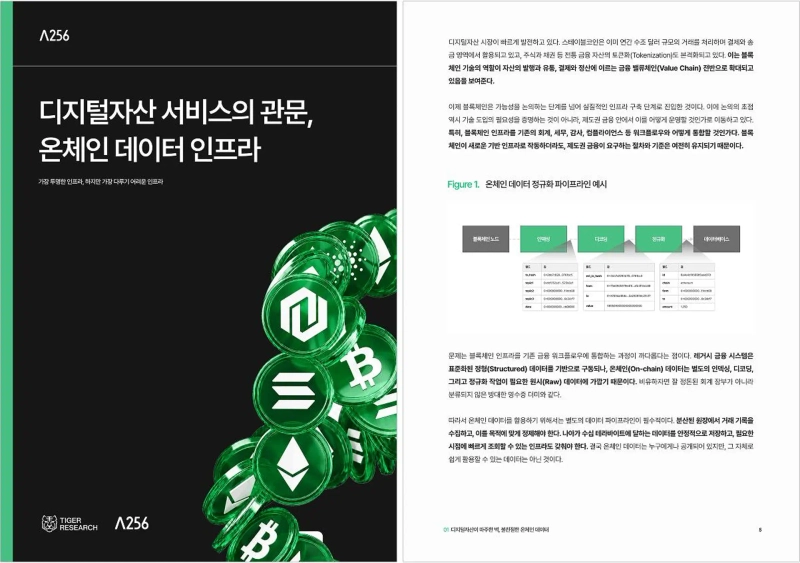
Tiger Research said the expansion of digital assets into mainstream finance is increasing the need for reliable data infrastructure.
In a report, the firm said on-chain data is publicly available but not in a form that traditional financial systems can use directly. Blockchain data is essentially raw data that must be indexed, decoded and normalized, requiring separate infrastructure to meet financial-industry standards.
Tiger Research identified completeness, consistency and stability as the core requirements for on-chain data infrastructure used by institutional finance. If transaction data is missing or if blockchain reorganizations and network errors are not properly reflected, mistakes can spread from balance calculations and settlement to every subsequent stage of data use. In a 24-hour blockchain environment, the report added, infrastructure must also be able to respond in real time during chain upgrades.
As an example of a platform that meets those conditions, the report highlighted DataShare, the on-chain data platform developed by Lambda256, Dunamu's blockchain technology subsidiary.
DataShare uses its own indexing engine to normalize data spread across multiple blockchains into a format suited to financial institutions' existing operating environments. The collected data is cross-checked against blockchain ledgers, and the system is designed to remain stable during heavy request volumes and node failures. The report said the platform also meets financial-sector security and network separation requirements through on-premise deployment based on domestic internet data centers and SOC 2 certification.
The report cited real-world asset tokenization, or RWA, and AI-based payment systems as key use cases. As more listed stocks are issued on blockchains in tokenized form, financial institutions face a new task: accurately identifying investors' token holdings when processing dividends or voting rights. The report also said infrastructure capable of delivering accurate finalized data will be essential in an agentic payment environment, where AI executes payments.
"Every financial process, from asset issuance to payment and settlement, is being reorganized around on-chain data," Cho Yoon-sung, a senior researcher at Tiger Research, said. "Missing or inaccurate data can create critical regulatory risks beyond simply undermining service reliability. Choosing the right data infrastructure is the starting point for building successful digital-asset services."

Suehyeon Lee
shlee@bloomingbit.ioI'm reporter Suehyeon Lee, your Web3 Moderator.