PiCK
Park Young-sun Calls Stablecoins AI-Era Payments Infrastructure, Urges Faster Lawmaking
Summary
- Park said stablecoins should be treated as core payments infrastructure for the AI era and stressed that related legislation should move faster.
- He said the U.S. and Japan are stepping up institutional competition in the global stablecoin market, and that South Korea should also consider both the use of won-based stablecoins and their international competitiveness.
- Park said the National Assembly and the government should establish a legal foundation that allows AI agents to transact safely, and stressed that national competitiveness will depend not only on technology but on how quickly institutions are put in place.
Forecast Trend Report by Period


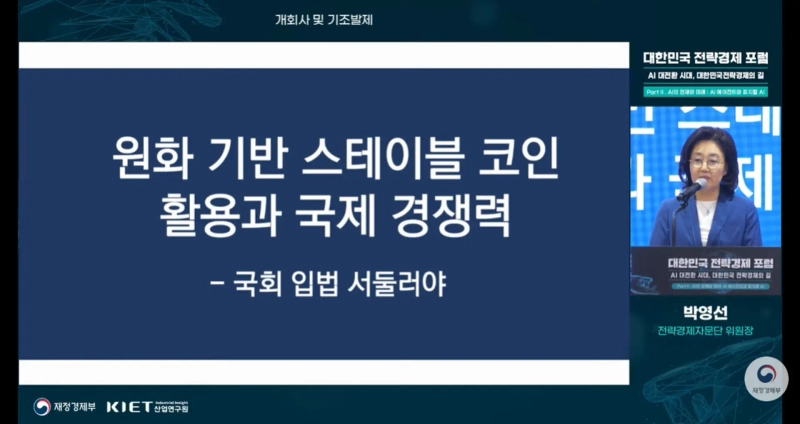
Park Young-sun, chair of the Strategic Economy Advisory Group at South Korea’s Ministry of Economy and Finance, said stablecoins should be treated as core payments infrastructure for the artificial intelligence era and that related legislation needs to move faster.
Speaking in an opening address and keynote presentation at the Korea Strategic Economy Forum at the Lotte Hotel in Seoul on July 21, Park said stablecoins in an AI agent economy are not simply virtual assets but transaction infrastructure used by AI.
The forum, hosted by the Ministry of Economy and Finance and the Korea Institute for Industrial Economics & Trade, focused on “AI Agents and Physical AI.” Discussions covered economic and financial infrastructure for the AI era, including stablecoins.
Park said the role of stablecoins is shifting as advances in AI turn AI agents into participants in economic activity. Stablecoins should therefore be approached not just as digital assets, but as a payment tool underpinning AI-based economic activity.
South Korea’s National Assembly should prepare legislation from the standpoint that stablecoins are payments infrastructure for the AI era rather than simply a digital-asset issue, he said. The legislative process also needs to strike a balance between entrenched interests and the new technological revolution.
Park also pointed to growing regulatory competition in the global stablecoin market. The U.S. is seeking to take the lead in setting global standards, while Japan is using regulation to build market trust. Competition over institutions has begun alongside the technology race, he said.
The National Assembly and the government should establish a legal foundation that allows AI agents to transact safely, Park said. They should also consider both the use of won-based stablecoins and their international competitiveness. National competitiveness will be determined not only by technology, but by how quickly institutions are put in place, he added.
Ten bills related to digital assets and stablecoins proposed by lawmakers from both the ruling and opposition parties are currently pending in the National Assembly.

Suehyeon Lee
shlee@bloomingbit.ioI'm reporter Suehyeon Lee, your Web3 Moderator.